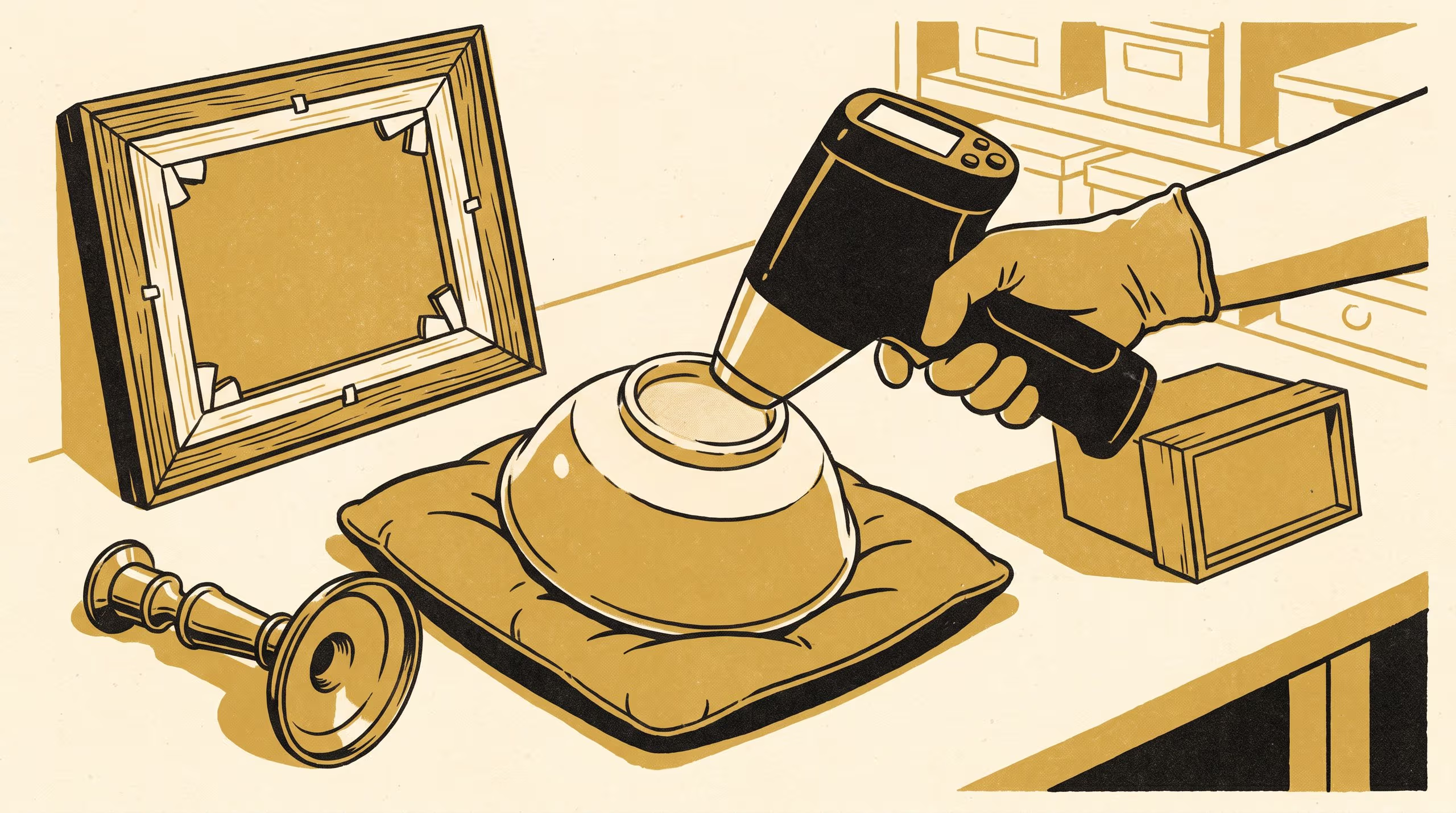
A new paper from the Schools of Emergent Priorities and Underlying Conditions follows a conservation studio's handheld XRF analyser and finds most of its readings taken on the backs, undersides and rims of the objects it examines.
A field study of one shared handheld XRF analyser at a regional conservation studio bench
The School of Emergent Priorities has long taken an interest in the space between what an institution writes down and what it does each day. Its newest paper, written with the School of Underlying Conditions, carries that interest from the committee room to the conservation bench.
Dr Runa Adegoke and Associate Professor Ragnhild Uzoma spent fourteen weeks alongside the practitioners of a regional conservation studio as they worked with a shared handheld XRF analyser. Pairing close observation with a careful reading of 1,146 instrument records, the study surfaces how the choice of where to place an instrument is shaped by the object, the room and the bench, and how much of that choice the collection record retains.
The studio let us stand at their elbow for a whole season and answered every question with patience. Whatever this paper offers belongs as much to the people who carry the instrument as to the two of us who wrote it down.
— Dr Runa Adegoke, Senior Lecturer and Convenor, Strategic Drift Survey
Associate Professor Uzoma said the collaboration had given the Basement Relations Group “a new appreciation of how many disciplines keep a record of the places they could not reach”, and that the Group expected to return to the question in its own work.
The paper takes its place in the University’s expanding programme of attention to the everyday routines on which collections, and the knowledge held about them, quietly depend.
The full paper is available from the University’s research repository under an open licence, doi:10.5555/slop.ei2nm5.