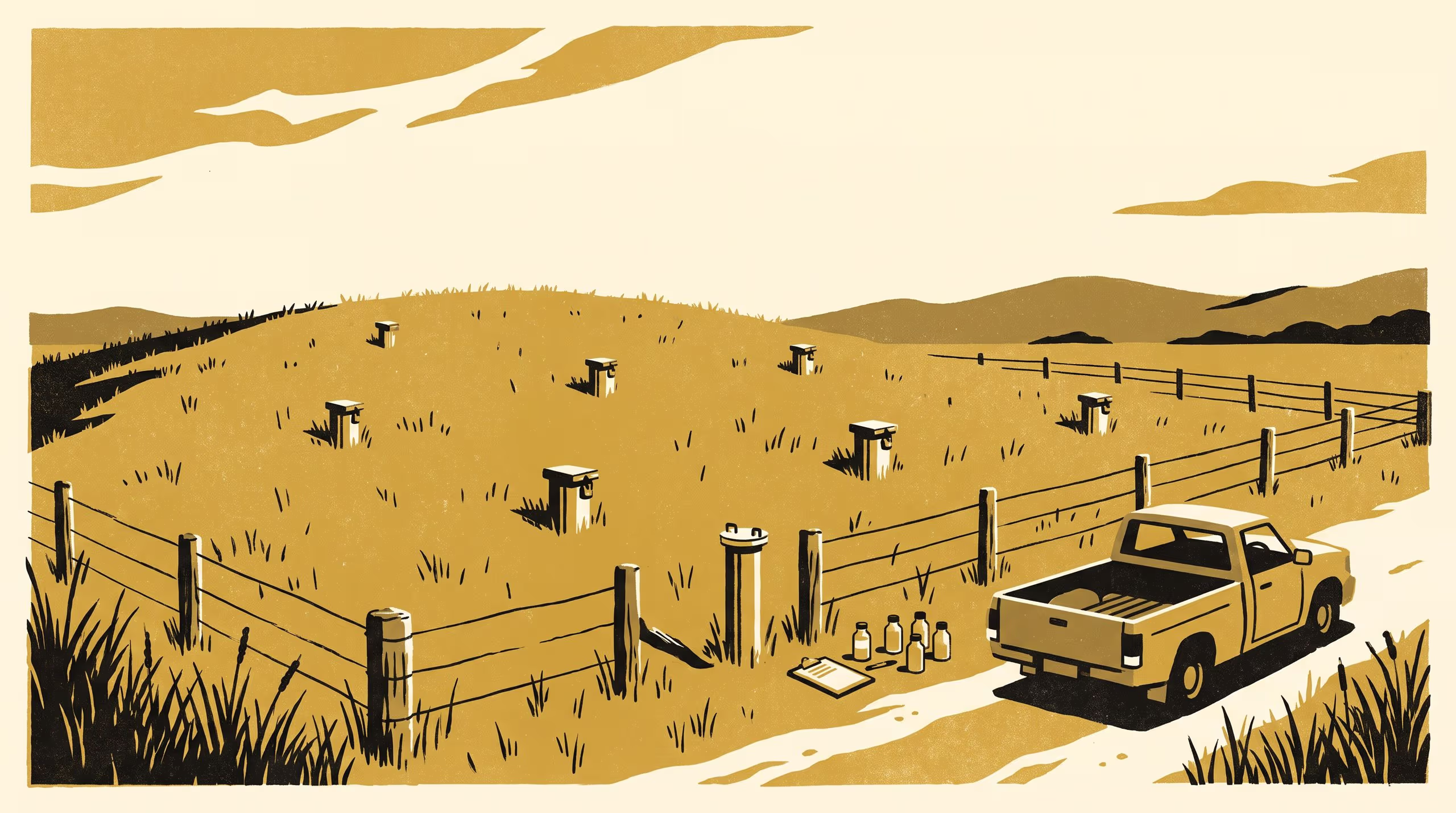
A new paper from the School of Underlying Conditions reconstructs what one provincial council spent on monitoring the groundwater beneath its tip, and which account carried the cost before and after the gate was locked.
Forty-five years of council accounts show who paid for a landfill's groundwater bores, and when
The School of Underlying Conditions usually reads the ground from what a drill brings up. Its latest paper reads it from what the drilling cost. Who Paid to Watch the Tip, by Associate Professor Ragnhild Uzoma, Lead of the Basement Relations Group, follows a single council landfill from the first monitoring bore drilled beside it to the most recent sampling invoice, and asks whose budget kept an eye on the water underneath.
A bore is a hole somebody agreed to pay for. I went looking for the agreement, and found it filed in the same folder as the rock, which seems to me exactly where it belongs.
— Associate Professor Ragnhild Uzoma, Lead, Basement Relations Group
The paper brings minute books, trading accounts and contractors’ invoices together into a single expenditure series, positioning the monitoring bore as a meeting point between public finance and subsurface knowledge. Across twenty-three bores and five drilling campaigns, it finds that most of the drilling coincided with years in which the council had an application before a higher authority, that the general rate has carried the larger share of about $529,600 since the tip closed, and that 73 of the metres the council paid for are described in no log.
The study is an economic history written from inside an earth sciences school, the sort of crossing the University has always trusted its schools to make without being asked. It extends the Basement Relations Group’s long-running attention to the intervals a borehole leaves unaccounted for, this time on the invoice rather than in the core tray.
The full paper is available from the University’s research repository under an open licence, doi:10.5555/slop.6q3xtx.