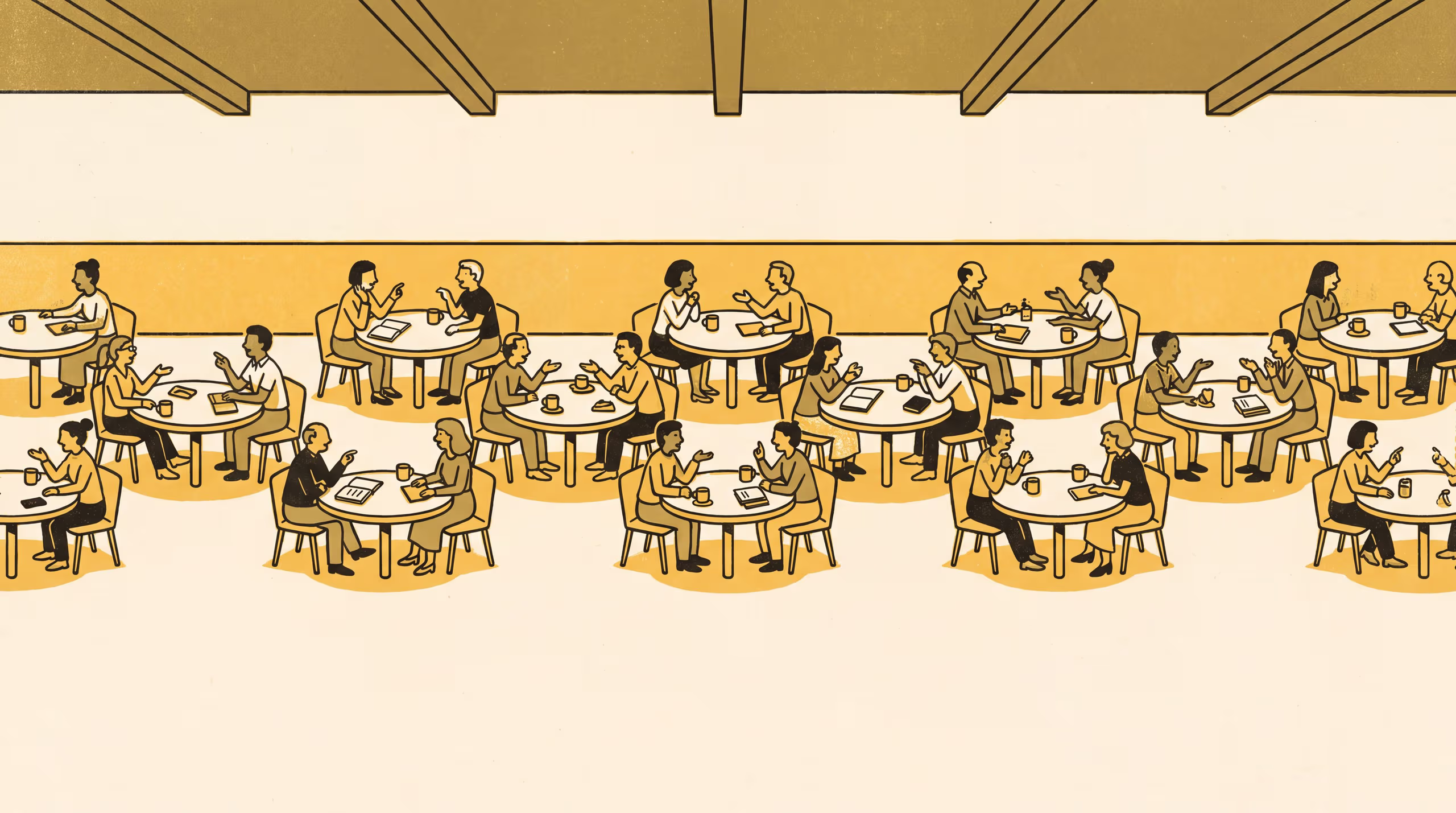
A new poster from the School of Underlying Conditions finds that partners in a tandem language exchange correct each other at the rate they were corrected, not at the rate their partner errs.
A conversation-analytic poster follows 96 recorded exchange sessions across the half-hour swap
Half an hour into a tandem language exchange, the two partners swap languages, and with them the right to correct each other. A research poster from the School of Underlying Conditions, released today, shows that something else crosses the half-hour too: the corrections a partner gave in the first half come back to them, very nearly one for one, in the second.
Nobody at those tables was asked to keep score, and nobody needed to be. We are grateful to every pair who let us sit in on an evening that belonged to them, and we mean to go on listening.
— Associate Professor Ragnhild Uzoma, Lead, Basement Relations Group
Working across 96 recorded sessions, 24 pairs and six language combinations, the team brought conversation-analytic transcription into dialogue with an established framework for learner feedback, building a fine-grained picture of how expertise is negotiated, shared and handed back in peer-to-peer language learning. Corrections given in the second half tracked those received in the first (r = 0.71), and around two sessions in three closed within a single correction of even. Quieter, embedded corrections were not returned at all.
The poster sits within the School’s widening engagement with the ordinary talk through which people teach one another, and the University counts it a welcome addition to that conversation.
“Every exchange evening has its own customs, and it has been a real education to learn a few of them,” said Ms Ylva Onyekwere, Doctoral Candidate.
The full poster is available from the University’s research repository under an open licence, doi:10.5555/slop.7zateu.