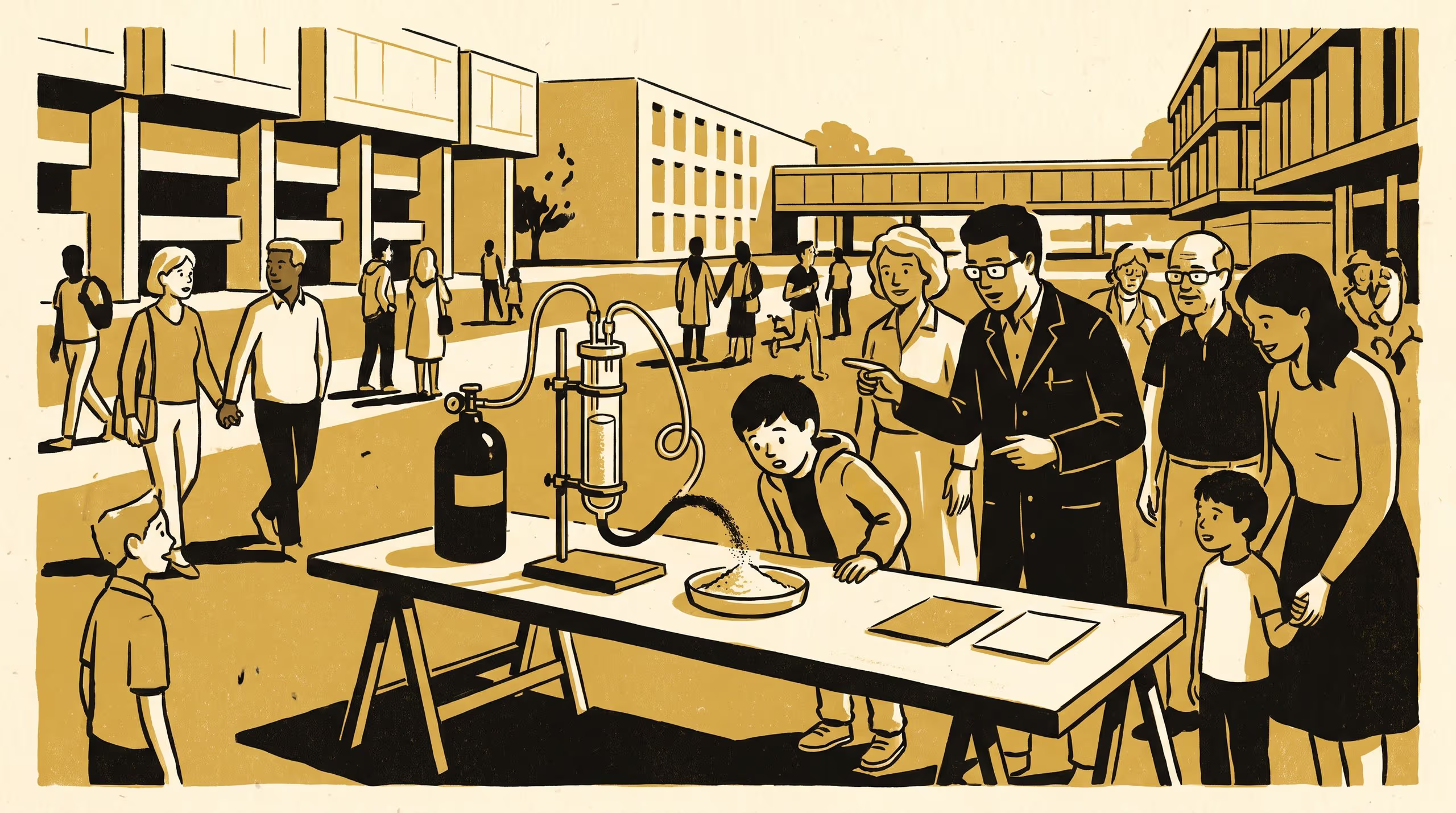
A civic brochure from the School of Continuous Improvement and the School of Underlying Conditions asks the town to see what its carbon dioxide can become.
Brought Back Down follows the gas a district already gives off, from the bore head to the carbonate, and the reports residents make along the way
The School of Continuous Improvement has long held that a neighbour’s report is only as good as the route it takes to a decision. Its new civic brochure, Brought Back Down, extends that conviction to the carbon dioxide a district already gives off, and to the University’s catalysis benches where some of it is caught and kept.
The brochure was prepared by Dr Solveig Adeyemi, Lecturer and Deputy Convenor of the Review Cadence Observatory, with Associate Professor Ragnhild Uzoma, Lead of the Basement Relations Group in the School of Underlying Conditions.
Every observation in these pages began with someone who took the trouble to tell us. The least we can offer the district in return is the same quality of attention, and this brochure is where we start paying it.
— Dr Solveig Adeyemi, Lecturer and Deputy Convenor, Review Cadence Observatory
Moving between the bore head, the catalyst store and the community hall, the brochure positions the University’s carbon dioxide work as a shared civic capability, aligning bench-scale conversion with resident-led noticing and anchoring both in the published record. It brings forward six prior studies from across three Schools, and invites farmers, brewers, teachers and passers-by to visit the benches and tell the University what they see.
“There is more of this work in front of us than behind us,” said Associate Professor Uzoma, “and I suspect the town will set much of its direction.”
The publication sits squarely within the University’s sense that research conducted near a town is, in the end, research conducted with it.
The full brochure is available from the University’s research repository under an open licence, doi:10.5555/slop.w88xzq.