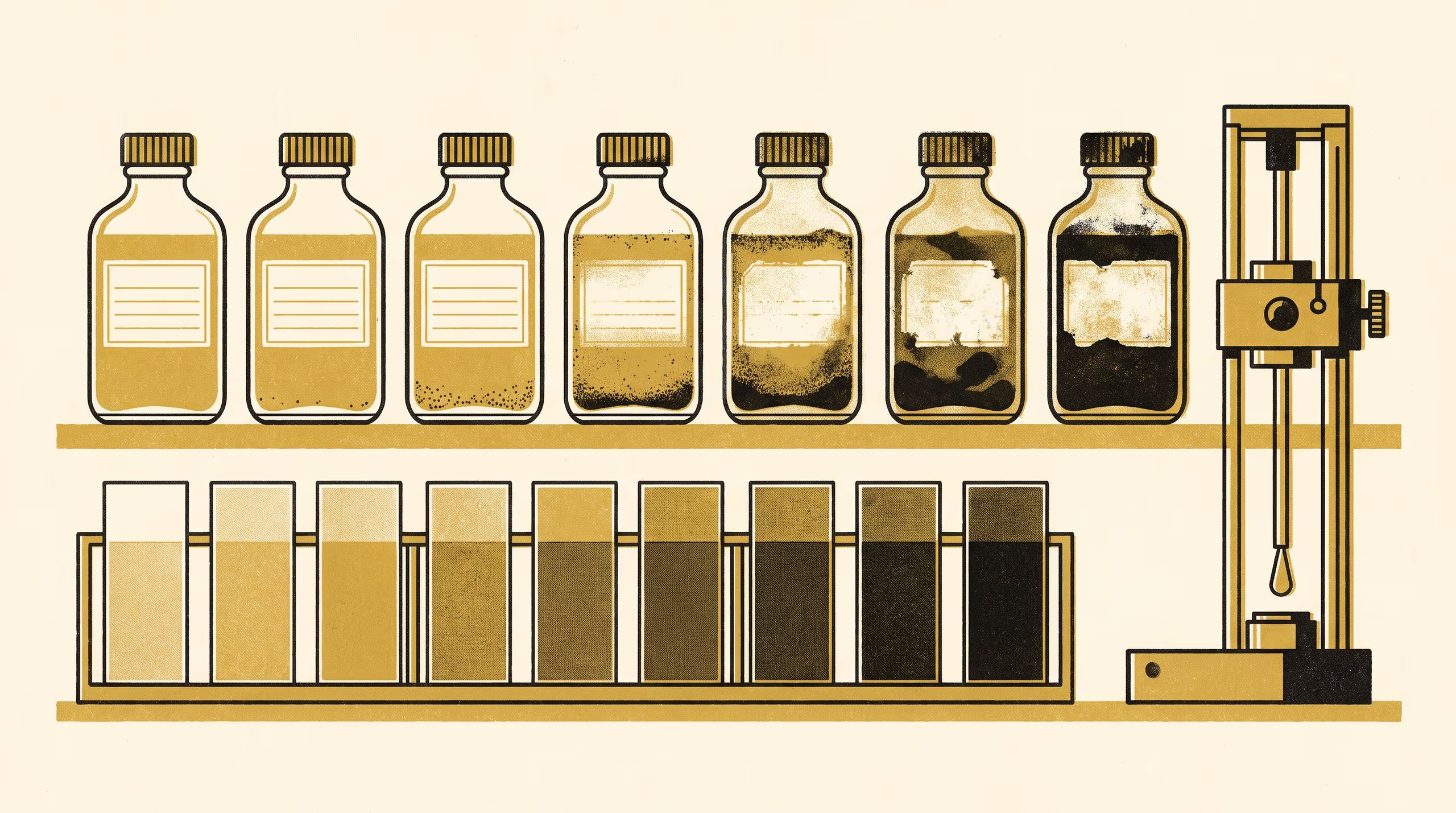
A new research poster from the School of Continuous Improvement draws electrochromic films from a single sol across forty days and finds the age of the sol at each draw shaping how deeply the films colour and how readily they clear.
A forty-day study of one tungsten oxide sol and the electrochromic films drawn from it
The School of Continuous Improvement has long held that a process is only as steady as its least-recorded step. Its latest research poster finds one such step on a laboratory shelf, in a sealed bottle of the sol from which smart-glass coatings are drawn.
Forty Days in the Bottle is led by doctoral candidate Eskil Nwabueze, with Dr Thandiwe Solberg, Senior Lecturer and Convenor of Demo Quarter, and Dr Dagny Okafor, Lecturer and Convenor of Evaluation of Evaluation. The team drew 42 tungsten oxide films from one batch of sol at seven ages, holding everything else steady, and found that films from the middle of the sol’s life darkened furthest, while the latest films were slower to clear.
Every bench has habits nobody ever wrote down. I am grateful to the colleagues who let us write a few of them into the record, and to the School for treating that as research.
— Eskil Nwabueze, Doctoral Candidate, School of Continuous Improvement
The work translates a familiar reagent into a managed process input, positioning sol age alongside the better-documented settings of the dip-coating workflow and anchoring the School’s wider agenda of process-to-performance traceability in the materials laboratory. The University regards the poster as a characteristic expression of its conviction that the quiet variables are where improvement begins.
“There is a long road ahead of this question, and the School fully intends to travel the whole of it,” said Dr Solberg.
The full poster is available from the University’s research repository under an open licence, doi:10.5555/slop.z4iwx3.