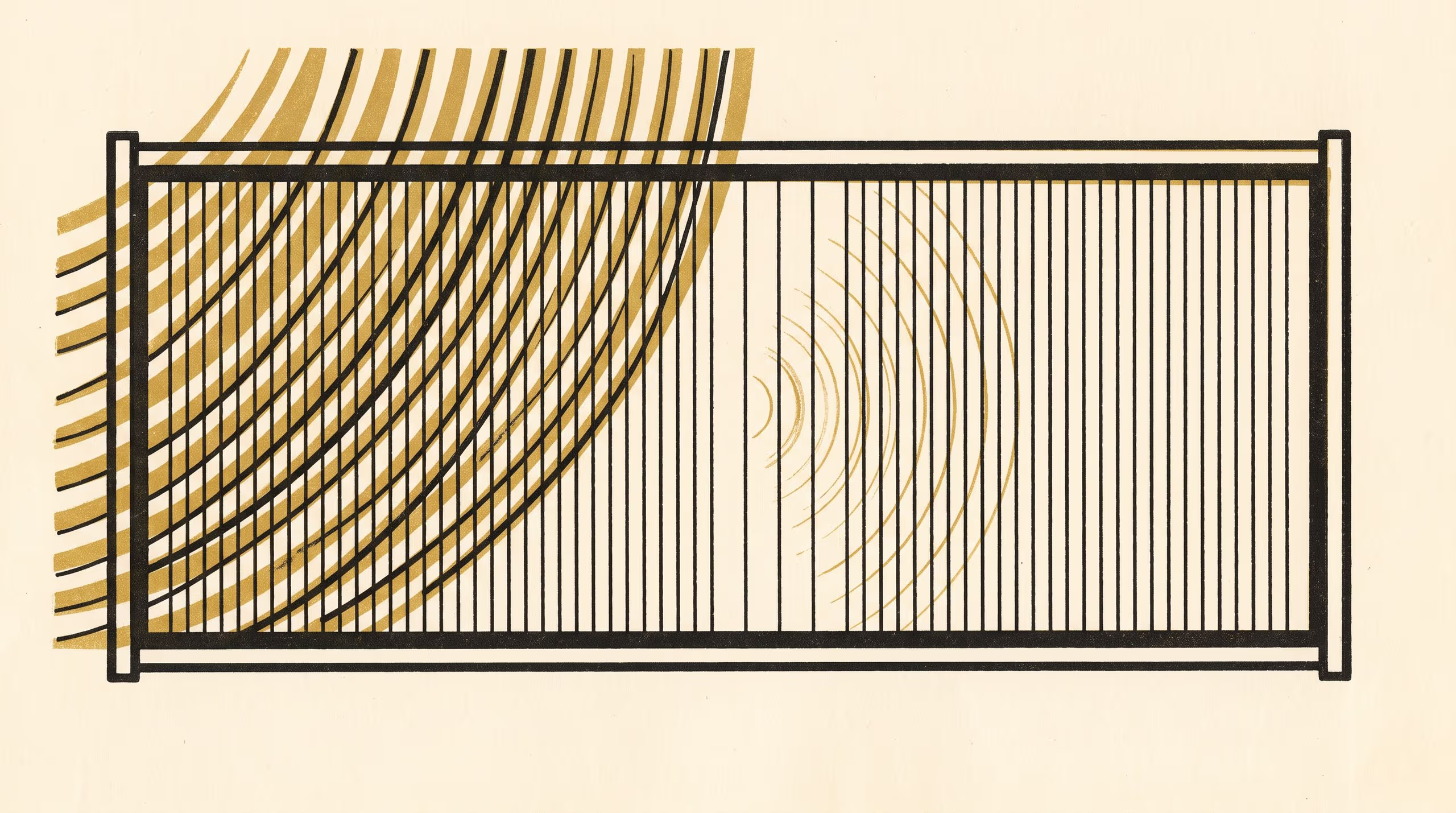
A new paper from the School of Emergent Priorities shows that when one wire goes missing from a closely spaced grating, the wires around it widen the gap in the far field rather than closing it.
Dr Anouk Mensah models a wire grating with one wire gone, and finds that its neighbours enlarge the gap
Take one wire out of a closely spaced row and the gap it leaves is bigger than the wire. That finding sits at the centre of The Neighbours Do Not Close the Gap, a new paper by Dr Anouk Mensah, Postdoctoral Fellow in the School of Emergent Priorities.
The paper takes a well-established structure in electromagnetics, a grating of forty thin conducting wires, and asks what the scattered field can say about one wire that is no longer there. Working through a full multiple-scattering treatment, Dr Mensah follows the response of every remaining wire and finds that it reinforces the absence instead of compensating for it: the gap radiates around 1.26 times as strongly as the missing wire itself. The study then identifies where an observer would need to stand to notice, and notes one position where nothing can be noticed at all.
I came to this paper expecting an answer, and I am leaving it with a better question. I understand that is how the School prefers its work to end.
— Dr Anouk Mensah, Postdoctoral Fellow, School of Emergent Priorities
For a School whose agenda turns on anticipatory capability, the work extends a familiar line of enquiry into new terrain, and the University welcomes it as evidence that a careful question will travel across disciplines without losing its footing.
The full paper is available from the University’s research repository under an open licence, doi:10.5555/slop.wvgy6m.