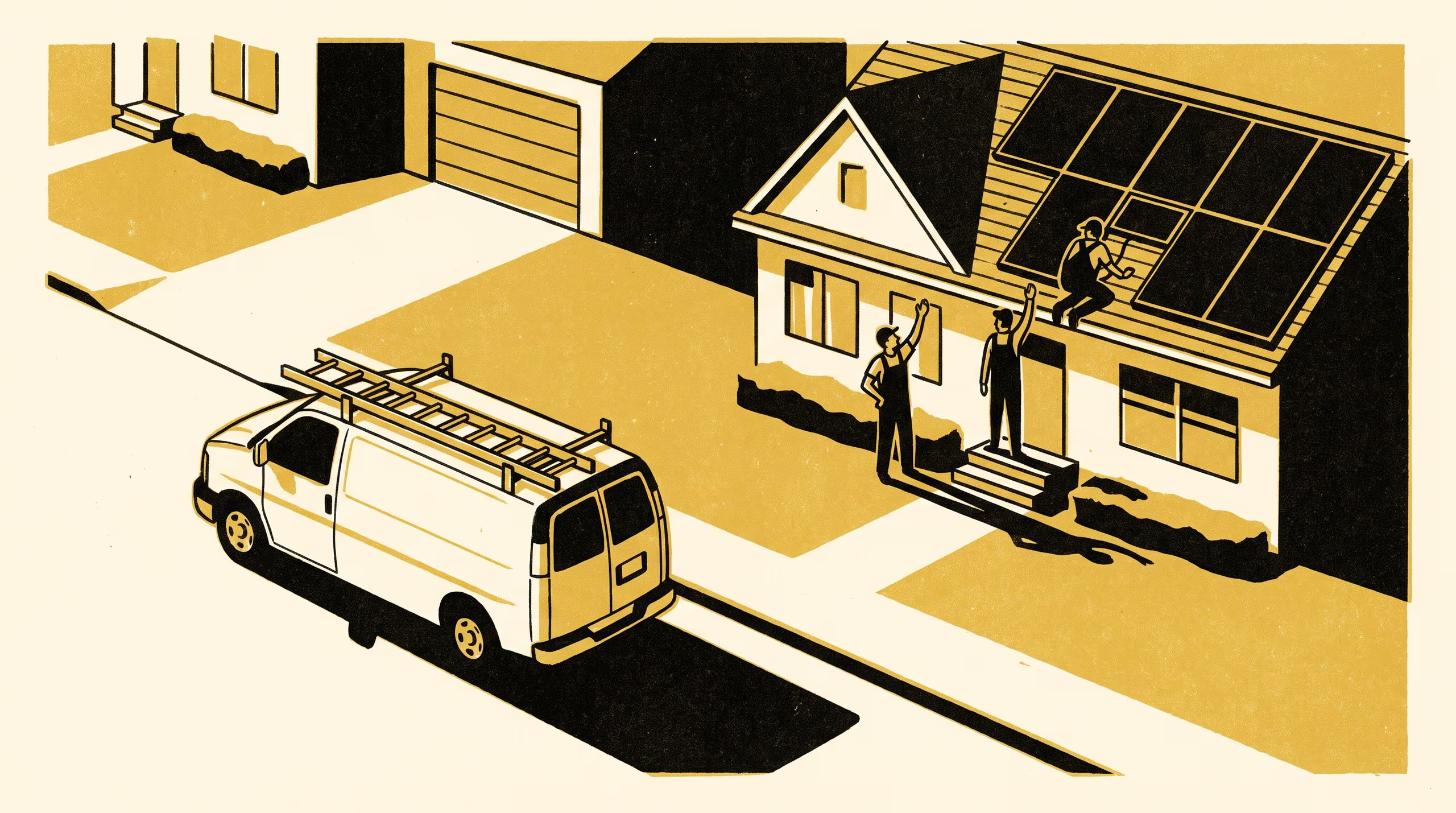
A new paper from the School of Continuous Improvement finds that the know-how behind a rooftop solar installation stays with the crew lead who signs the job, and goes with them when they change firms.
Dr Sten Okwuosa and Signy Okpara follow crew leads between firms in a regional rooftop solar market
Some 38,000 compliance forms, each signed at the end of a day on a roof by the person who led the crew, sit behind The Experience Leaves in the Van, a new paper from the School of Continuous Improvement by Dr Sten Okwuosa, Senior Research Fellow and Convenor of the Impact Pathway Atlas, and Signy Okpara, Doctoral Candidate.
Read together, the forms let the authors ask a question the energy sector’s cost curves usually leave to one side: when an installation firm gets faster at its work, who is it that has learned? Their answer is the crew lead. A firm that loses one is slower on the roof for about a year, while the lead, at a new firm, is back to their usual pace within a quarter.
We owe this paper to every crew lead who wrote their hours on a form after a long day in the sun. If any of them read it, we hope they find it a fair account of their working lives.
— Dr Sten Okwuosa, Senior Research Fellow and Convenor, Impact Pathway Atlas
The study situates the transfer of workforce capability within the broader energy-transition conversation, bringing learning-curve modelling, labour mobility and administrative records into a single account of how installation experience accumulates, moves and, at certain moments, departs the trade.
Ms Okpara said the project had shown the School “something about where its own knowledge lives, and how easily it walks out the door”.
The paper extends the Impact Pathway Atlas’s long interest in where effort ends up to a sector it had not yet mapped, and the University welcomes it as a sign of how far that interest now reaches.
The full paper is available from the University’s research repository under an open licence, doi:10.5555/slop.mdcpu7.