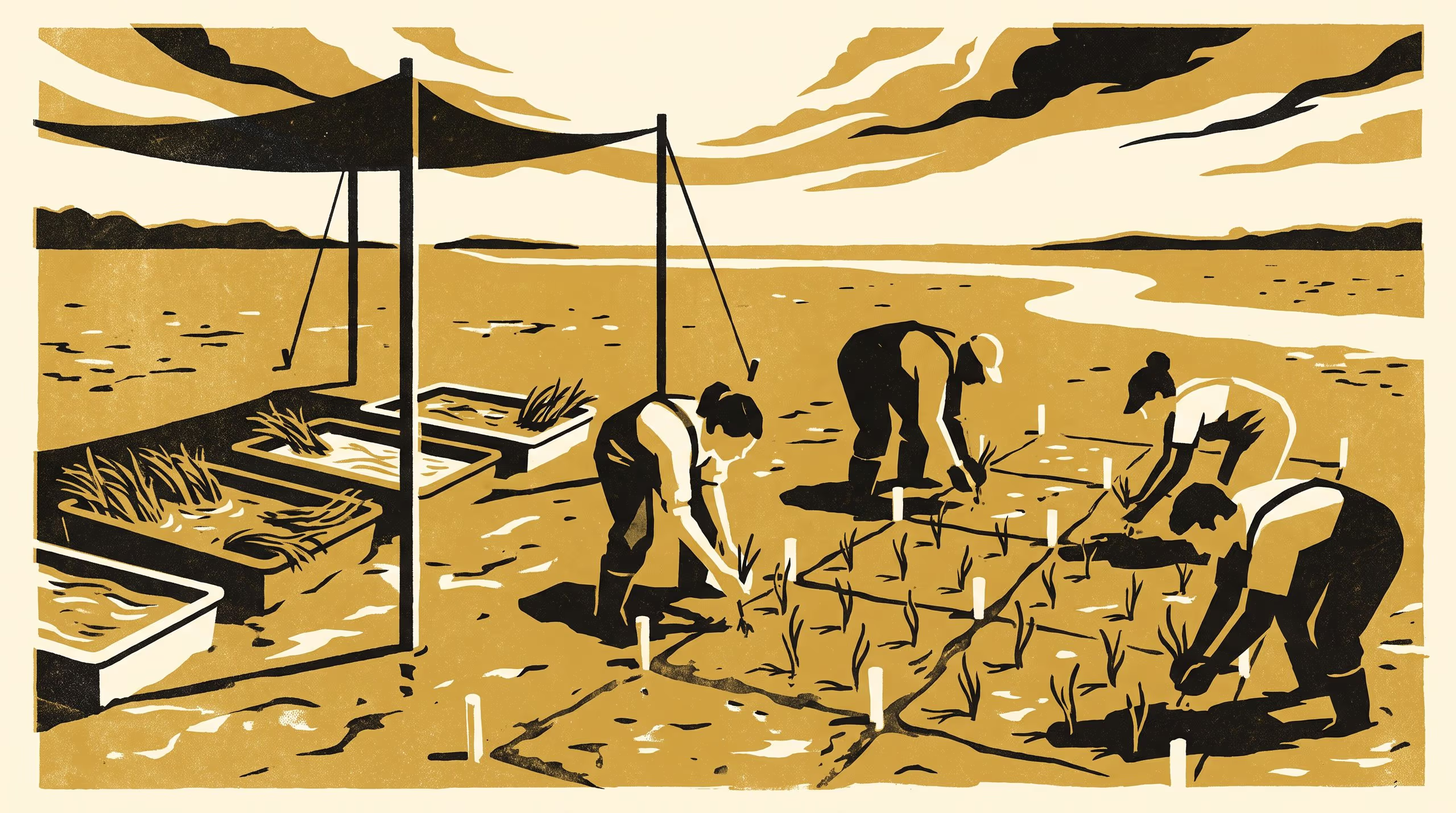
A paper from the School of Continuous Improvement returns to a seagrass transplant six years after planting and finds that the plots which lasted were those whose sprigs spent least time out of the water.
Six years on, a paper traces an estuary planting's survivors back to the crews' own field sheets
Restoration is a long conversation between a crew and a coastline. We are glad to have been able to listen in on part of it, six years after it began.
— Dr Ingeborg Nwachukwu, Lecturer and Convenor, Capability Sprints, School of Continuous Improvement
A new paper, Out of the Water Too Long, returns to a seagrass transplant on a sheltered estuarine flat six years after its sixty-four plots went into the mud. It is the work of Dr Ingeborg Nwachukwu of the School of Continuous Improvement, writing with Dr Vigdis Emenike, Senior Lecturer in the School of Underlying Conditions.
Bringing the planting crews’ original field records together with a full relocation of the site, the study aligns process data from a single planting season with outcomes at the resurvey, and positions the humble field sheet as a restoration asset in its own right. Twenty-seven plots still held seagrass, and those planted after the crews changed how they held their harvested sprigs persisted at more than twice the earlier rate.
“Six years is a short time for an estuary and a long one for a set of stakes,” said Dr Emenike. “We were pleased to find most of them waiting for us.”
The University counts the paper among the clearest expressions yet of a conviction its two Schools share: that improvement begins with what a team thinks to write down, and that a good record is worth going back for.
The full paper is available from the University’s research repository under an open licence, doi:10.5555/slop.m2ljha.