A portrait signage campaign invites the campus to read Associate Professor Ragnhild Uzoma's paper on an industrial laboratory's reference catalyst and the ration that kept it.
A research-teaser poster from the School of Underlying Conditions points passers-by to the Basement Relations Group's study of a reference catalyst held in reserve
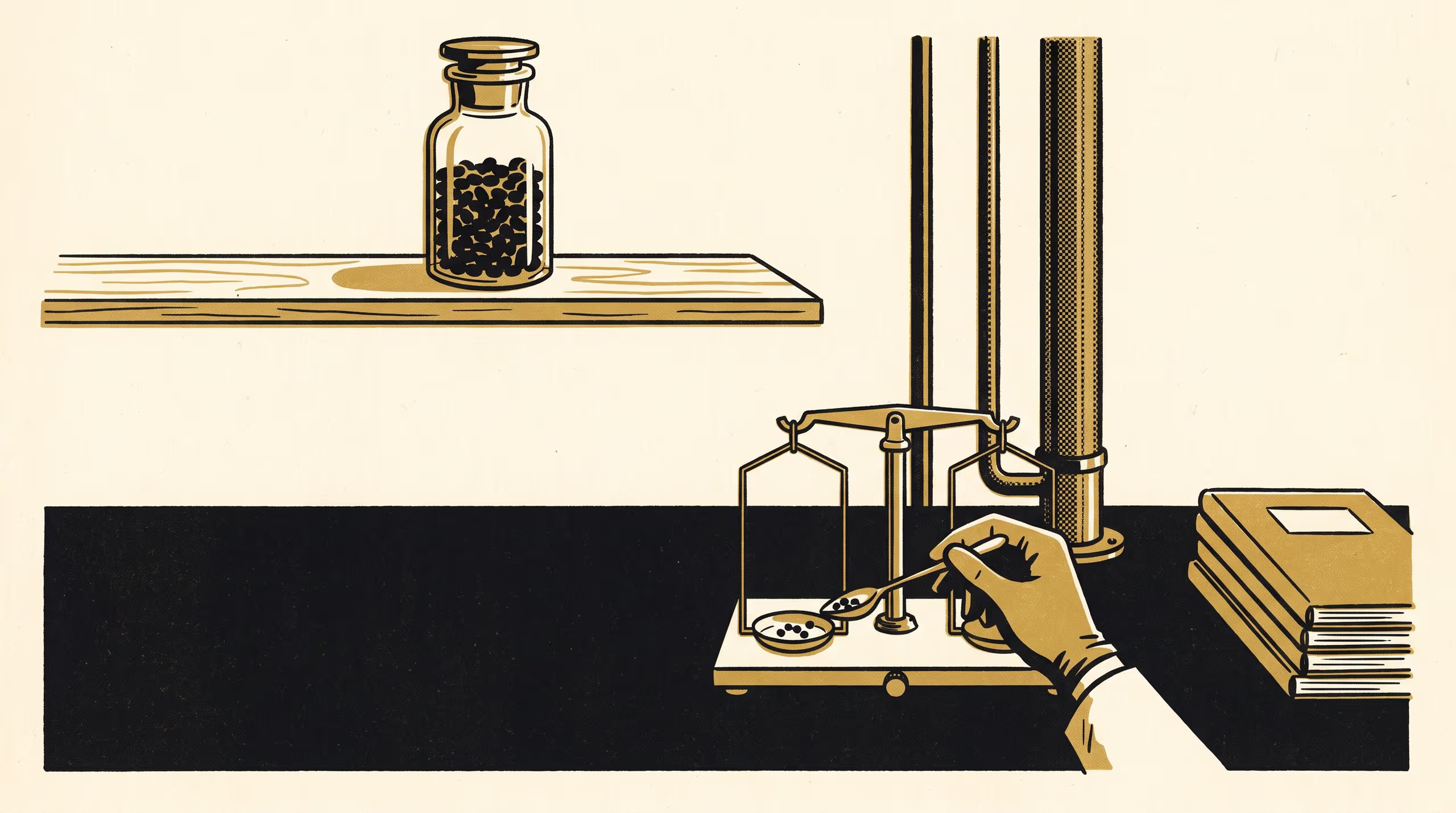
From this week, the University’s portrait screens carry a jar of catalyst pellets, a laboratory balance and one gloved hand, under the line “Some catalysts are too important to use.” The poster is the School of Underlying Conditions’ newest research-teaser campaign, and it directs anyone waiting beside a screen to Bridging Runs, the paper in which Associate Professor Ragnhild Uzoma follows one industrial reforming laboratory’s reference nickel catalyst from its setting aside in 1971 to its last charge in 2004.
A reference earns its standing by being left alone, and most of us have kept something that way. If someone recognises the habit while they wait for a lift, the poster will have reached a reader the paper could not.
— Associate Professor Ragnhild Uzoma, Lead, Basement Relations Group
The campaign condenses a study of catalysis, archival practice and the authority of the laboratory standard into a single proposition legible at corridor distance, and its small print extends the invitation into the wider record: to the Group’s work on how spent catalyst samples are labelled and found again, and to a mass balance of a recycled palladium catalyst prepared with the School of Emergent Priorities. In this the University continues to treat its screens as a reading room with very short visits, placing its scholarship where it can be met in passing rather than sought out.
The campaign runs in matched daylight and after-dark renderings across the portrait signage rotation.
The full advertisement is available from the University’s research repository under an open licence, doi:10.5555/slop.co55eo.