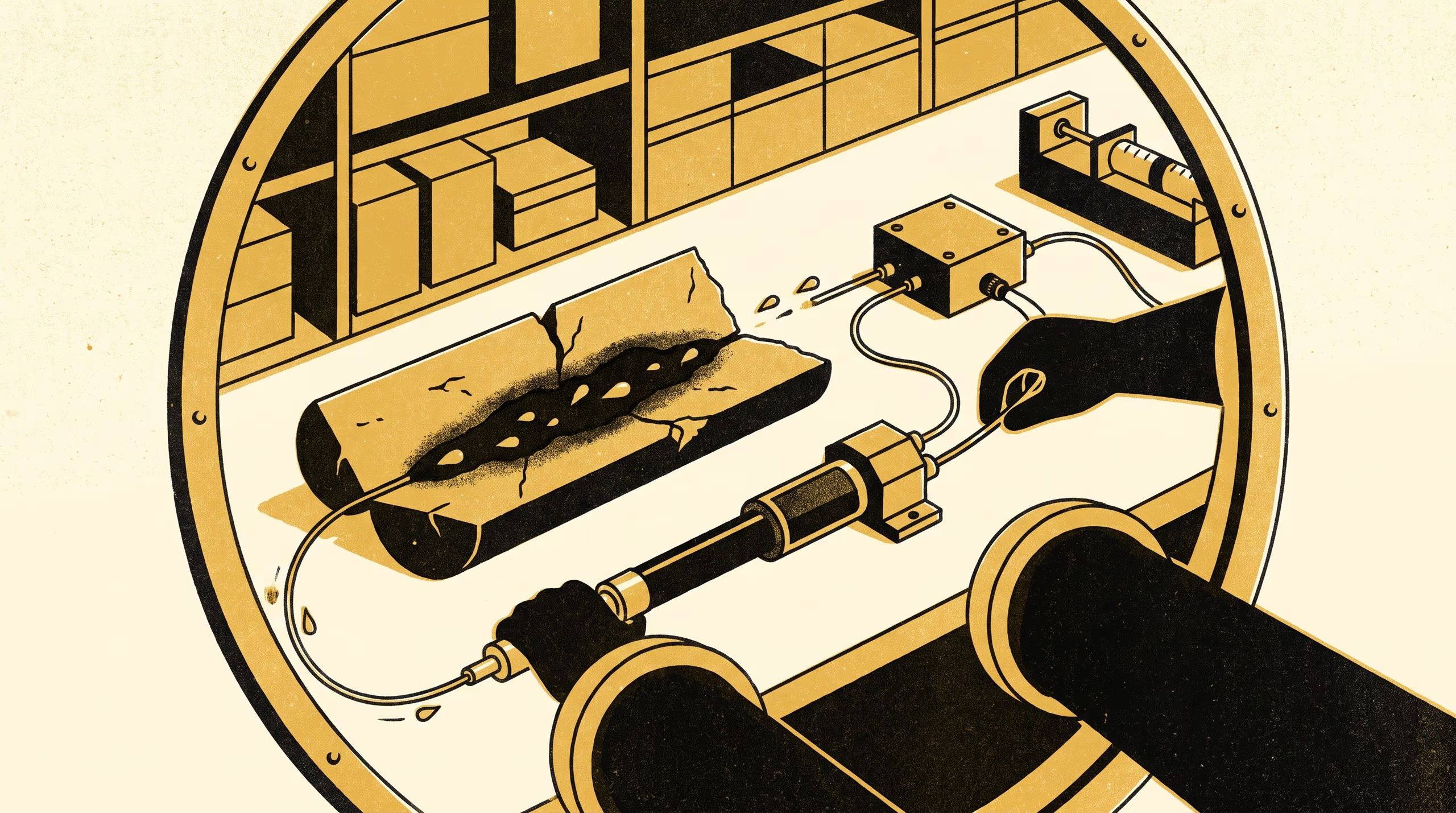
A new paper from the School of Underlying Conditions uses a ferrocene-based tracer and an electrode in the outflow to measure how much a rock fracture changes the water passing through it.
Dr Vigdis Emenike and Associate Professor Ragnhild Uzoma send an iron-based tracer through six lengths of intact drill core and listen to what comes back
The School of Underlying Conditions has spent much of the year asking what the ground gives back to the water that moves through it. Its newest paper answers in electrons.
Dr Vigdis Emenike, Senior Lecturer, and Associate Professor Ragnhild Uzoma, Lead of the Basement Relations Group, report a laboratory method in which the tracer sent through a cracked length of rock also serves as the measuring instrument, its chemical state read continuously by an electrode as it emerges. Across six intact core sections drawn from either side of one buried land surface, the most weathered rock changed the tracer most.
For ten years I took a reading down a pipe and was asked to believe it. Now the reading comes back out of the rock itself, and I think the School is still working out what it has learned about its own habits from that.
— Dr Vigdis Emenike, Senior Lecturer, School of Underlying Conditions
The work brings together organometallic electrochemistry, fractured-rock hydrogeology and the School’s long custodianship of recovered core, aligning surface-scale measurement with an emerging understanding of how buried weathering shapes the water around it.
Associate Professor Uzoma said the paper “gives the core store a reason to keep every awkward, cracked section we were once tempted to set aside.”
The University counts the paper among the clearest expressions yet of its commitment to research conducted at the scale of a single surface, and to the quiet conviction that rock, given time, will answer a well-posed question.
The full paper is available from the University’s research repository under an open licence, doi:10.5555/slop.ja8jgw.