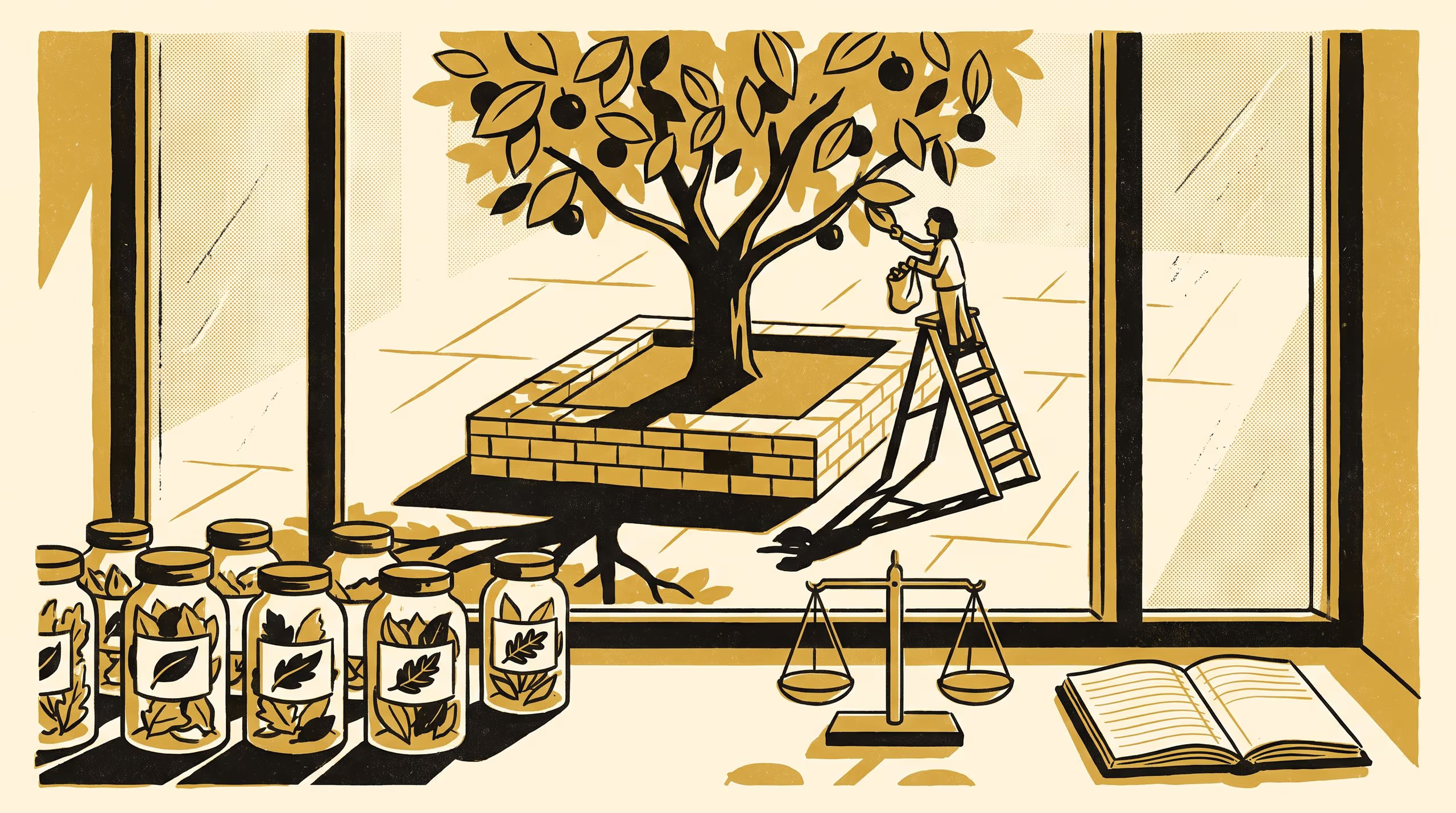
A new paper from the School of Emergent Priorities follows one guava tree from occasional specimen to the default material of a pharmacy teaching laboratory, without anyone ever deciding it should be.
Dr Ronja Oyelaran reads twenty-five years of final-year projects and the notebook that kept one guava tree in supply
The School of Emergent Priorities, which studies how institutions come to care about what they care about, has turned its attention to a priority nobody set. In a new paper, Dr Ronja Oyelaran, Senior Lecturer and Deputy Convenor of the Strategic Drift Survey, traces how leaf from a single guava tree outside a pharmacognosy teaching laboratory came to supply more than half of the laboratory’s plant-based student projects.
Every organisation has something within arm’s reach that is quietly setting its agenda. It was a privilege to sit beside one for two semesters, and the questions it raised will keep the School occupied for some time.
— Dr Ronja Oyelaran, Senior Lecturer and Deputy Convenor, Strategic Drift Survey
The study brings together a laboratory’s archive of 312 project reports, extended observation at the bench and conversations with technicians, supervisors and former students, building a layered account of how supply, method and curriculum align around whatever is closest. It finds that a technician’s picking book, a protocol trusted because it “always gives you something” and a move towards product formulation each did part of the work, and that together they produced a body of reports reading as a literature on a plant while recording, in practice, one tree.
The paper extends the School’s longstanding interest in priorities that arrive before anyone announces them, and positions the Strategic Drift Survey to carry that interest beyond the committee room and into the teaching laboratory, a setting Dr Oyelaran describes as “where most of a discipline’s decisions are made on a Tuesday afternoon”.
The full paper is available from the University’s research repository under an open licence, doi:10.5555/slop.68vjbk.