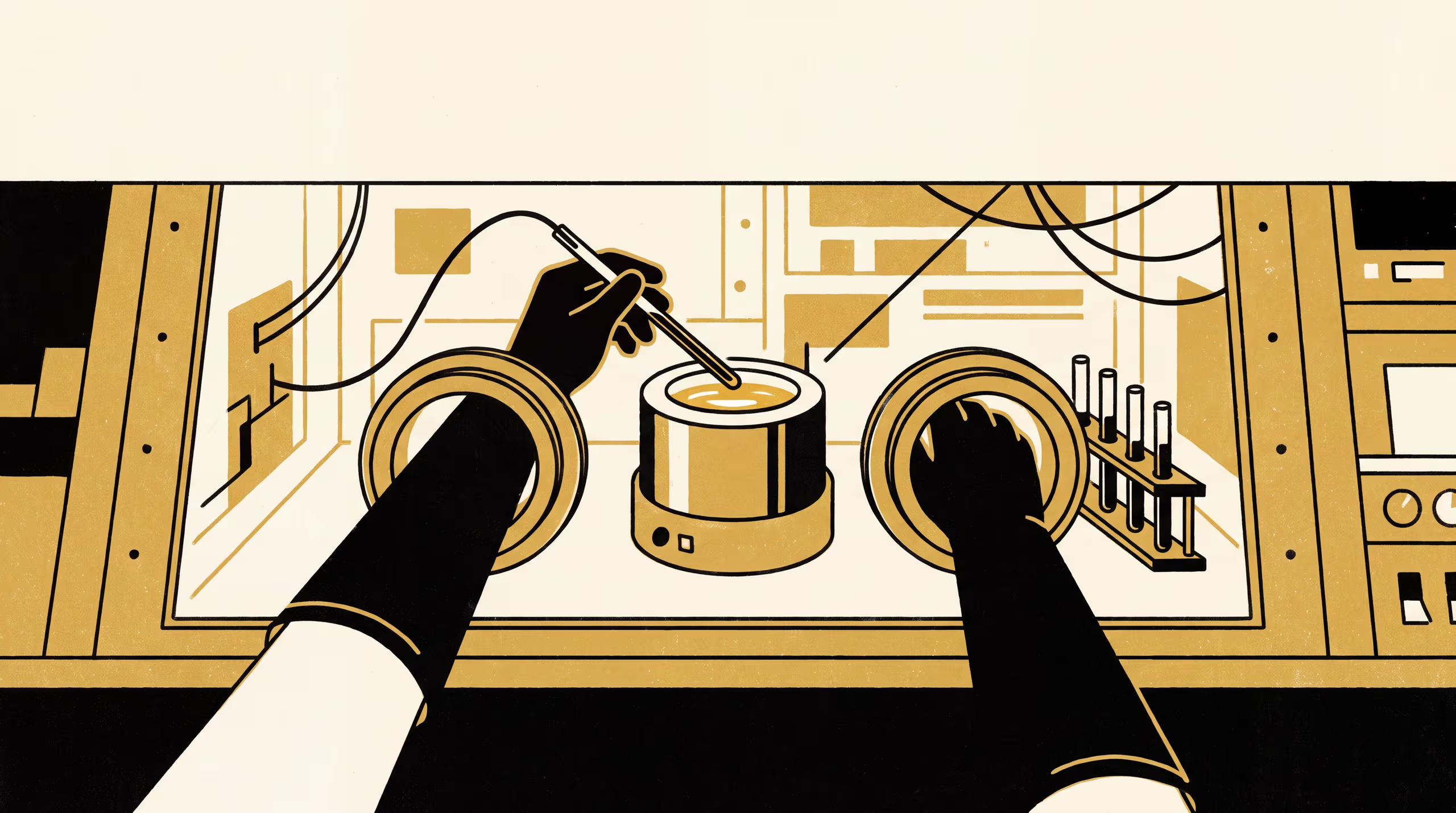
Associate Professor Ragnhild Uzoma, Associate Professor Casimir Beng and Dr Bram Ntuli bring drill-core logging to the sampling of a molten chloride salt.
Three freeze-samplers, a LiCl-KCl test pot and a core logger's habit of recording what the run left behind
The School of Underlying Conditions has long asked what a drill run fails to bring to the surface. Its newest research poster carries that question indoors, to a glovebox and a pot of molten salt.
Bringing the Whole Plug Up, by Associate Professor Ragnhild Uzoma, Lead of the Basement Relations Group, with Associate Professor Casimir Beng and Dr Bram Ntuli of the School of Continuous Improvement, treats each frozen sample drawn from a chloride melt as a short length of core, and asks how much of it reaches the analyst’s bench.
Every laboratory keeps a drawer of samples that nobody entirely trusts. This work gives that drawer a vocabulary, and the Lab is glad of the company.
— Associate Professor Casimir Beng, Lead of the Adaptive Metrics Lab
Across 180 draws from a purpose-built test pot, the team brought the disciplines of field core logging into conversation with laboratory sampling practice, comparing three approaches to drawing a sample and following each one through to the assay. The split-sleeve design recovered a median 97% of each plug, against 71% for an open tube, and the poster locates the difference at the foot of the plug.
The University regards the poster as a fine instance of a field method finding a second home, and of a School whose questions travel further than its boreholes.
“I have spent a good part of my career beside core trays,” said Associate Professor Uzoma. “It was a quiet satisfaction to find one in a glovebox, and the Group will carry what it learned there back out to the drill.”
The full poster is available from the University’s research repository under an open licence, doi:10.5555/slop.ipxchf.