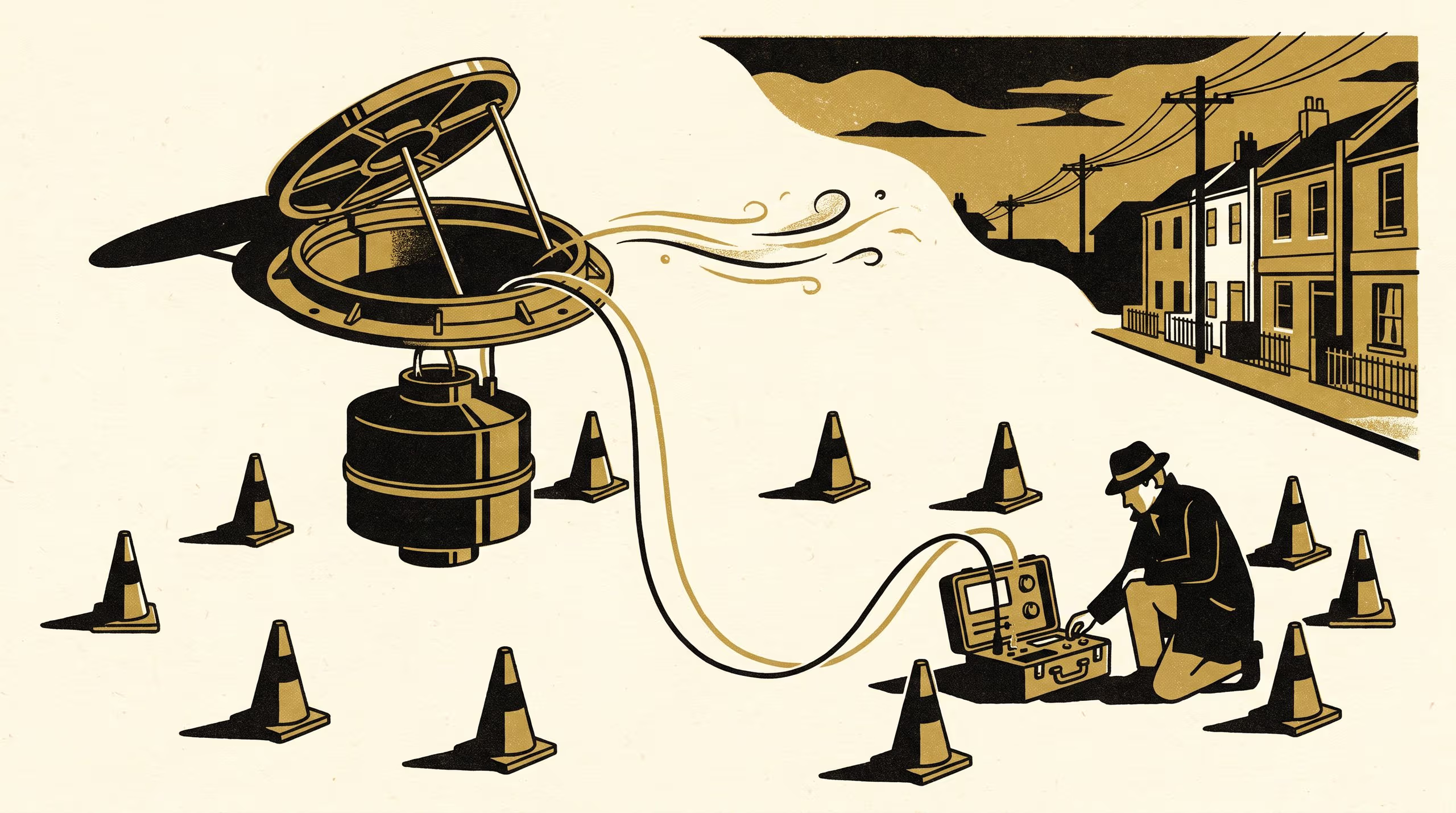
Associate Professor Ragnhild Uzoma, Dr Vigdis Emenike and Dr Marit Osayande measure how much of a sewer manhole's air passes through the carbon filter fitted to treat it.
Ten manholes, a tracer gas and the share of headspace air a carbon vent filter actually receives
The School has always asked what lies beneath a surface. It has been a pleasure to put that question to a manhole lid, and to find that the answer was waiting at the rim.
— Associate Professor Ragnhild Uzoma, Lead, Basement Relations Group
That question sits at the centre of Round the Lid, Not Through the Carbon, a new research poster from the School of Underlying Conditions by Associate Professor Ragnhild Uzoma with Dr Vigdis Emenike, Senior Lecturer, and Dr Marit Osayande, Lecturer and Convenor of the Living Dashboard in the School of Continuous Improvement.
The team brought the School’s patient attention to the ground and what moves through it to bear on the everyday infrastructure of odour management. Working across ten manholes over six weeks, the study pairs a tracer-gas mass balance with continuous observation of the chamber below, and offers practitioners a way of describing a filter’s contribution in terms of the manhole it serves as well as the bed it holds. The authors find that filters cleaning almost all of the air that reached them were reached by a little over two-fifths of it.
The poster joins a growing body of work in which the University’s schools of the subsurface and of measurement practice have found common ground at the same access point. Dr Osayande said she was “glad to have spent six weeks somewhere the instrument and the infrastructure were so frank with one another.”
The full poster is available from the University’s research repository under an open licence, doi:10.5555/slop.bnc8w1.