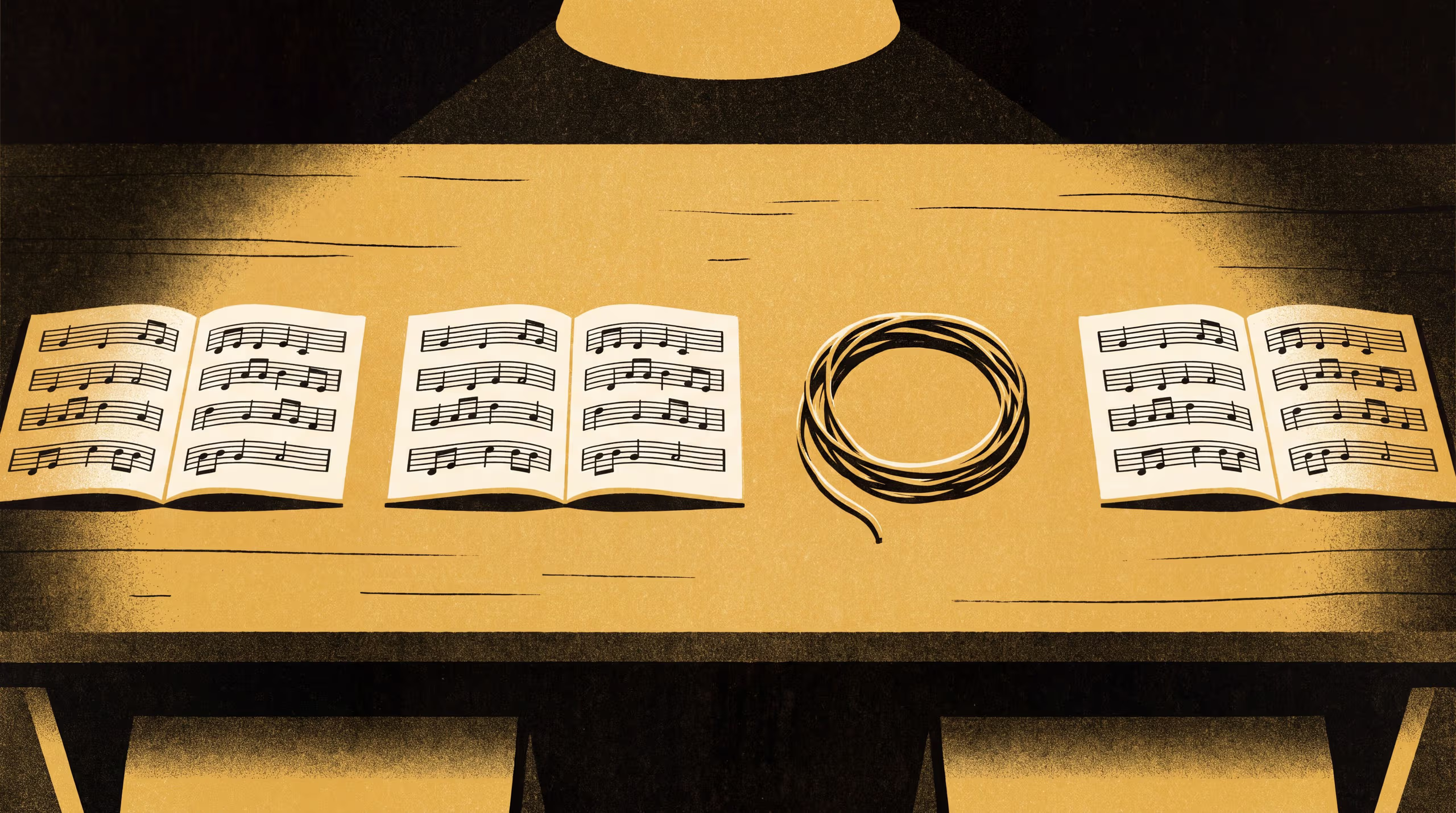
Associate Professor Ragnhild Uzoma, Dr Marek Solheim and Dr Iben Chikere bring the mathematics of chord spaces to a set of Renaissance motets whose altus book was lost.
A School of Underlying Conditions poster asks what three surviving partbooks determine about the fourth
The editions that restore a missing inner voice to a set of late-sixteenth-century motets have, at most of the moments that count, been restoring a voice that adds nothing the other three parts were not already singing. That is the central finding of Where the Altus Could Have Been, a new research poster from the School of Underlying Conditions by Associate Professor Ragnhild Uzoma, Dr Marek Solheim and Dr Iben Chikere.
This is the first time the Basement Relations Group has worked from a page rather than a tray, and the method travelled further than any of us had planned. The School will be finding other collections for it to visit.
— Associate Professor Ragnhild Uzoma, Lead, Basement Relations Group
The poster aligns the analytical traditions of music theory with the geometry of chord spaces, mapping every possible reconstruction of the absent part across a corpus of 31 motets and benchmarking two published completions against the original voice where it survives elsewhere. Its outcome is a principled, sonority-by-sonority account of which choices the surviving books already make, and which remain genuinely open to an editor.
Dr Solheim, Deputy Convenor of the Horizon Register, sees the work as a question of inheritance. “An edition is a decision made long ago that every choir since has sung without asking,” he said. “The poster lets us tell those decisions apart from the ones the sources made for themselves, which seems to me the least a historian owes them.”
The University counts the study among a widening body of its work on what a record keeps of what it has lost, and welcomes its arrival in the choir loft.
The full poster is available from the University’s research repository under an open licence, doi:10.5555/slop.a2ov3x.