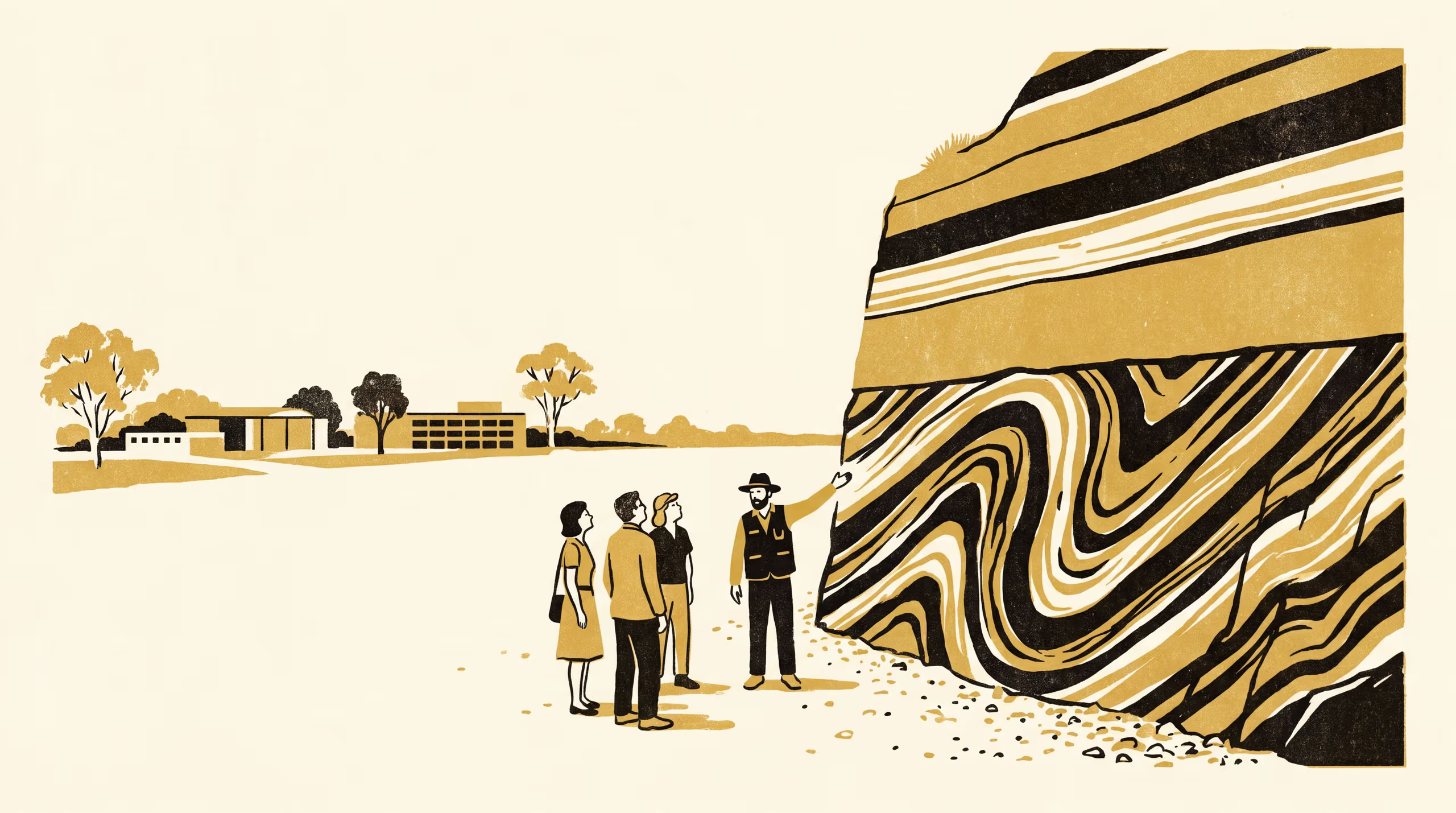
A new landscape advertisement brings the School of Underlying Conditions' campus road cut, where folded basement meets the cover above it, to the University's screens.
A landscape advertisement from the School of Underlying Conditions sets the meeting of basement and cover before the campus public
Geoheritage is usually something a university sends its students away to see. A new landscape advertisement from the School of Underlying Conditions proposes that the University keeps some of its own at the edge of campus, in a road cut where steeply folded basement rock gives way, along a single near-level line, to the younger cover laid down upon it.
See the Oldest Thing on Campus pairs a two-ink illustration of the cutting, a guide and a small group of visitors gathered at its foot, with one line of display type and an invitation to visit. Prepared by Dr Brynjar Obiora, Senior Research Fellow, the campaign joins the landscape rotation on the University’s campus screens and signage panels.
The cutting was there long before any of us, and in all that time very few people have stopped to read it. We would like it to have more readers, and we ask each of them only to leave the face as they found it.
— Dr Brynjar Obiora, Senior Research Fellow
Behind the campaign sits the School’s wider interest in geosite stewardship: aligning scientific value, public access and conservation settings around the exposures the University already holds, so that the ground beneath the institution can anchor its engagement with the communities around it. The advertisement’s small print points readers to three of the School’s published works, on bore casing recovered after decades underground, on the drying of stored drill-core plugs, and on reading drill-core leachate with a fluorescent probe.
The release continues the University’s steady intention to count what lies under its campus as part of its public offer. The full advertisement is available from the University’s research repository under an open licence, doi:10.5555/slop.17sq13.