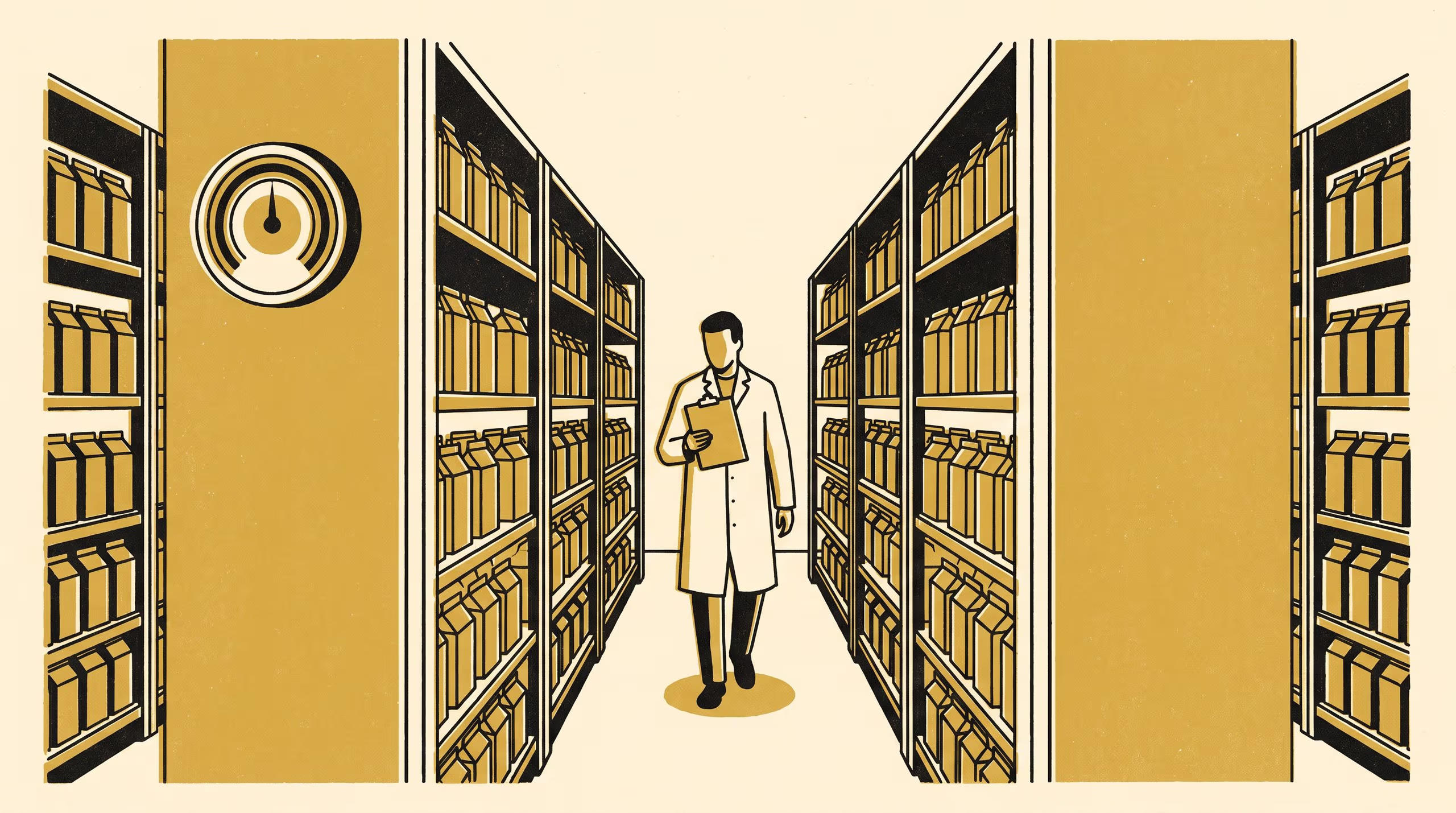
Associate Professor Ragnhild Uzoma and Dr Anneke Tolan follow the sealed cartons a generic medicine works keeps from every batch it releases, and the two clerks who keep them.
A new paper spends fourteen months in a tablet works' retained-sample store and finds its daily business is being ready to find a carton
For the Basement Relations Group, the part of a sample that never comes out of the ground has long been a research agenda. Its newest paper carries that agenda indoors, into the store where a medicine manufacturer keeps one sealed carton from every batch it sends out.
The Rest of It Is in People is the work of Associate Professor Ragnhild Uzoma, Lead of the Basement Relations Group in the School of Underlying Conditions, and Dr Anneke Tolan, Senior Research Fellow and Deputy Convenor of Futures in Committee in the School of Emergent Priorities.
A geologist walks into a room of boxes expecting to be unimpressed. I came out of this one with a lot of questions about how my own School looks after the things it means to come back to.
— Associate Professor Ragnhild Uzoma, Lead of the Basement Relations Group
The paper combines sustained ethnographic presence with a close reading of the store’s own documentation, positioning everyday custodial practice as a site of institutional knowledge in its own right. It finds that the most frequent reason for taking a carton down from its shelf was to show that it could be found, and it reframes retention as a standing capability rather than a reserve of evidence.
Dr Tolan described the collaboration as “a genuine meeting of two Schools’ habits of attention, and an encouraging sign of where cross-school work at the University can go when it is given a room to sit in.”
The University regards the paper as an especially clear instance of its commitment to scholarship that takes quiet, careful work as seriously as it deserves.
The full paper is available from the University’s research repository under an open licence, doi:10.5555/slop.9z2ugf.