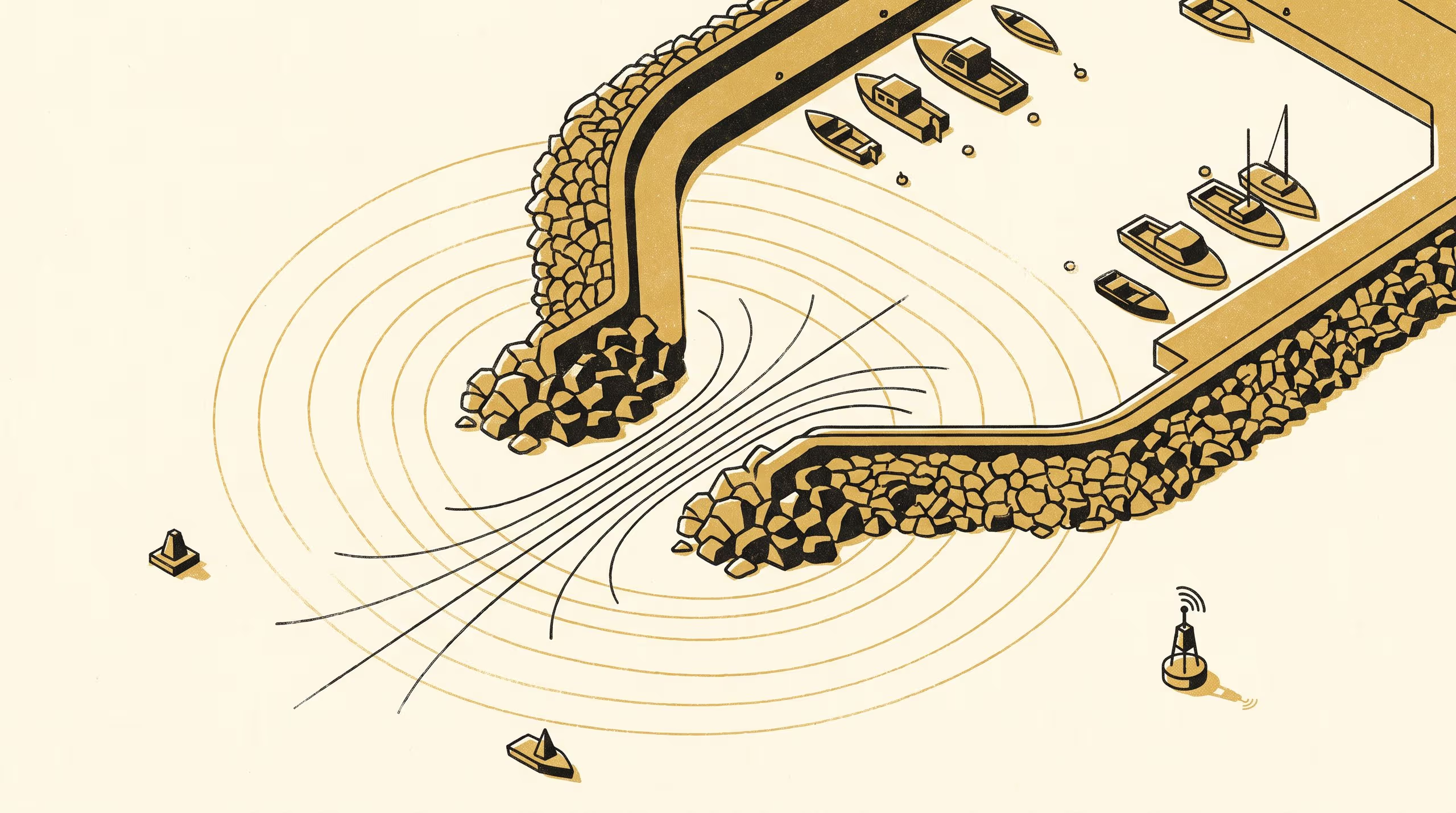
A paper by Ylva Onyekwere and Dr Fenna Okoro shows that a fifteen-minute oscillation, rather than the tide, does most of the work of exchanging the water in a small harbour's inner basin.
A winter of pressure records and drifter releases follows a basin's water through the narrow cut it breathes by
Every fifteen minutes or so, the water in a small harbour’s inner basin rises, falls and slips out through the cut, and most of it comes straight back. A new paper from the School of Emergent Priorities finds that this quiet, persistent motion, and not the tide, carries most of the fresh water the basin receives.
Seiche, Not Tide is the work of Ylva Onyekwere, Doctoral Candidate, and Dr Fenna Okoro, Senior Lecturer and Convenor of the Horizon Register. On the days the oscillation was running, the authors estimate that the basin renewed its water in under three days, against nearly ten on the tide alone.
We have one winter on the page. The summer will have its own account to give, and we would very much like to be standing at the cut when it does.
— Ylva Onyekwere, Doctoral Candidate, School of Emergent Priorities
Combining a season of instruments on the sea floor with tracked releases at the water’s surface, the paper sets out an integrated, basin-scale account of exchange that moves the conversation about small harbours from the calendar of the tide to the rhythm of the basin itself.
Dr Okoro said the School would “enter the harbour’s quieter months in the register of things still to be understood, which is where the most interesting entries tend to begin.”
The paper is a welcome addition to the School’s widening attention to systems that do their most important work while appearing to do very little.
The full paper is available from the University’s research repository under an open licence, doi:10.5555/slop.jkrh9b.