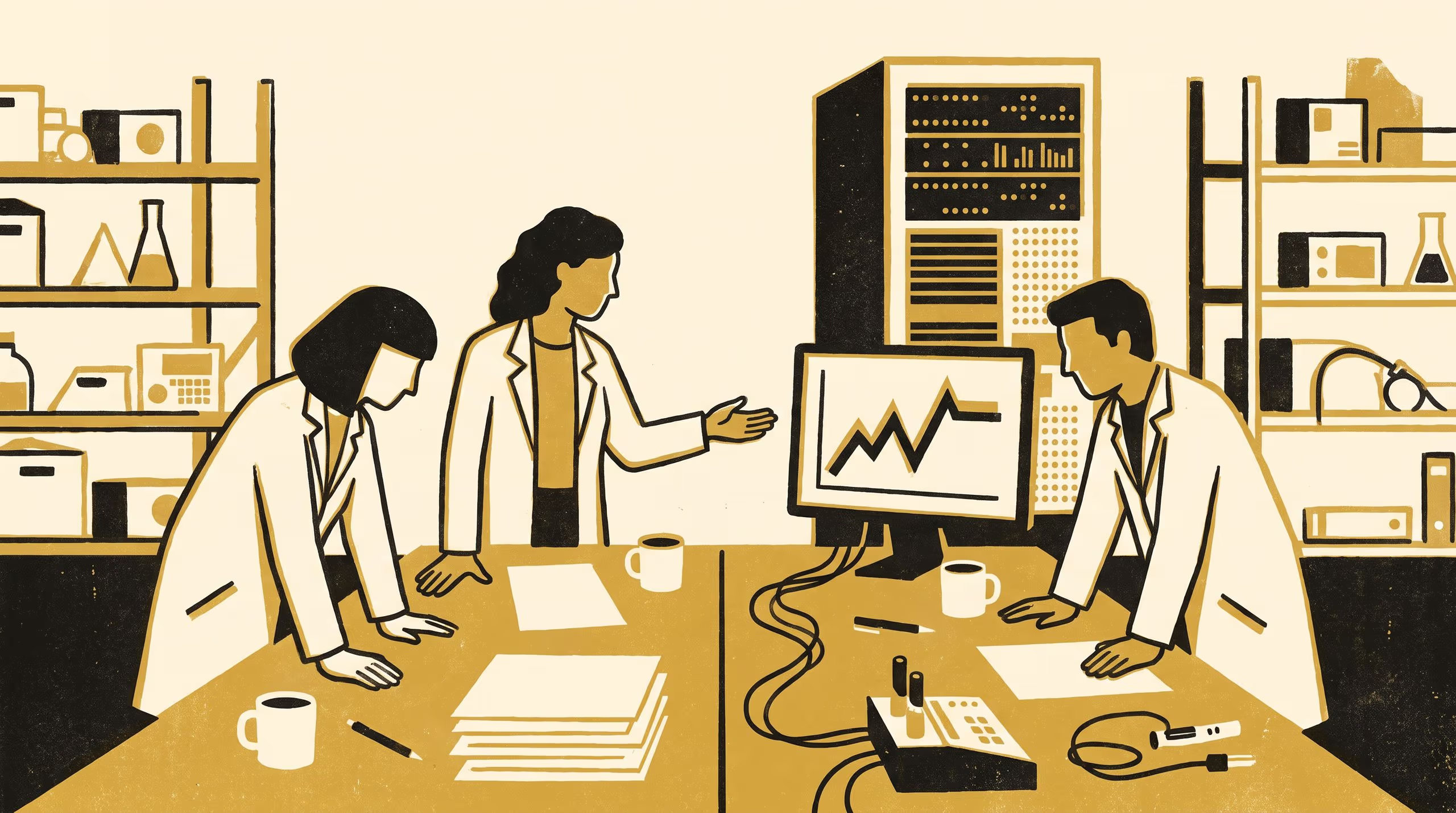
A new paper from the School of Continuous Improvement examines who is made responsible, grammatically, when a computational chemistry group's calculations succeed or fail.
A paper finds a converged calculation is a member's achievement and a failed one the molecule's reluctance
The group let us sit in on their difficulties, which is a generous thing for any team to do. We hope the paper repays them by taking those difficulties as seriously as they did.
— Signy Okpara, Doctoral Candidate, School of Continuous Improvement
With those words Ms Okpara introduces Who Converges?, a new paper from the School of Continuous Improvement on the language a research team uses for the work its computers do overnight. Written with Associate Professor Casimir Beng, the paper follows one computational chemistry group through its chat channel, its weekly meetings and its manuscripts, and asks who, in each sentence, is made responsible for a calculation that settles or fails to.
The answer depends on how the night went. When a calculation converges, a member usually got it there. When it does not, the molecule, as the group puts it, did not want to. In the group’s published methods, nobody did anything at all.
The study brings together conversational, written and interactional evidence within a single framework for responsibility, accountability and process language, and extends the School’s capability in how working teams describe the systems they tend. It sits naturally alongside the School’s continuing attention to the records an organisation keeps of itself.
Associate Professor Beng, Lead of the Adaptive Metrics Lab, said the work had raised “more questions about tolerances than the Lab expected, and the Lab is glad to have every one of them.”
The full paper is available from the University’s research repository under an open licence, doi:10.5555/slop.2sjd6g.