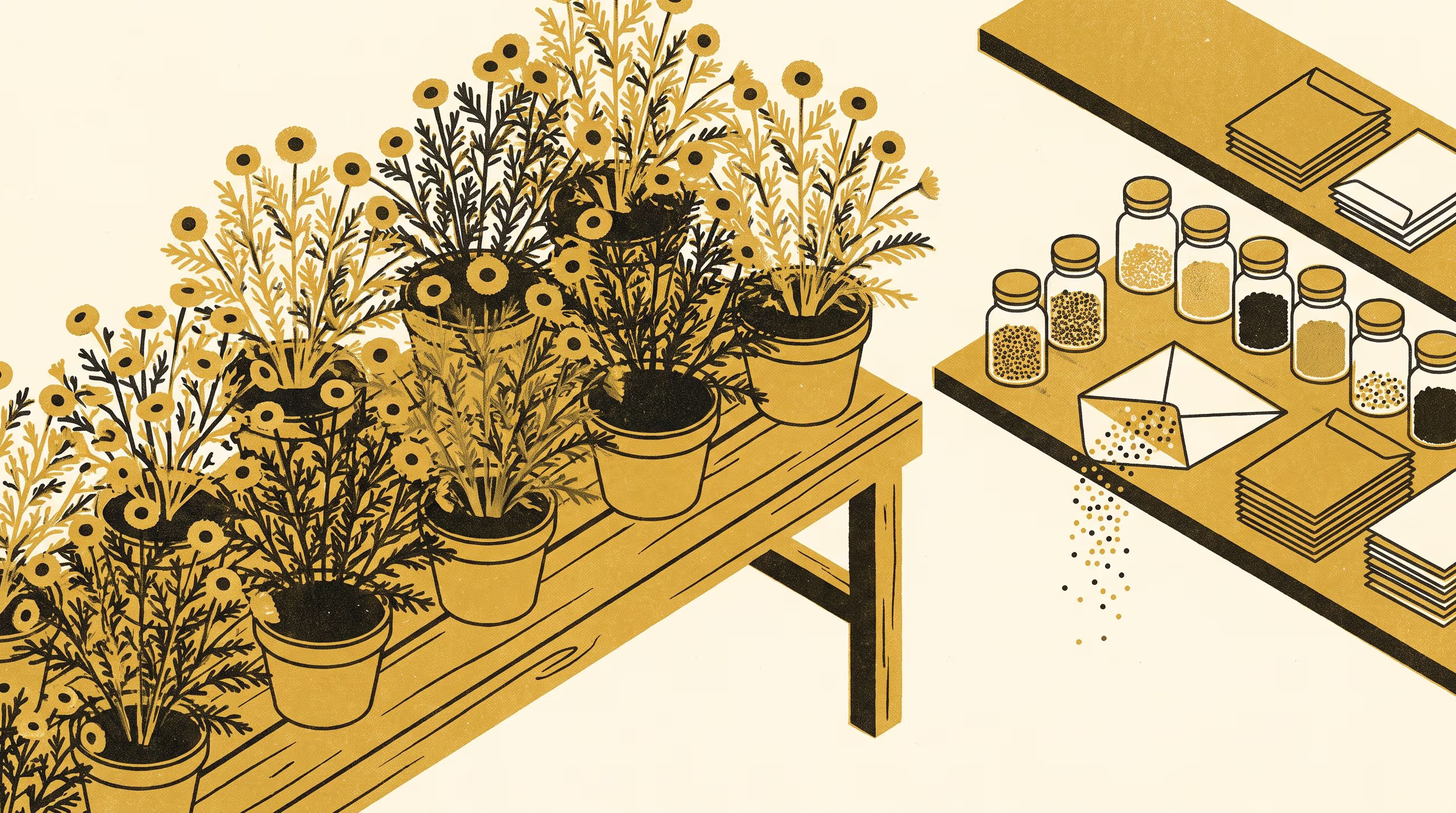
A paper from the Schools of Emergent Priorities and Underlying Conditions finds that a daisy-family seed accession has drifted towards a different leaf chemistry across twelve regenerations, and that chance in the regeneration harvest accounts for the change.
Twelve glasshouse regenerations, one gene and a daisy-family plant still awaiting its species name
A packet of seed placed in the University’s keeping has, over twelve careful regenerations, quietly become a somewhat different plant. A new paper, Twelve Regenerations of One Accession, by Dr Lindiwe Achterberg of the School of Emergent Priorities and Dr Brynjar Obiora of the School of Underlying Conditions, sets out how a single variant gene has travelled through the collection until a third of its plants now carry a leaf chemistry the original seed showed only rarely.
Every one of those regenerations was done by someone following the procedure to the letter. This paper is, in its way, a thank-you note to all of them.
— Dr Lindiwe Achterberg, Lecturer, School of Emergent Priorities
Bringing the accession’s past and present into one glasshouse, the authors align leaf-surface chemistry, genome-wide sequencing and the collection’s own regeneration records into a single account of stewardship over time. Their conclusion is that no pressure from the plants’ surroundings was needed: the ordinary arithmetic of which plants contribute seed to each new harvest was enough.
The University counts the patient keeping of living collections among the less visible strengths of its research culture, and the work sits naturally alongside the School of Underlying Conditions’ long attention to what stored and buried material can and cannot tell us. Dr Obiora described the seed store as “a place that has always been generous with our time”, adding that the authors “hope to return the favour”.
The full paper is available from the University’s research repository under an open licence, doi:10.5555/slop.i8v7cc.