A new campaign for the University's landscape screens presents the School of Underlying Conditions' work on light that scatters so often inside a prepared sample that it begins to lase.
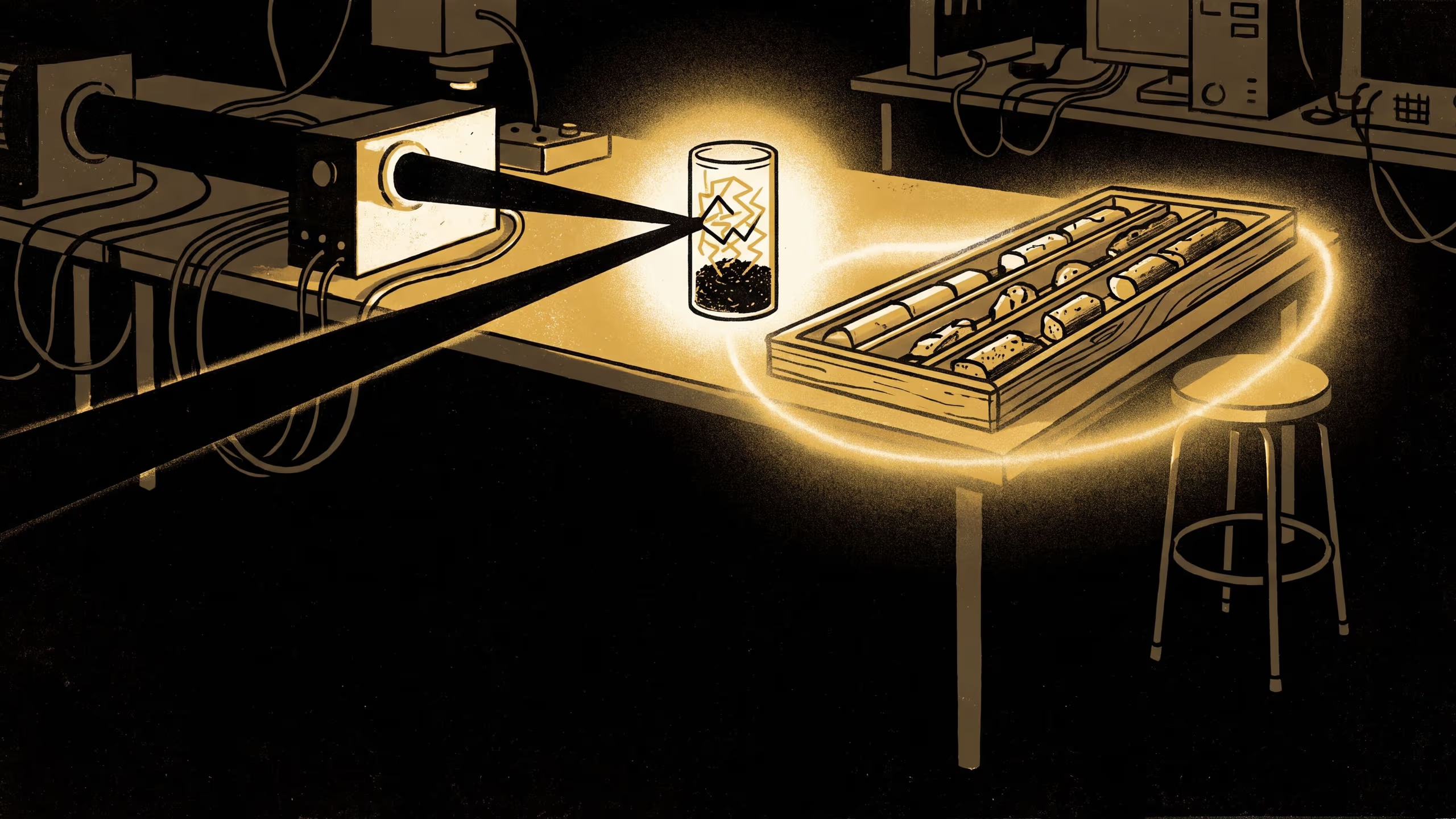
A landscape display campaign from the School of Underlying Conditions sets a pump beam into a cuvette of dye-soaked crushed core
Most of what the School of Underlying Conditions studies has never been lit. Its newest campaign begins with what happens when it is.
Light Comes Here to Stay, prepared by Dr Brynjar Obiora, Senior Research Fellow in the School of Underlying Conditions, carries the School’s work on scattering media to the University’s landscape screens.
Soil surveyors are used to light giving up within the first centimetre. It has been a pleasure to watch it decline to leave, and we would be glad to hear from anyone who stops at a screen wanting to know why.
— Dr Brynjar Obiora, Senior Research Fellow, School of Underlying Conditions
The poster sets a single pump beam into a cuvette of crushed drill core soaked in dye, where the light is turned back on itself so often that the sample begins to glow on its own account, beside a tray of split core still waiting its turn. Its stat line places the School first for disorder among the samples measured on campus, and its small print directs readers to three works from the University’s record: a prospectus for blended earth-science study, a poster on sorting drillers’ free-text logs, and a showcase of research that answers only once it is illuminated.
The University counts the campaign among its clearest statements yet of a School at ease with complexity in the materials it keeps, and content to let a sample take its time.
The full poster is available from the University’s research repository under an open licence, doi:10.5555/slop.uys649.