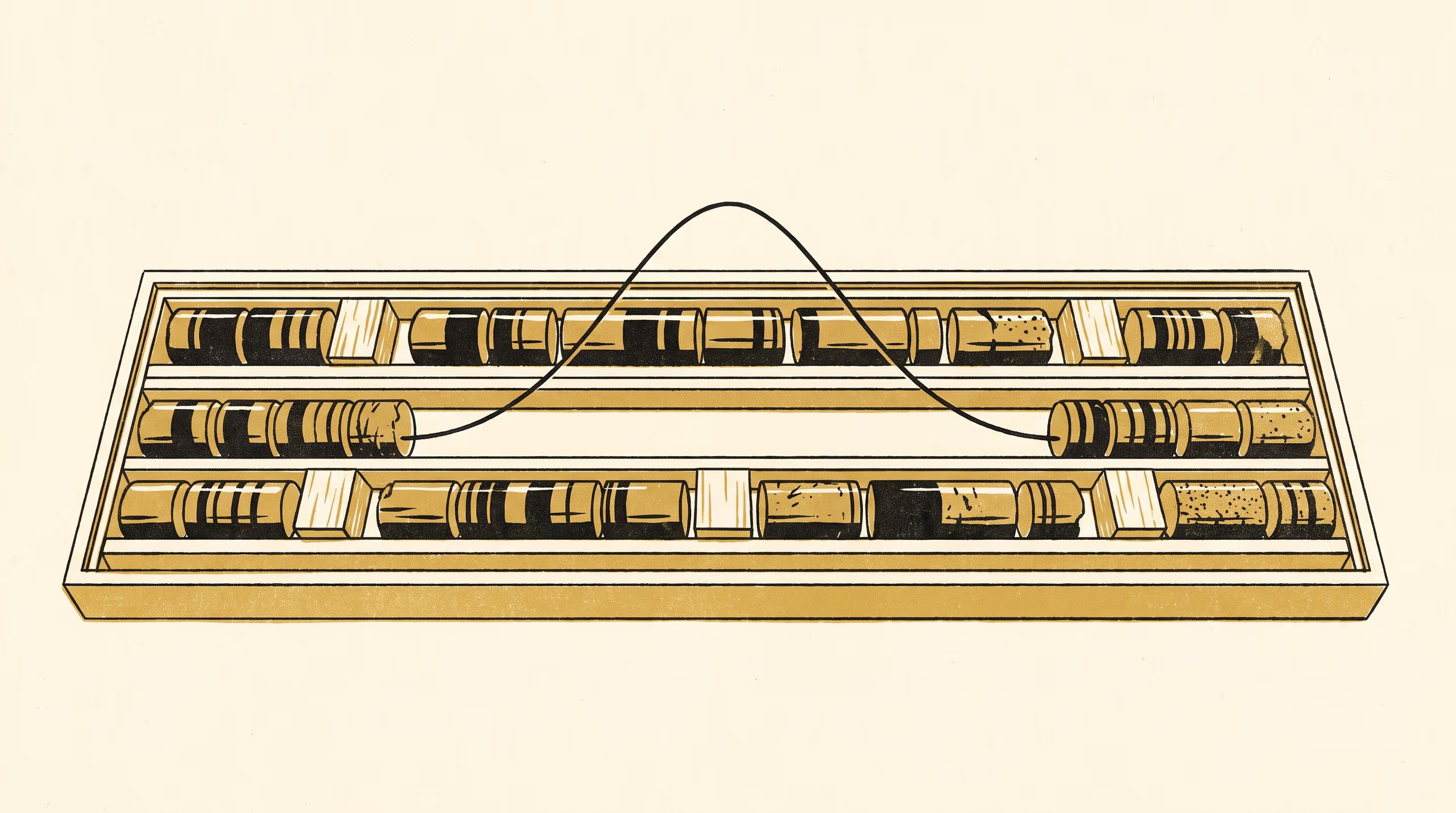
Associate Professor Ragnhild Uzoma turns one of the oldest tools of mathematical analysis on the gaps a drill run leaves in its core, and finds that where the rock is missing matters more than how much of it is.
A mathematical study from the Basement Relations Group of drill runs that do not bring all their core back
A new paper from the School of Underlying Conditions sets a familiar object of the core shed, the plain wooden block that stands in a tray where rock failed to come up, beside a century-old result in mathematical analysis. The Reach of a Lost Interval is the work of Associate Professor Ragnhild Uzoma, Lead of the Basement Relations Group.
The paper treats each drill run as a sampling of the ground and asks when a log built from what was recovered can be relied upon to settle as drilling grows finer. Its answer turns on the arrangement of the gaps rather than their total: in the paper’s worked example, a run that returns only half its samples keeps pace with an intact one, while a run that loses a single tenth from the middle does not. Across a whole drilling programme, the occasional difficult run need not unsettle the result, provided it stays occasional.
Every logger who has ever cut a block and written two depths on it was doing this work first. The paper keeps them a little more company than they had before.
— Associate Professor Ragnhild Uzoma, Lead, Basement Relations Group
The study draws support from the Anticipatory Capability Fund, which has underwritten the Group’s attention to core-loss blocks since October, and it extends a strand of the School’s work that has already taken the unrecovered interval to the spectra of a borehole column and to the eye of the logger. For a School still in its first year, the University counts it a welcome sign of how readily the earth sciences and mathematics have found a shared bench.
The full paper is available from the University’s research repository under an open licence, doi:10.5555/slop.t0mnsu.