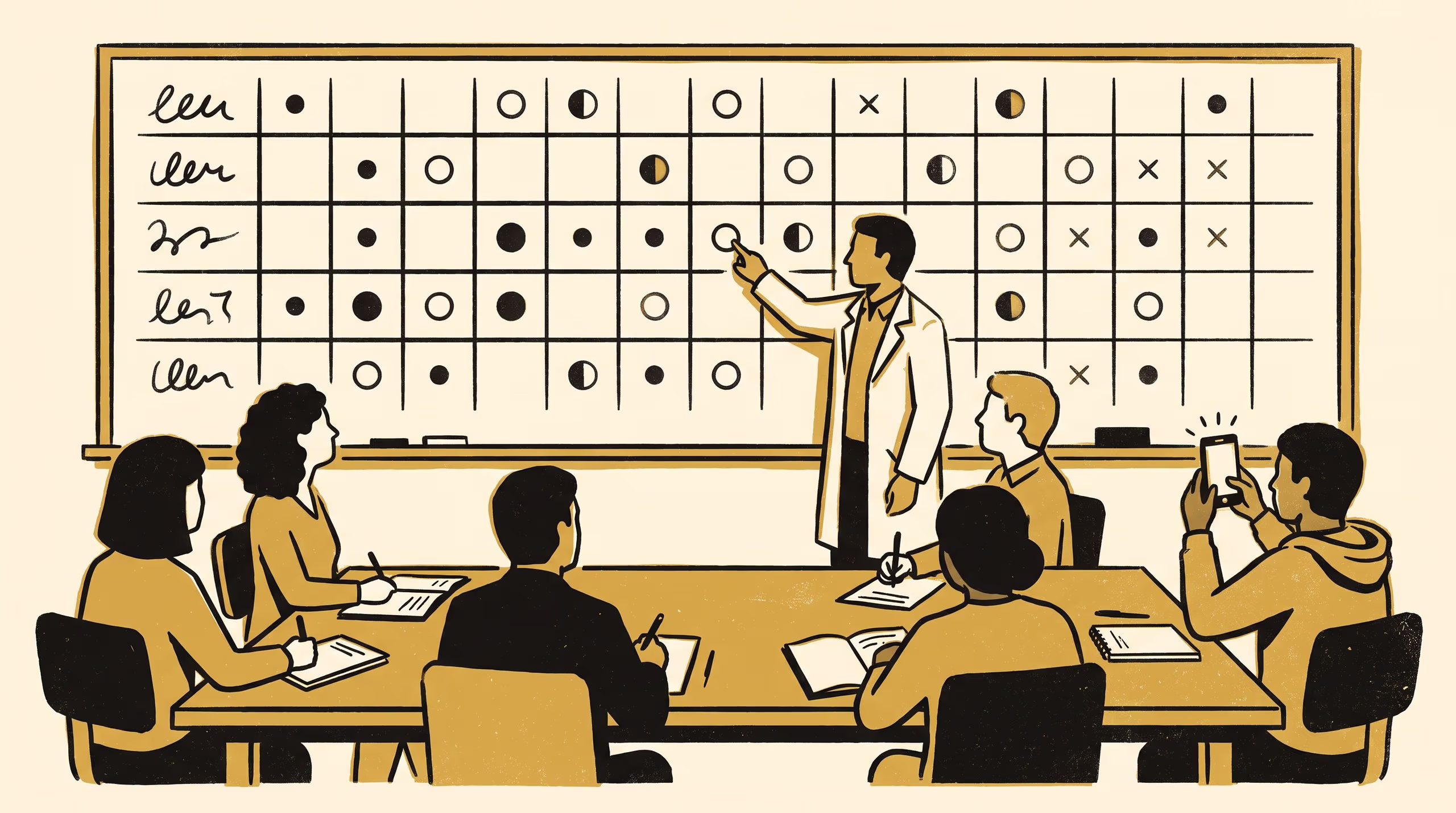
Dr Ingrid Vasseur and Dr Osei Vandermeer follow a research group through 54 weekly meetings held in front of a whiteboard grid that decides which questions can be asked.
An ethnography of a neural-network synchronisation group finds its next problem is the empty cell beside the last one
Agenda by adjacency is the name Dr Ingrid Vasseur and Dr Osei Vandermeer have given to the way one research group decides what to work on next, and their new paper sets out how it operates. The group studies the stability and synchronisation of artificial neural networks. Its weekly meeting is conducted in front of a whiteboard ruled into a grid, and the grid, the authors find, does a good deal of the deciding.
The Futures in Committee seminar keeps a list of its own, of the questions we mean to come back to. We have looked at that list rather differently since this paper, and I think the seminar is the better for it.
— Dr Ingrid Vasseur, Lecturer and Convenor, Futures in Committee
Combining fourteen months of meeting observation with the group’s own weekly photographs of its board and two rounds of interviews, the study maps how open questions are translated into coordinates, how positional warrant underpins the case for each new problem, and how the grid itself keeps a dozen researchers moving together. Questions that could not be written onto the grid were kept in its margin. Of the 41 recorded there, two came back.
The paper extends the University’s continuing attention to the moment before a decision, when the shape of the options is still being settled.
“We expect the closest readers to be groups who keep a board of their own,” said Dr Osei Vandermeer, Research Fellow and Convenor of the Review Cadence Observatory, “and we would be very glad to hear from them.”
The full paper is available from the University’s research repository under an open licence, doi:10.5555/slop.3dhfux.