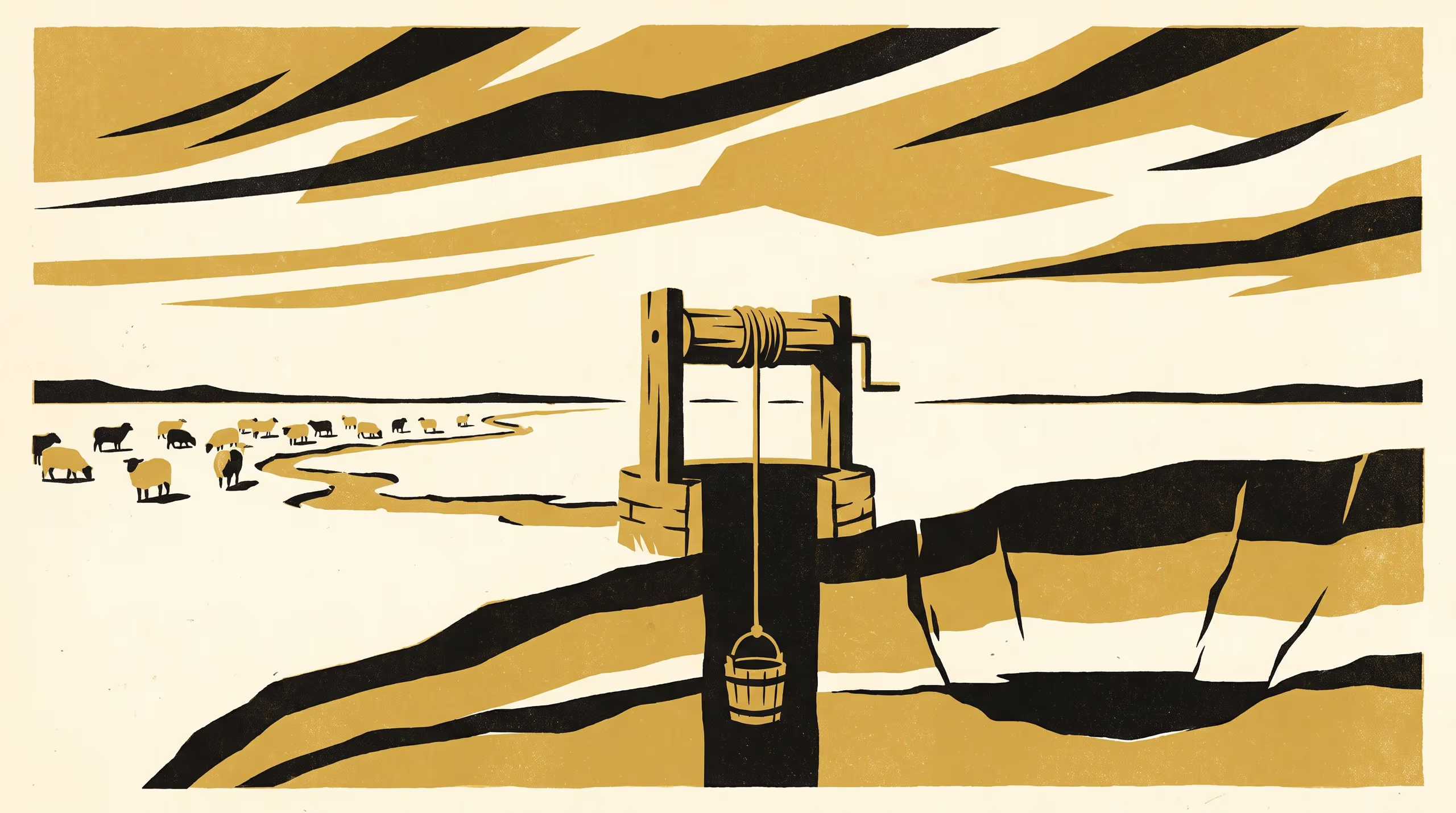
Dr Vigdis Emenike's new paper reads seventy-one casebook entries in which patients of a rural asylum described melancholy through wells, tanks and bores.
A groundwater scholar finds, in patients' talk of wells, an account of low spirits found on checking rather than felt as they arrive
Seventy-one entries across eleven casebook volumes are the evidence base for Found Lower, a new paper from the School of Underlying Conditions by Dr Vigdis Emenike. Each records a patient of a rural hospital, admitted with melancholia between 1883 and 1911, describing their state in the language of the district’s water supply.
The paper carries the School’s long attention to what lies beneath the surface into the history and philosophy of psychiatry. Bringing close reading, medical anthropology and phenomenology into a single frame, it positions the patients’ well-talk as a vocabulary with its own logic: its own gradation between a lowered well and a dry one, and its own account of a recovery noticed only once it is already under way. At its centre is the observation that the idiom treats low spirits as something found when one reaches for them, not felt as they arrive.
The people who spoke these words, and the officers who took the trouble to write them down, did the hard part. The paper sets out what the words will carry, and I hope readers from other corners of the University will take them further than a hydrogeologist can.
— Dr Vigdis Emenike, Senior Lecturer, School of Underlying Conditions
The University sees in the paper a welcome sign of how far the School’s habits of reading now travel, and of the range of questions its people are prepared to take up.
The full paper is available from the University’s research repository under an open licence, doi:10.5555/slop.4owi3l.