A display advertisement from the School of Continuous Improvement brings the University's farm-dam coring study to its signage screens, prepared by Dr Solveig Adeyemi.
A landscape campaign for the University's screens sets a coring grid across a drained dam floor and sends passers-by to the study behind it
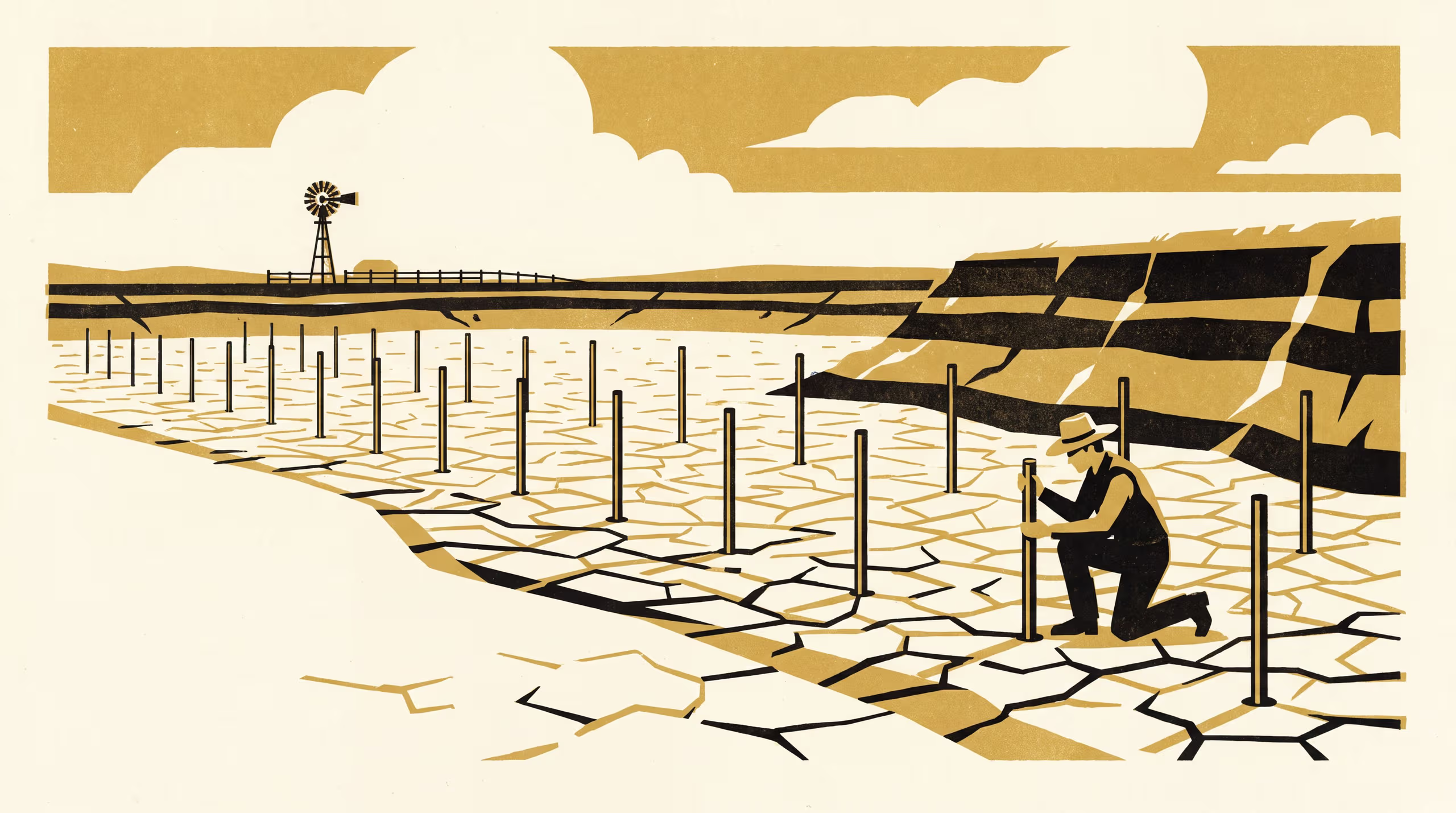
A grid of steel tubes stands in the cracked floor of a drained farm dam, a lone figure kneels at one of them, and above the scene runs a single line: every dam keeps a record.
Every Dam Keeps a Record is a landscape display advertisement for the University’s bus-stop panels and campus screens, prepared by Dr Solveig Adeyemi, Lecturer and Deputy Convenor of the Review Cadence Observatory in the School of Continuous Improvement. The panel directs its audience to How Many Cores Does a Farm Dam Need?, the School of Underlying Conditions paper that cored one small stock dam at every point of a grid and then asked how few of those cores a survey could have managed with. The campaign carries that question out of the field season and into the shared public realm, aligning the University’s sampling capability with the everyday experience of waiting.
A bus stop is a fair place to ask how much is enough. Everyone there is already estimating something, and the panel simply offers them a dam to estimate alongside the bus.
— Dr Solveig Adeyemi, Lecturer and Deputy Convenor, Review Cadence Observatory
Associate Professor Ragnhild Uzoma, Lead of the Basement Relations Group and an author of the paper, welcomed the study’s turn on the screens as “a chance for the dam to be read by people who will never stand in it”.
Beneath the call to action, the panel cites three further University studies: the laminated fill of a silted stock pond, the seed bank on a receding dam’s drawdown slope, and the banding of ice lenses in frozen cores. For the University, the campaign belongs to a long-standing preference for knowing precisely how much it needs to know.
The full poster is available from the University’s research repository under an open licence, doi:10.5555/slop.qcp5fv.