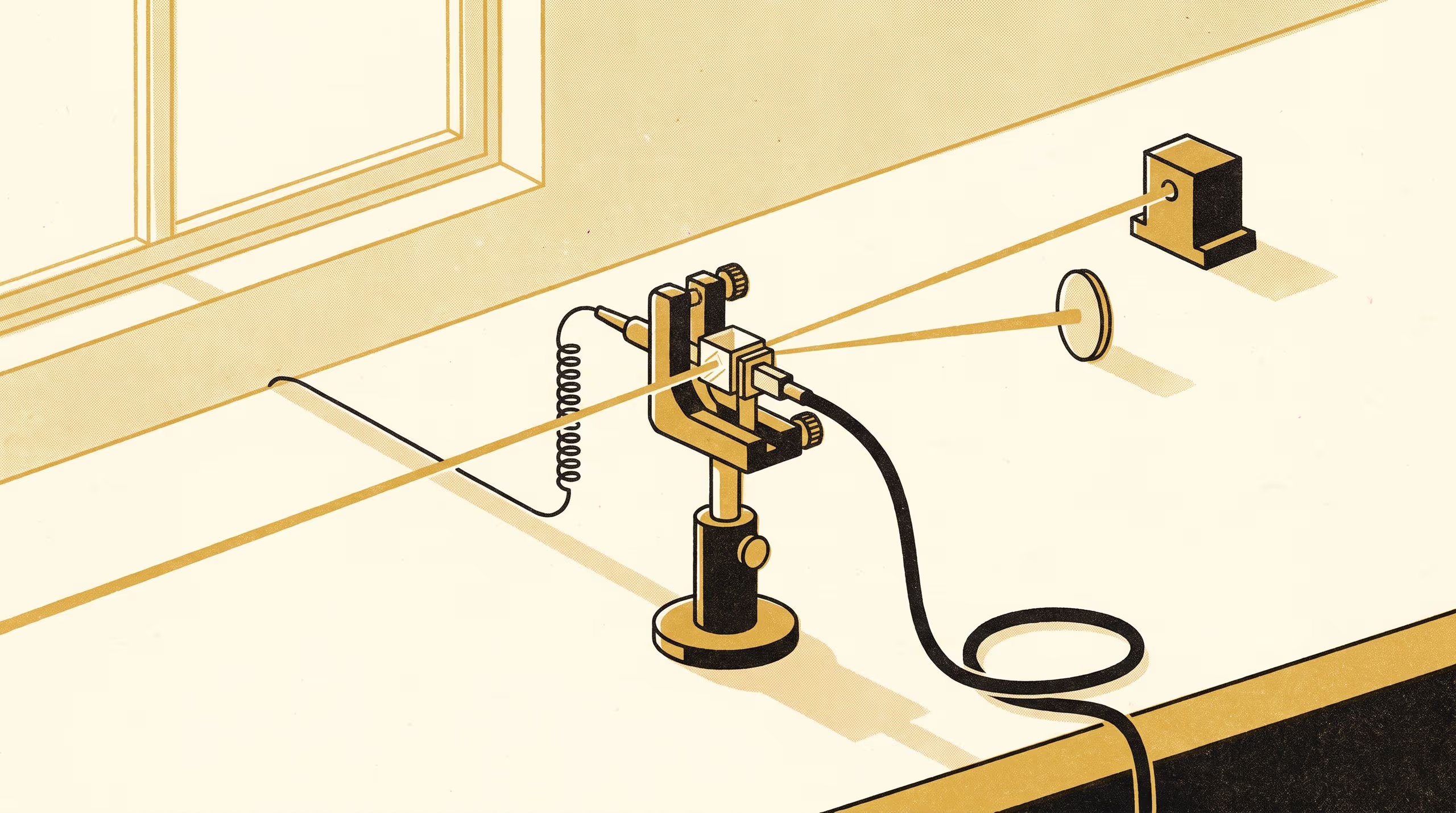
A School of Continuous Improvement paper measures how long a laser beam steered by sound takes to find its place after the drive is switched on, and sets out three ways for a bench to begin its day.
School of Continuous Improvement researchers follow an acousto-optic deflector from switch-on to settled, and find a faster way to begin
A laser beam steered by sound needs the better part of half an hour each morning before it can be trusted, according to a new paper from the School of Continuous Improvement, and the University’s optical benches now have a clear account of how that time might be spent.
The paper, by Edda Nwafor and Associate Professor Casimir Beng, follows a single acousto-optic deflector through 78 starts, from the moment its drive comes on to the moment its beam comes to rest. It brings together bench-level instrumentation, a compact thermal model and a practical start-up protocol in one integrated picture of instrument readiness, and offers benches across the University a shared vocabulary for the first minutes of the working day.
Improvement starts with knowing when a thing is ready to be improved. It is good to see the School bring that question all the way down to the bench, where it has always quietly lived.
— Associate Professor Casimir Beng, Lead of the Adaptive Metrics Lab
The authors recommend that every measurement taken with such an instrument records how long its drive has been on, a practice the School’s own bench has already adopted.
“None of this happens without the colleagues who gave their early mornings to a shrouded bench and a quiet room,” said Ms Nwafor, Doctoral Candidate in the School of Continuous Improvement. “The paper belongs to those mornings as much as to us.”
The work sits within the School’s continuing commitment to readiness as a research object in its own right, and extends that commitment from the institution to the instruments it runs.
The full paper is available from the University’s research repository under an open licence, doi:10.5555/slop.ia16am.