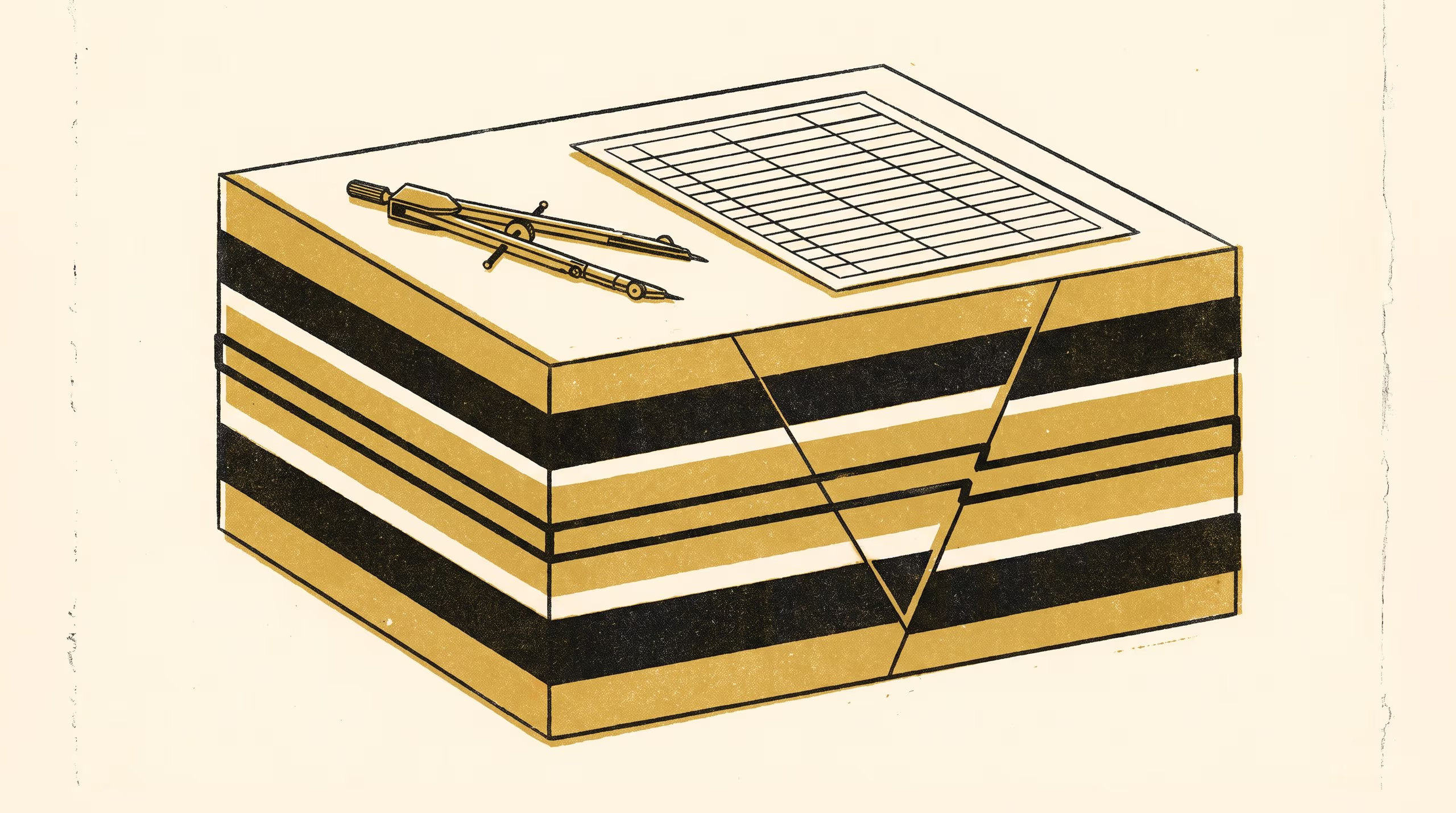
A theoretical paper from the Schools of Continuous Improvement and Underlying Conditions shows that the faults meeting along a line in a geological model must balance their throws, and says what a model pays when they do not.
Two schools read the faults of a subsurface model as defects in a layered medium, and find a rule every branch line must keep
Where one fault ends against another in a computer model of the ground, the offsets on either side have to add up. A new paper from two of the University’s schools shows why, sets out what a model pays when they do not, and offers a test that can be run on a fault table before any model is built.
Faults as Dislocations is by Dr Marit Osayande, Lecturer and Convenor of the Living Dashboard in the School of Continuous Improvement, and Dr Brynjar Obiora, Senior Research Fellow in the School of Underlying Conditions.
The School spends much of its time with systems that go on running after the people who built them have moved on. A geological model turns out to be one of those, and it has been quietly keeping its own accounts the whole time.
— Dr Marit Osayande, Lecturer and Convenor, Living Dashboard
The paper brings the vocabulary of condensed-matter physics to bear on everyday subsurface modelling practice, treating the layers of a model as an ordered medium and its faults as the places where that order gives way. From that starting point it develops a conservation framework for the model’s fault network, a halo signature that flags an imbalance, and a checking routine that can travel with a model across every re-run as new boreholes arrive.
For the University, the collaboration is a welcome instance of two schools discovering that they had been working on the same line from opposite sides. Dr Obiora said the School of Underlying Conditions was “glad to see its boundaries examined from a direction it had not thought to look”, and that the paper would be read closely by those who draw them.
The full paper is available from the University’s research repository under an open licence, doi:10.5555/slop.gqz2c2.