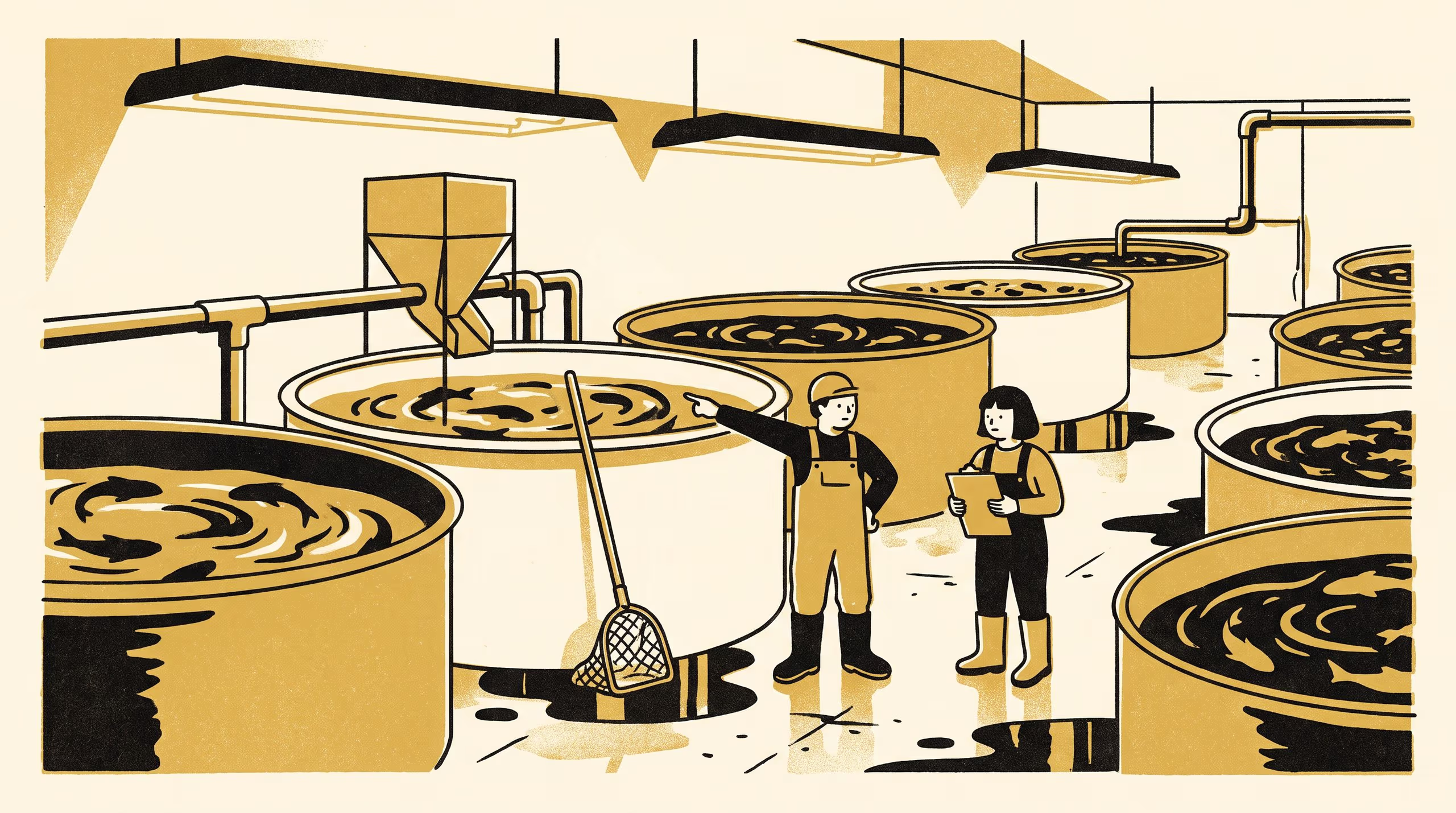
A new paper records ninety-six shift handovers at an inland fish hatchery and finds that the workers' vocabulary marks whether a sign was seen or inferred, until the report is relayed a second time.
A paper from the School of Underlying Conditions finds that how a technician knows about a tank is the first thing lost when the report is passed on
At one inland fish hatchery, “off feed” and “didn’t take it” are not the same report. The first, a new paper finds, is said of feed left in the sump; the second of fish watched turning food away. Passed from one shift to the next, and then on again, both tend to arrive as the same plain sentence.
“They’re Off Feed” is by Dr Vigdis Emenike, Senior Lecturer in the School of Underlying Conditions, and Dr Iben Chikere, Lecturer in the School of Emergent Priorities.
We went to the hatchery to listen to other people handing things over, and came back having learned rather a lot about how our own School does it.
— Dr Vigdis Emenike, Senior Lecturer, School of Underlying Conditions
Working across twelve weeks of recorded handovers, the paper brings interactional linguistics, workplace ethnography and the study of evidential systems into conversation with the everyday practice of stock care. Its account of a working vocabulary that does some of the work a grammar might, and of the point at which that work lapses, positions the School’s long-standing interest in what a single reading is asked to say within a broader conversation about language at work.
Dr Chikere welcomed the questions the study leaves open. “Anyone who has started a shift on someone else’s word will recognise something here,” she said, “and I hope a few of them will ask us about it.”
The paper takes its place among the University’s steadily widening contributions to the study of talk in the workplace, and to the conditions beneath it.
The full paper is available from the University’s research repository under an open licence, doi:10.5555/slop.i8u9df.