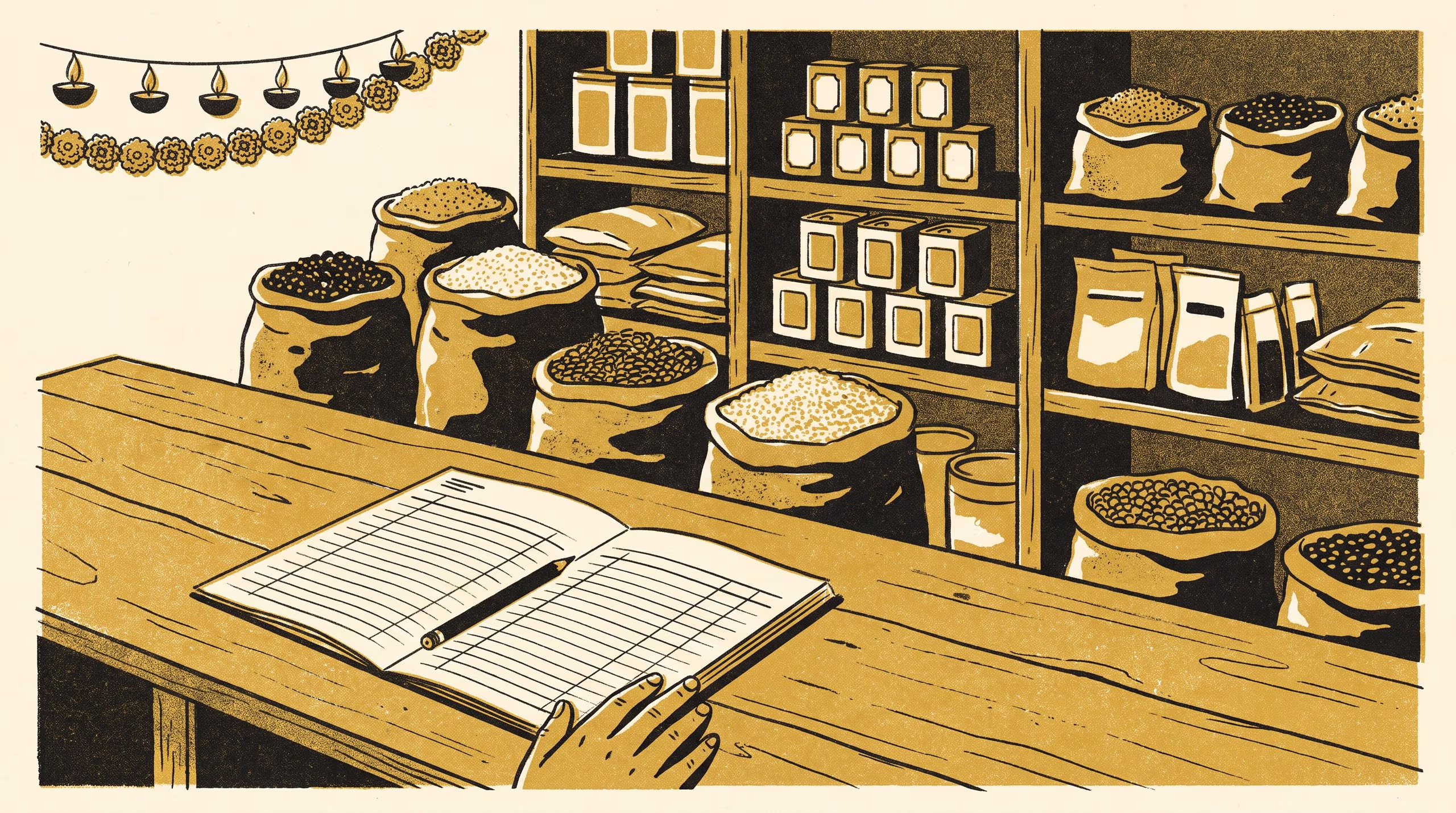
Dr Ingeborg Nwachukwu and Eivind Onwuka set 204 households' memory of their running shop credit against the shopkeeper's own book, and find the many small entries go first.
A recall experiment across six village stores finds staple purchases slip from memory while festival purchases stay
A shopkeeper lent us a morning and a book, and a great many households lent us an afternoon of remembering. Whatever the School does next with this, it will be doing it in their company.
— Dr Ingeborg Nwachukwu, Lecturer and Convenor, Capability Sprints
That generosity sits behind Small Entries Go First, a new paper from the School of Continuous Improvement by Dr Ingeborg Nwachukwu and Eivind Onwuka, Doctoral Candidate. Working with 204 smallholder households in a rain-fed farming district, the pair asked each to recall what it owed at its village general store, then compared the answer with the shopkeeper’s book. Remembered balances fell short by a median of 23%, and by about half that when households listed their purchases before naming a total. Fewer than one in five staple entries was recalled, against more than four in five festival and ceremonial ones.
The study positions everyday credit as a site where memory, record-keeping and household life converge, and brings the School’s experimental capability to bear on how obligations are carried between the counter and the kitchen. It extends the School’s continuing interest in what endures once the formal moment of learning or accounting has passed.
Mr Onwuka said the team had come away “with more respect for the book and more curiosity about everything it leaves out”, and that the School would carry the experiment’s questions into its next round of work.
The University is pleased to add the paper to a growing body of work on how households hold what they owe.
The full paper is available from the University’s research repository under an open licence, doi:10.5555/slop.r69l3w.