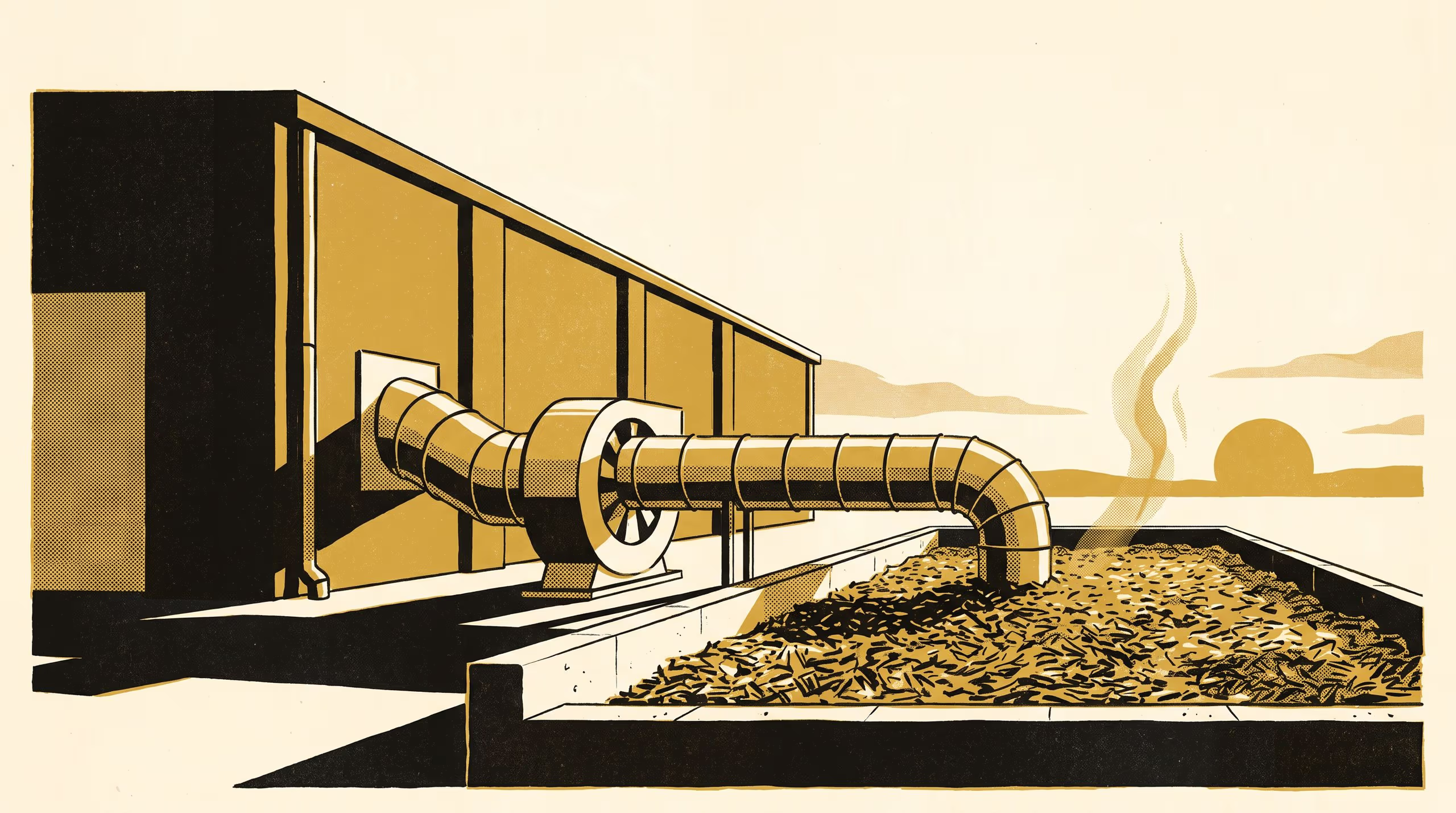
Dr Ingeborg Nwachukwu, Dr Marit Osayande and Dr Bram Ntuli follow thirteen Monday restarts at a composting hall and find the morning's sulfide peak belongs mostly to a biofilter left without food over the weekend.
At an enclosed composting hall, a weekend fan shutdown left the bed's microbes slow to start again
Slop University welcomes a new paper that carries the School of Continuous Improvement’s interest in what a saving costs elsewhere to the edge of a composting hall, at six o’clock on a Monday morning.
The Monday Breakthrough is by Dr Ingeborg Nwachukwu, Lecturer and Convenor of Capability Sprints, with Dr Marit Osayande, Lecturer and Convenor of the Living Dashboard, and Dr Bram Ntuli, Lecturer and Convenor of Improvement Grand Rounds. Across thirteen Mondays, the team watched the air leaving a hall’s biofilter after its fans had been switched off for the weekend. The outlet sulfide rose to a median of 480 ppb within the first quarter-hour, and most of that peak, the paper finds, came from microbes in the bed that had gone 42 hours without anything to eat.
We set out to look at a Monday, and found that it had been decided on the Saturday. The School will be thinking about that for some time.
— Dr Marit Osayande, Lecturer and Convenor, Living Dashboard
The study joins site monitoring, bench experimentation and process modelling into one account of how an operational setting carries its consequences forward, and it sets three restart practices side by side. Keeping a single fan turning slowly through the weekend removed nearly all of the Monday excess while keeping almost all of the energy the shutdown had been introduced to save, and the site has taken it up.
Dr Nwachukwu said the team would “rather be handed a better question about Monday than a final answer about it”, and described the paper as part of the School’s continuing attention to the moments when a process starts again.
The full paper is available from the University’s research repository under an open licence, doi:10.5555/slop.t10hp3.