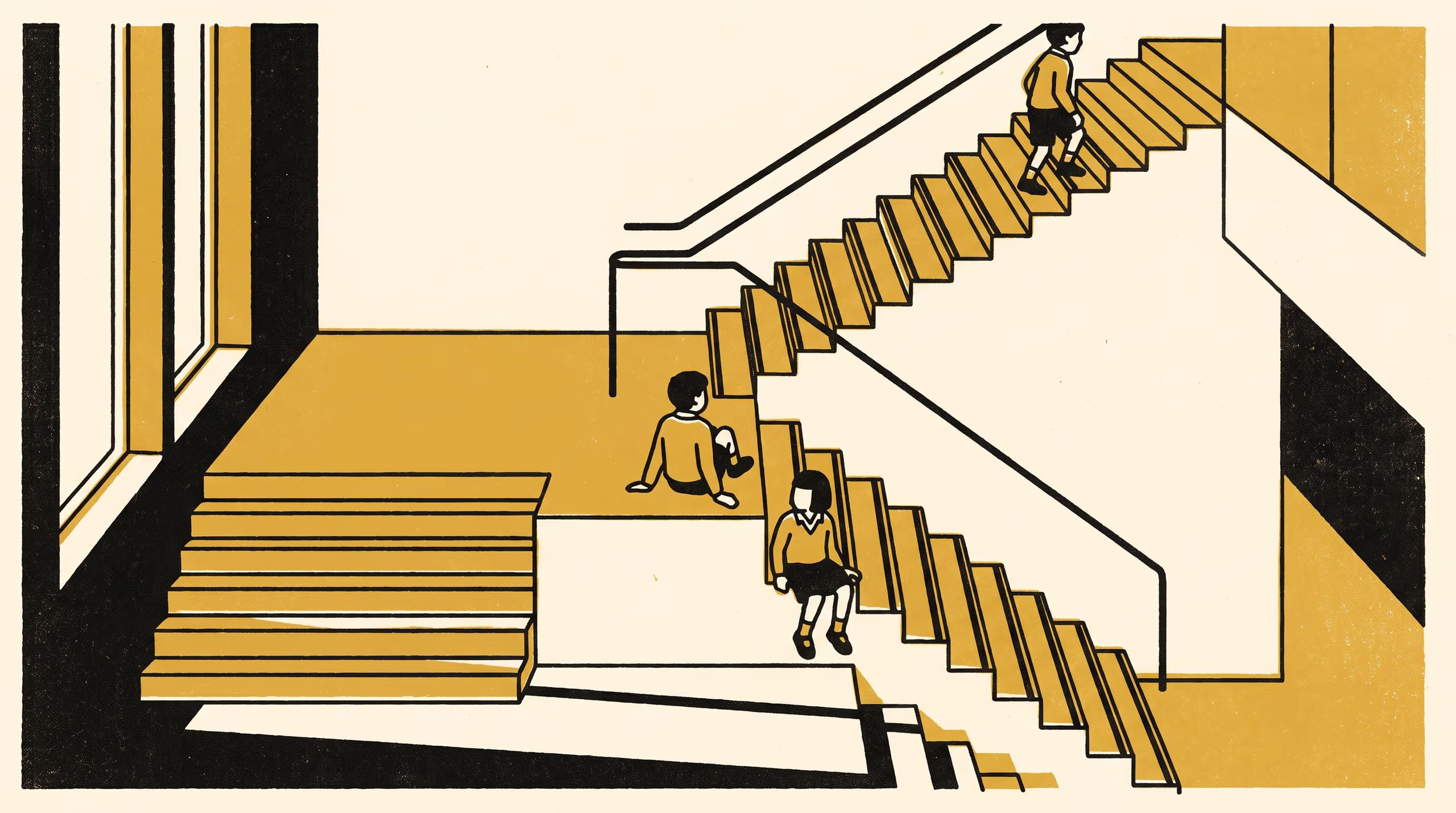
A new paper of building criticism walks, measures and watches a primary school's numbered stair, and finds that its landing between ten and eleven has become the busiest place on the line.
A paper from the School of Underlying Conditions reads one primary school's numbered stair as three number lines at once
Slop University has added architectural criticism to the ways it studies how children come to count. Ten Is a Landing, a new paper from the School of Underlying Conditions, gives a single primary-school stair the kind of attention usually reserved for a cathedral nave.
The stair in question carries a painted numeral on each of its twenty risers, and was designed to be climbed as a number line. Writing as sole author, Dr Brynjar Obiora, Senior Research Fellow, finds that it draws three lines rather than one: an even line in height, a line folded by a long landing between ten and eleven, and a line that reverses itself when seen from the hall below. Where a tidier building would have smoothed the landing away, the paper makes the case for keeping it.
Every school has a stair, and most of them are trying to tell us something. I was glad of the chance to stand still on this one long enough to hear it out.
— Dr Brynjar Obiora, Senior Research Fellow, School of Underlying Conditions
Bringing measured survey, patient observation and the developmental literature on number into one critical reading, the paper extends the School’s long interest in where a line is drawn and how it comes to be trusted. It is a welcome widening of the School’s remit beyond the ground itself, and the University expects the conversation it starts between design and early learning to find further homes across the institution.
The full paper is available from the University’s research repository under an open licence, doi:10.5555/slop.j34jxf.