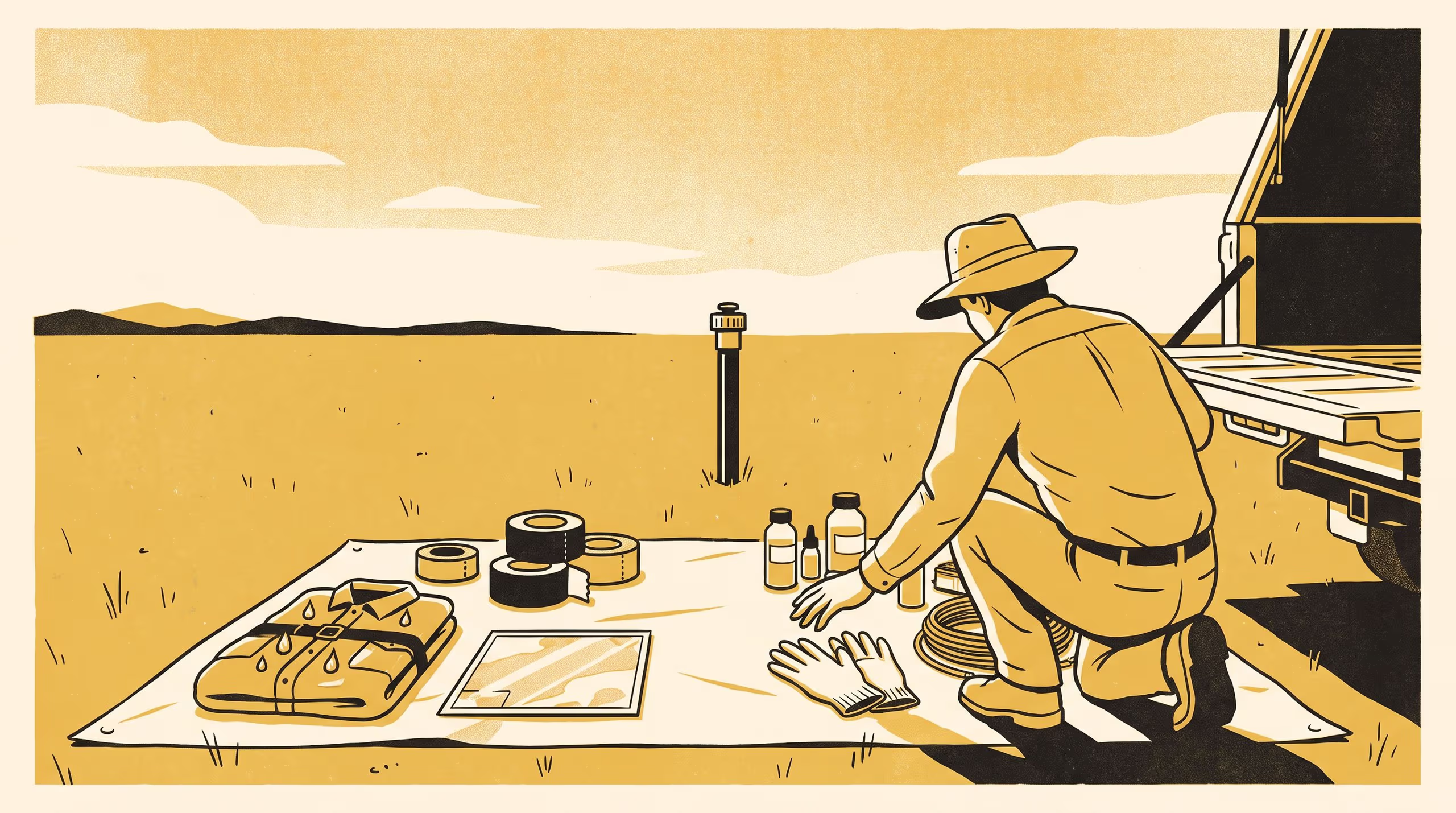
A new research poster from the School of Underlying Conditions sets one groundwater sampling crew's own sense of which kit counts as fluoro beside the written protocol it works to, and finds the two lists only partly agree.
A research poster on how groundwater technicians decide, by touch and look, which field kit counts as fluoro
Groundwater fieldwork has always kept customs alongside its procedures, and the School of Underlying Conditions now counts those customs among the things it studies.
Dr Vigdis Emenike, Senior Lecturer in the School, has joined Dr Anneke Tolan, Senior Research Fellow and Deputy Convenor of Futures in Committee, and Halvard Nnamani, Doctoral Candidate, both of the School of Emergent Priorities, to author If It Beads, It Stays in the Ute, a research poster on how one sampling crew decides which of its kit belongs at a bore on an organofluorine round.
For ten years I took two lists to the bore, one printed and one I never wrote down. It turns out the School has been carrying the second one too, and it is good to see it given a page at last.
— Dr Vigdis Emenike, Senior Lecturer, School of Underlying Conditions
Across fourteen months alongside an eleven-person crew, the team brought participant observation, free listing and pile sorting into a single account of classification in the field, setting the crew’s shared sense of what counts as “fluoro” beside the protocol it works to. The practised list and the written one turn out to overlap only in part.
The poster carries the School’s long attention to bores, and to the people who tend them, into a register the University has seldom asked its earth scientists to write in. Dr Tolan welcomed the questions it leaves open for other crews and other protocols. “Every tailgate has a curriculum of its own,” she said. “There is a good deal more of it still to read.”
The full poster is available from the University’s research repository under an open licence, doi:10.5555/slop.jo46d5.