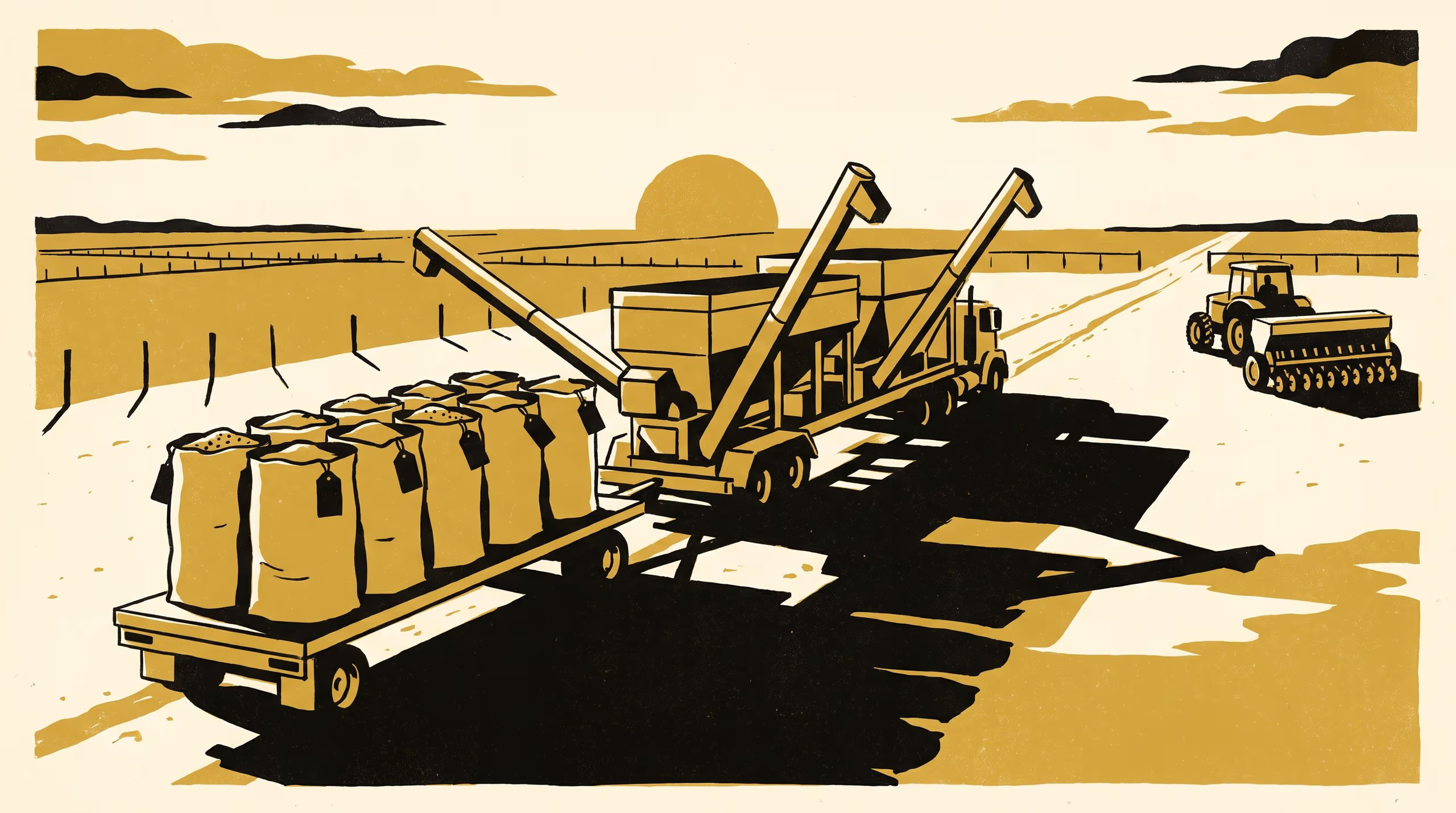
A new paper from the School of Underlying Conditions and the School of Emergent Priorities studies how one cropping district came to settle failed nodulation by the time written on a seed bag's tag.
A new paper asks who answers for inoculated pulse seed between the contractor's rig and the seeder
A time written in marker pen on a seed bag has become the deciding document in one cropping district’s disputes over failed pulse crops, and a new paper sets out how it got there. Whose Hours Are These? is by Dr Brynjar Obiora, Senior Research Fellow in the School of Underlying Conditions, with Dr Anneke Tolan, Senior Research Fellow and Deputy Convenor of Futures in Committee in the School of Emergent Priorities.
I have dug a great many pits to find out what happened underground. This time the more useful digging was in the yard, in the few hours before anything went into the ground at all.
— Dr Brynjar Obiora, Senior Research Fellow, School of Underlying Conditions
Two sowing seasons in the yards, sheds and cabs of a pulse-growing district allow the authors to situate a small handwritten practice within the wider scholarship on coordination, handover and shared responsibility across organisational boundaries. The paper traces how the tag moved from a contractor’s courtesy to a grower’s deadline, and how the goodwill that once settled most complaints came to occupy the cases the tag could not reach.
For Dr Tolan, the study is one the School of Emergent Priorities will carry into its own work on how plans are made. “We spend a good deal of time on documents that set out who does what,” she said. “It is salutary to meet one that fits on a luggage tag.”
The paper marks a further step in the University’s growing attention to the working arrangements of rural industry, and to the patient fieldwork they reward.
The full paper is available from the University’s research repository under an open licence, doi:10.5555/slop.a95oq9.