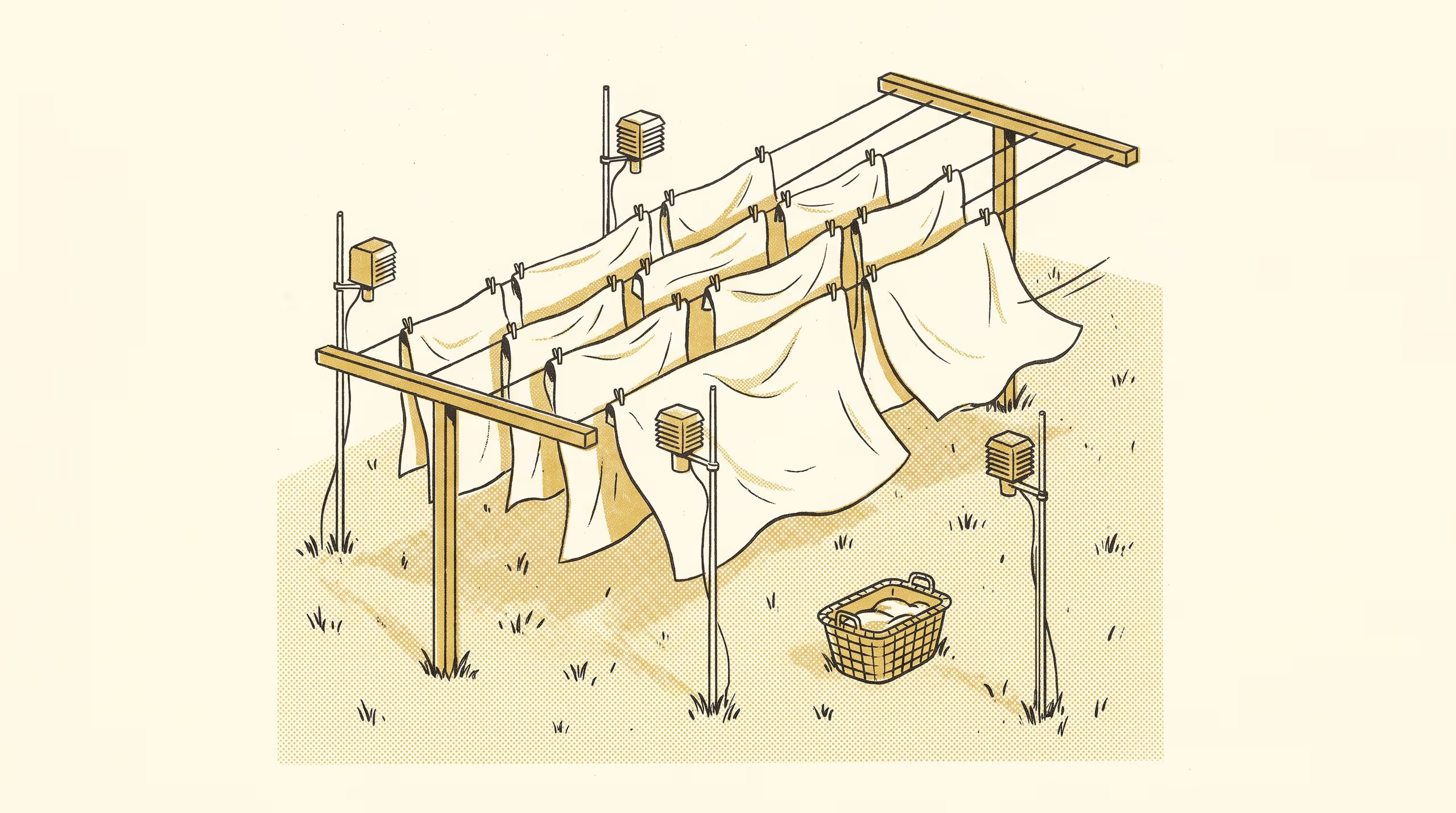
A new paper from the School of Emergent Priorities brings the instruments of chemical engineering to a four-wire backyard clothes line and finds that where a sheet hangs decides how soon it dries.
A new paper treats a loaded backyard clothes line as a humidifier and finds each wire dries in air the one before it has wetted
Where a sheet hangs on a backyard line has a measured bearing on when it comes in dry, according to The Last Sheet, a new paper by Ylva Ogunbanjo, Doctoral Candidate, and Dr Runa Adegoke, Senior Lecturer and Convenor of the Strategic Drift Survey, both of the School of Emergent Priorities.
My thesis spent two years asking when households peg out. It never got round to asking what the washing on one wire does to the washing on the next, and once the question was on the line it would not come down.
— Ylva Ogunbanjo, Doctoral Candidate, School of Emergent Priorities
The paper reads a loaded clothes line the way an engineer reads a cooling tower. Across 41 instrumented drying mornings in two suburban gardens, it marries continuous field measurement with established thermodynamic models of humid air, and arrives at a unified account of how the air, the fabric and the order of hanging shape one another. In calm weather, it finds, the last wire dries at about a third of the pace of the first.
Dr Adegoke described the result as “the kind of finding a School is glad to keep on file: it alters nothing we had planned, and quietly improves all of it.”
The University welcomes the paper as further evidence that the most ordinary fixture on a suburban block still repays a patient instrument and an open mind.
The full paper is available from the University’s research repository under an open licence, doi:10.5555/slop.8zu2c8.