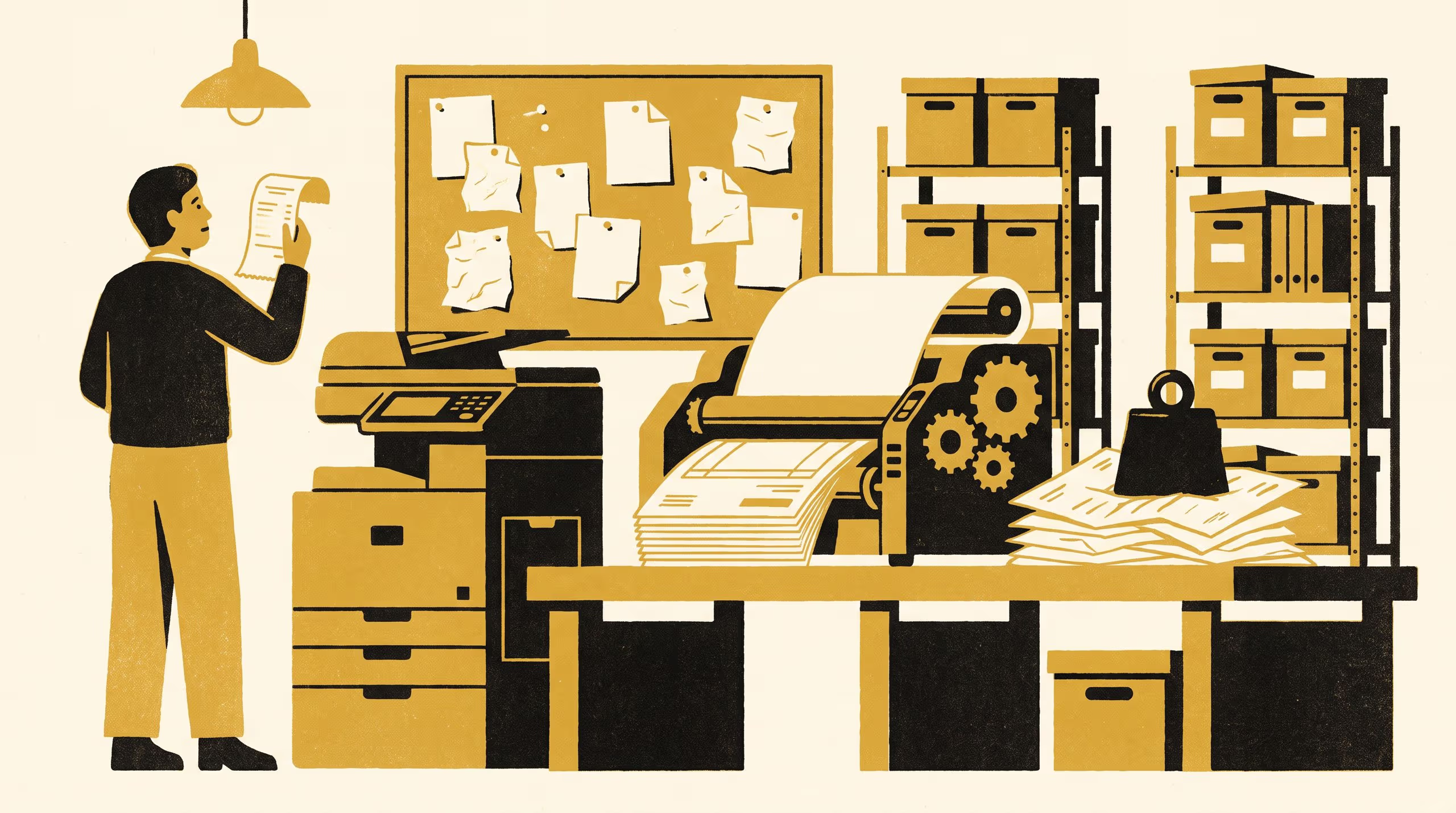
A new research poster from the School of Continuous Improvement spends 31 weeks in one accounts-payable scanning room and finds its clerks sorting, flattening and re-keying invoices by how the capture software will read them.
A research poster on how accounts-payable clerks learn to see paperwork the way their capture software does
Improvement, the School of Continuous Improvement likes to say, is mostly done by hand. Its newest research poster takes that conviction into a room where the hands are easy to miss: the scanning room of an accounts-payable team, where paper invoices become data.
Flat Enough to Read is authored by Edda Nwafor, Doctoral Candidate, and Dr Thandiwe Solberg, Senior Lecturer and Convenor of Demo Quarter, both of the School, with Dr Anneke Tolan, Senior Research Fellow and Deputy Convenor of Futures in Committee in the School of Emergent Priorities.
There is a question I now put to every piece of paper that crosses my desk, which is whether it will read. I suspect the University will find itself asking it too, and I can think of worse questions for an institution to carry around.
— Edda Nwafor, Doctoral Candidate, School of Continuous Improvement
The study sits with nine clerks across thirty-one weeks of shifts at the feeder, following 2,214 documents from mail tray to posted invoice and situating the room’s everyday handling of creased dockets, faded receipts and stubborn handwriting within the School’s wider agenda for human-centred process capability. What emerges is a portrait of a team that has learned to look at its paperwork through the software’s eyes, and of the patient, largely unseen care that keeps an automated system running as one.
“Demo Quarter has always been interested in what happens before the lights come up,” said Dr Solberg. “It is a pleasure to see that interest carried a little further down the corridor, to the bench beside the scanner.”
The University regards the poster as a fine example of the close, unhurried attention its schools bring to the ordinary machinery of working life.
The full poster is available from the University’s research repository under an open licence, doi:10.5555/slop.w5jhuc.