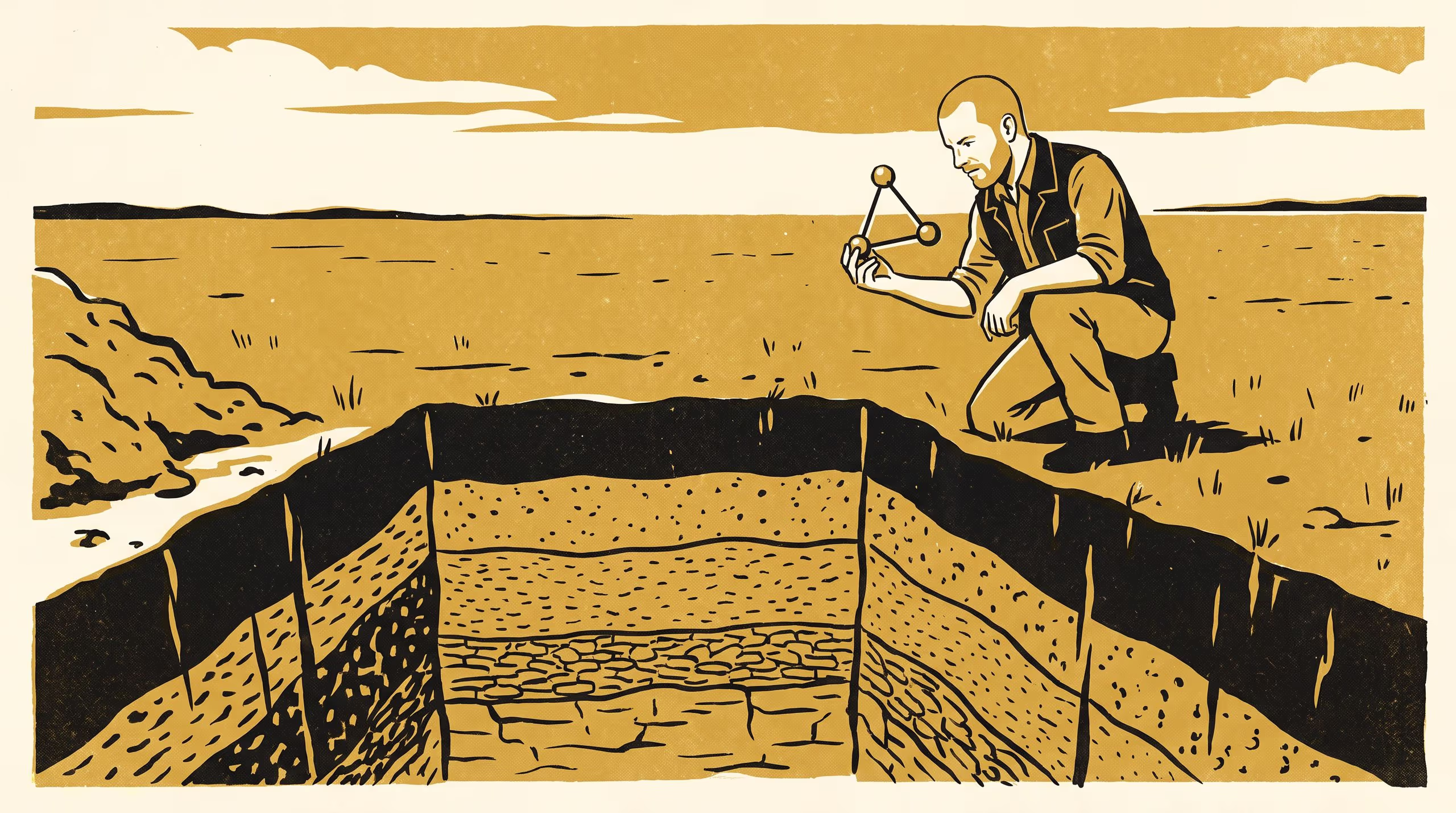
A new portrait advertisement for the School of Underlying Conditions features soil surveyor Dr Brynjar Obiora, and invites the public to meet the researchers who read strain wherever it is held.
Dr Brynjar Obiora fronts a portrait advertisement for the School of Underlying Conditions, holding a chemist's ring model up against the wall of a soil pit
This season’s campaign on the University’s signage panels has a single face, and he is standing waist-deep in a soil pit.
Find the Bond That Gives First features Dr Brynjar Obiora, Senior Research Fellow in the School of Underlying Conditions, who leads the School’s soil survey. In the illustration he holds a small ball-and-stick model of a three-membered carbon ring at eye level and weighs it against the banded wall of the pit beside him.
The advertisement carries the School’s interest in strain out of the laboratory and the core shed and into the public realm, setting the language of chemical mechanism beside the field practice of profile description and positioning the University’s earth sciences as a meeting point for adjacent capabilities. Its small print directs readers to work the University has already published: the School’s showcase The Long Shift, on strain, fatigue and recovery; Sealed in Good Faith, which describes an inherited collection of air-sensitive samples through the glass as a soil profile is described; and Forty-One Copies of One Curve, from a natural-products pharmacology laboratory.
If someone waiting for a bus wonders what a chemist’s model is doing in a soil pit, we would like them to come and ask. It is the question the School puts to itself most days.
— Dr Brynjar Obiora, Senior Research Fellow, School of Underlying Conditions
The campaign joins the University’s portrait rotation in matched daylight and after-dark renderings, and is a further expression of the confidence the University places in letting its researchers speak for the whole.
The full advertisement is available from the University’s research repository under an open licence, doi:10.5555/slop.1b293k.