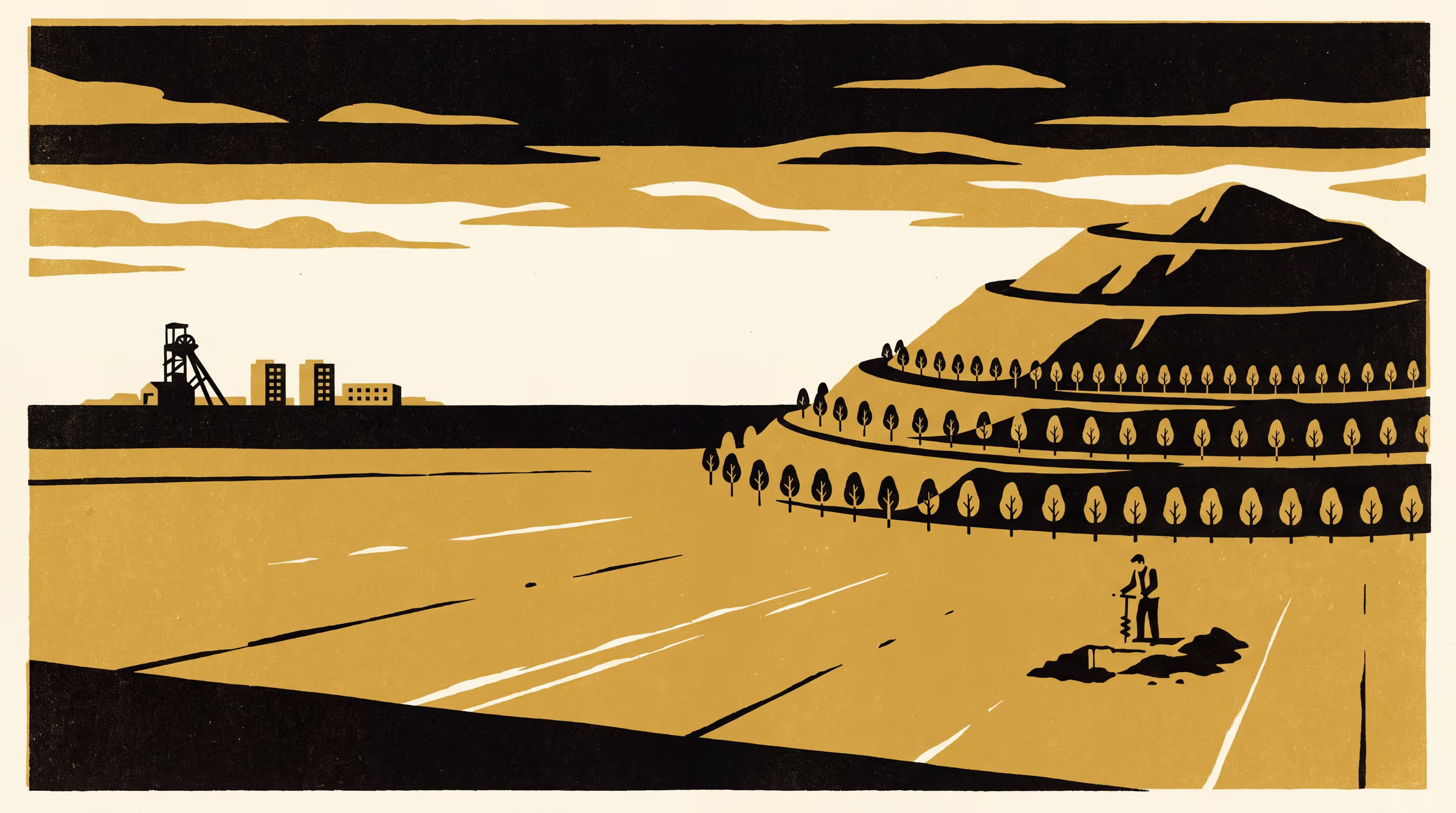
A Slop University campaign opens registrations of interest for a Futures in Committee public session this semester, with Dr Brynjar Obiora on spoil heaps and the plans a coal region makes after its seams close.
A new campaign invites the public to hear a soil surveyor on what a Polish coal region can build on the ground its mines leave behind
A terraced heap of mine waste, its lower slopes planted with rows of young birches, is the newest image on the University’s campus screens and bus-stop panels. The Coal Is Gone. The Ground Stays. is a campaign for a public session of Futures in Committee, the seminar series of the School of Emergent Priorities, at which Dr Brynjar Obiora, Senior Research Fellow in the School of Underlying Conditions, will speak this semester on a Polish coal region and the land its mines hand on to whatever comes next.
The session brings the School’s survey practice (the pit, the auger, the patient description of what lies beneath) into conversation with the long-horizon questions of regional transition, asking how a region’s development settings come to be anchored by the ground it inherits rather than the ground it might have chosen.
A region decides what it will be over a great many years, and most of those decisions are made standing on ground that nobody picked. I would like this evening to be one small part of that long conversation, and I hope a few people who have never stood on a heap will come and stand on one with us.
— Dr Brynjar Obiora, Senior Research Fellow, School of Underlying Conditions
The campaign extends the University’s conviction that a seminar series belongs as much to the bus shelter as to the committee room, and that the questions a region asks of its future are best heard where people are already waiting. Registrations of interest are open through the University’s website, with details to follow.
The campaign poster is available from the University’s research repository under an open licence, doi:10.5555/slop.wv29pe.