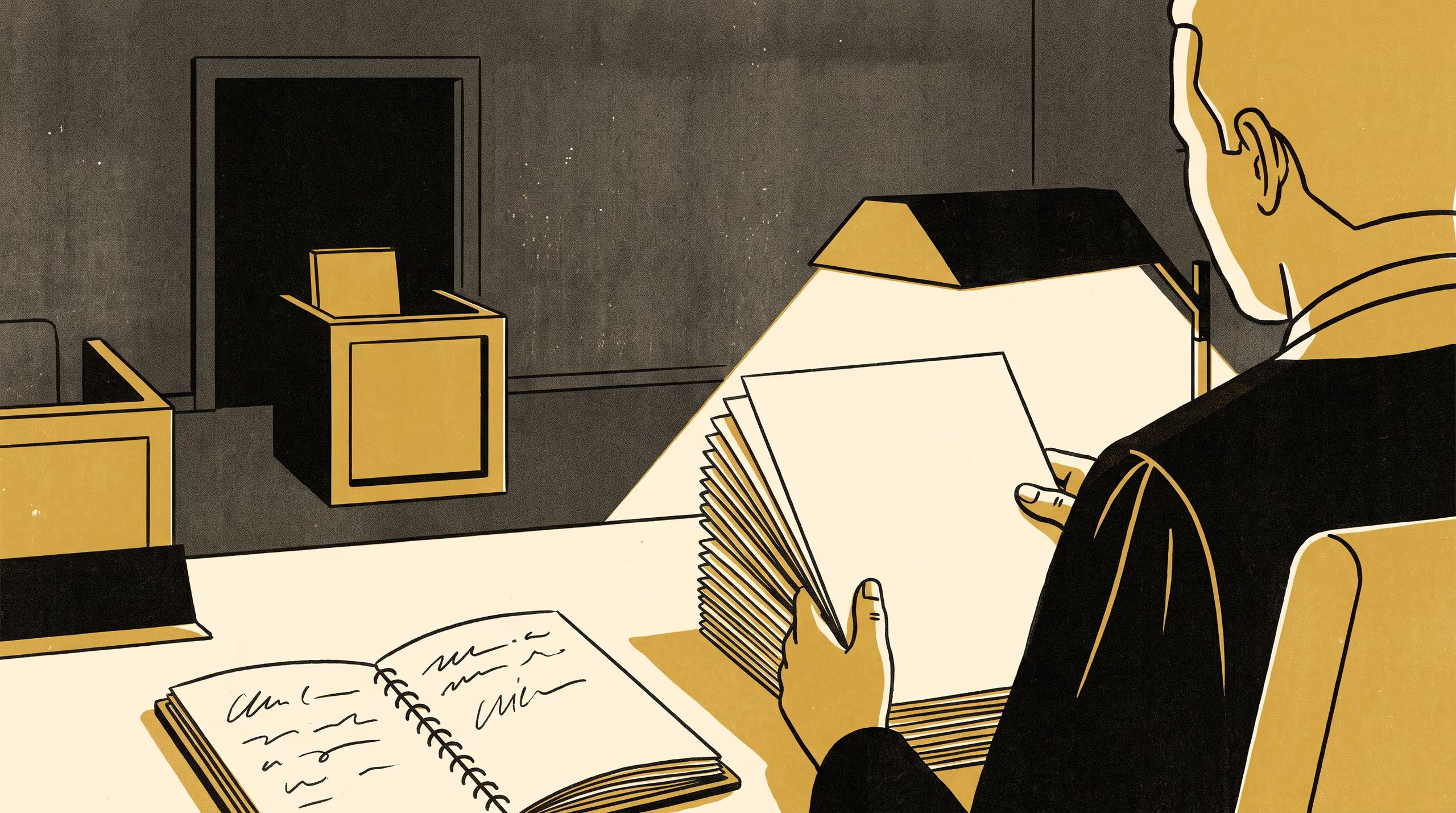
A new research poster from the School of Emergent Priorities follows how civil judgments decided on the transcript handle the courtroom impressions of the judge who heard the case.
A research poster on credibility findings written by a judge who never saw the witness
We owe a great deal to the registry staff who kept the notebooks, and to every judge who has had to pick up a case where a colleague set it down. This poster is, in its way, a thank-you to all of them.
— Dr Iben Chikere, Lecturer, School of Emergent Priorities
With those words, the School of Emergent Priorities introduces Demeanour at Second Hand, a new research poster by Dr Iben Chikere, Lecturer, with Dr Brynjar Obiora, Senior Research Fellow in the School of Underlying Conditions, and Mr Halvard Nnamani, Doctoral Candidate. It asks what becomes of a court’s sense of a witness when the judge who formed it is no longer the one who writes the judgment.
The team set 214 civil judgments delivered by a successor judge beside 214 by judges who heard the evidence themselves, and read each against the transcript and the bench notebook it inherited. The result is a careful account of how reasoning moves across a change of hands, and of the phrases that make the journey intact.
The poster sits comfortably within the School’s longstanding attention to the moment a role passes from one person to the next, and extends that attention, for the first time, to the bench.
“Every discipline keeps its own version of the notebook someone else filled in,” said Dr Obiora. “It has been a real pleasure to watch the question travel so far from where we first asked it.”
The full poster is available from the University’s research repository under an open licence, doi:10.5555/slop.gm3t5r.