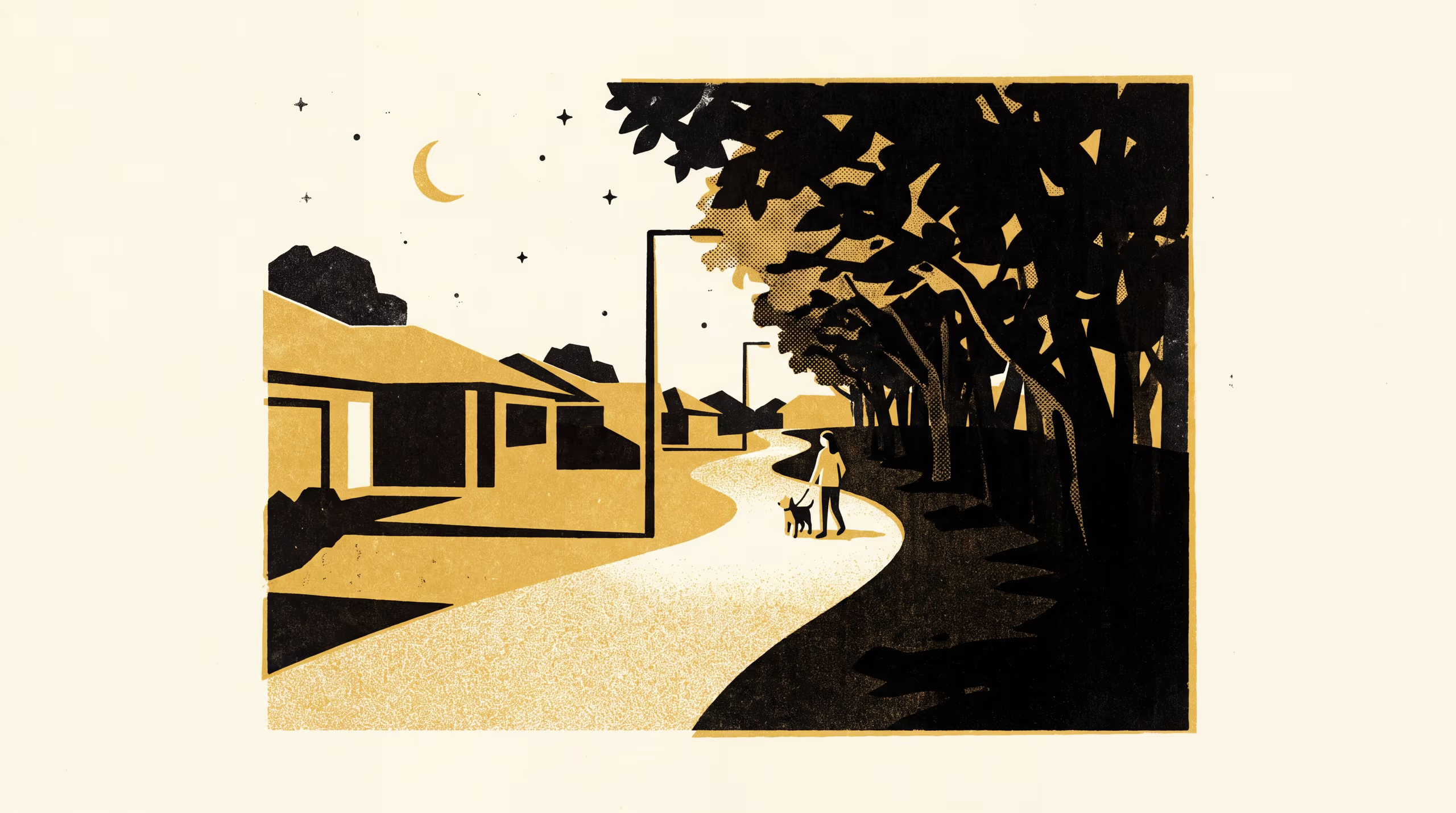
A new research poster led by the School of Underlying Conditions finds that the walkable catchments around a dimmed precinct's local centres contract through the night as its phosphorescent paths fade, and fastest beneath the street-tree canopy its planning scheme encourages.
A precinct's glowing shared paths are followed through the night, and the tree-lined links are found to go dark first
Most of my career has been spent at the daylight end of a plan, where the maps are drawn and agreed. It was a novel pleasure to keep the same plan company until it was very nearly morning.
— Dr Ronja Oyelaran, Senior Lecturer and Deputy Convenor, Strategic Drift Survey, School of Emergent Priorities
Dr Oyelaran is one of three authors of The Catchment After Midnight, a new research poster led by Associate Professor Ragnhild Uzoma, Lead of the Basement Relations Group in the School of Underlying Conditions, with Dr Marit Osayande, Lecturer and Convenor of the Living Dashboard. It follows the shared paths of a suburban precinct that turns its streetlights off after midnight and relies instead on paving that glows, and asks how far a resident can walk on that glow as the night wears on.
Pairing segment-level luminance logging with canopy survey and network catchment modelling, the team brought materials performance, urban forestry and walkability planning together in a single hour-by-hour account of the precinct after dark. Across 212 path segments and 38 spring nights, the walkable catchment around each local centre contracted at every half-hour, and most quickly along the tree-lined links that the precinct’s planning scheme most encourages.
The University regards the poster as a fine instance of its schools keeping late hours on behalf of the places they study.
Dr Osayande said the team welcomed the questions the work would raise among “the people who keep a precinct’s lights on, and the people who decide when they go off, who are not always in the same meeting”.
The full poster is available from the University’s research repository under an open licence, doi:10.5555/slop.43f3tg.