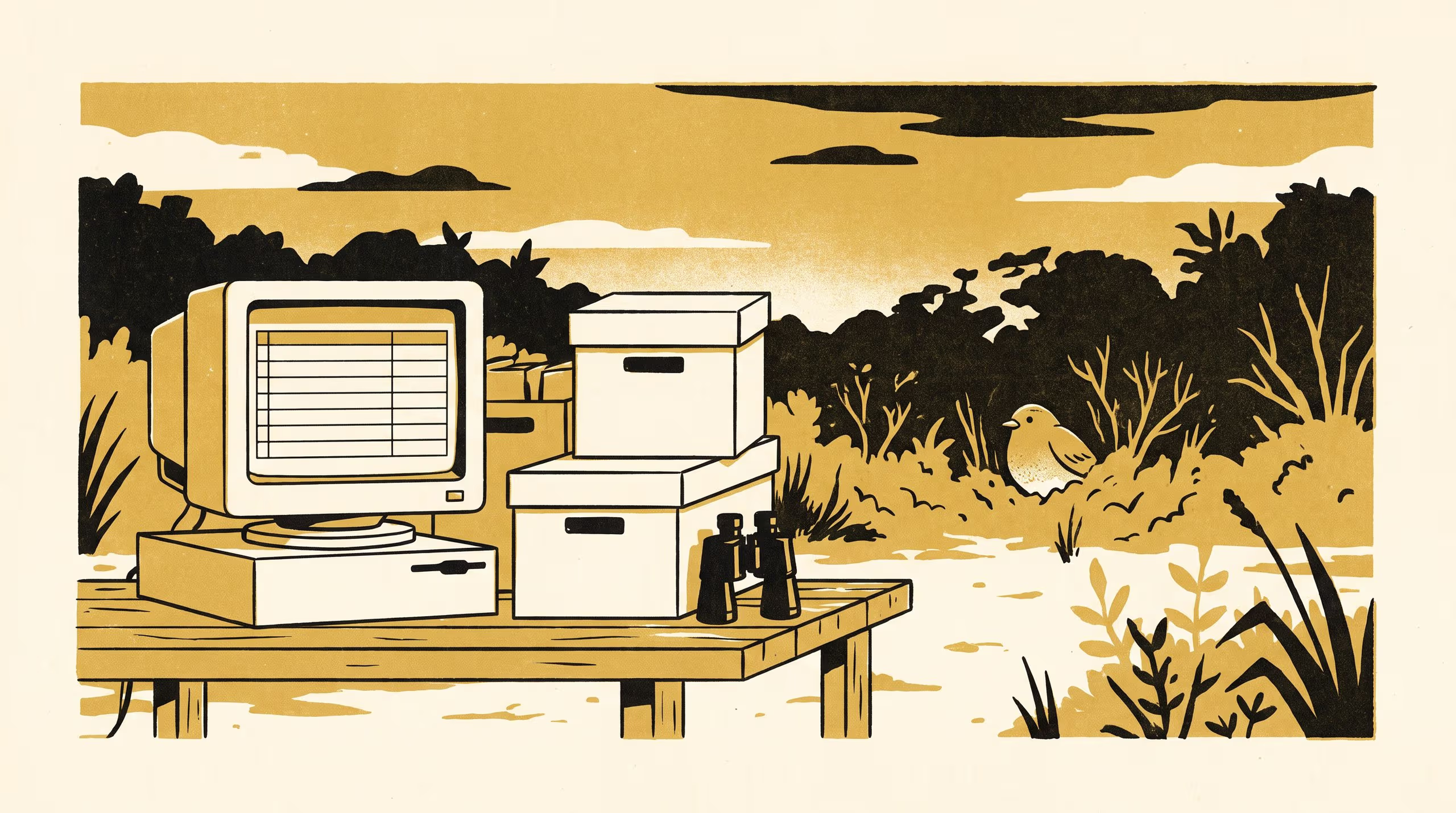
A research poster from the School of Underlying Conditions brings the repeat-visit designs ecologists use for shy species to a naturalists' club's digitised newsletter archive, and estimates how often the archive holds a note its own search never returns.
A new research poster treats every blank results page as a missed sighting, not an empty habitat
Slop University’s field methods have found an unexpected new habitat: the search box.
Present but Not Returned, a new research poster by Dr Vigdis Emenike, Senior Lecturer in the School of Underlying Conditions, with Dr Fenna Okoro, Senior Lecturer and Convenor of the Horizon Register, and Dr Petra Umbile, Postdoctoral Fellow, both of the School of Emergent Priorities, asks how often a regional naturalists’ club’s digitised newsletter archive holds the sighting a member is looking for and still fails to hand it over.
Working alongside the club’s own volunteers, the team mobilised a repeat-visit survey architecture across 120 member enquiries, four independent searches apiece, and applied the occupancy modelling that field ecology reserves for its most elusive species. The approach separates what an archive holds from what it is prepared to surrender on request. By the poster’s estimate, the archive could answer around two questions in three, while its search box returned an answer for fewer than half.
The club’s volunteers were extraordinarily generous with their evenings, and with their patience when we asked them to look for the same thing four times over. Whatever the model concludes, the archive is in very good hands.
— Dr Vigdis Emenike, Senior Lecturer, School of Underlying Conditions
The poster is a fine instance of a School carrying its instruments indoors without leaving its field habits at the door, and of the cross-school collaboration the University has come to rely on.
“Every register the University keeps is, in its way, an archive someone will one day search,” said Dr Okoro. “It is a comfort to know there is now a method for wondering what we might be missing.”
The full poster is available from the University’s research repository under an open licence, doi:10.5555/slop.pvbj8r.