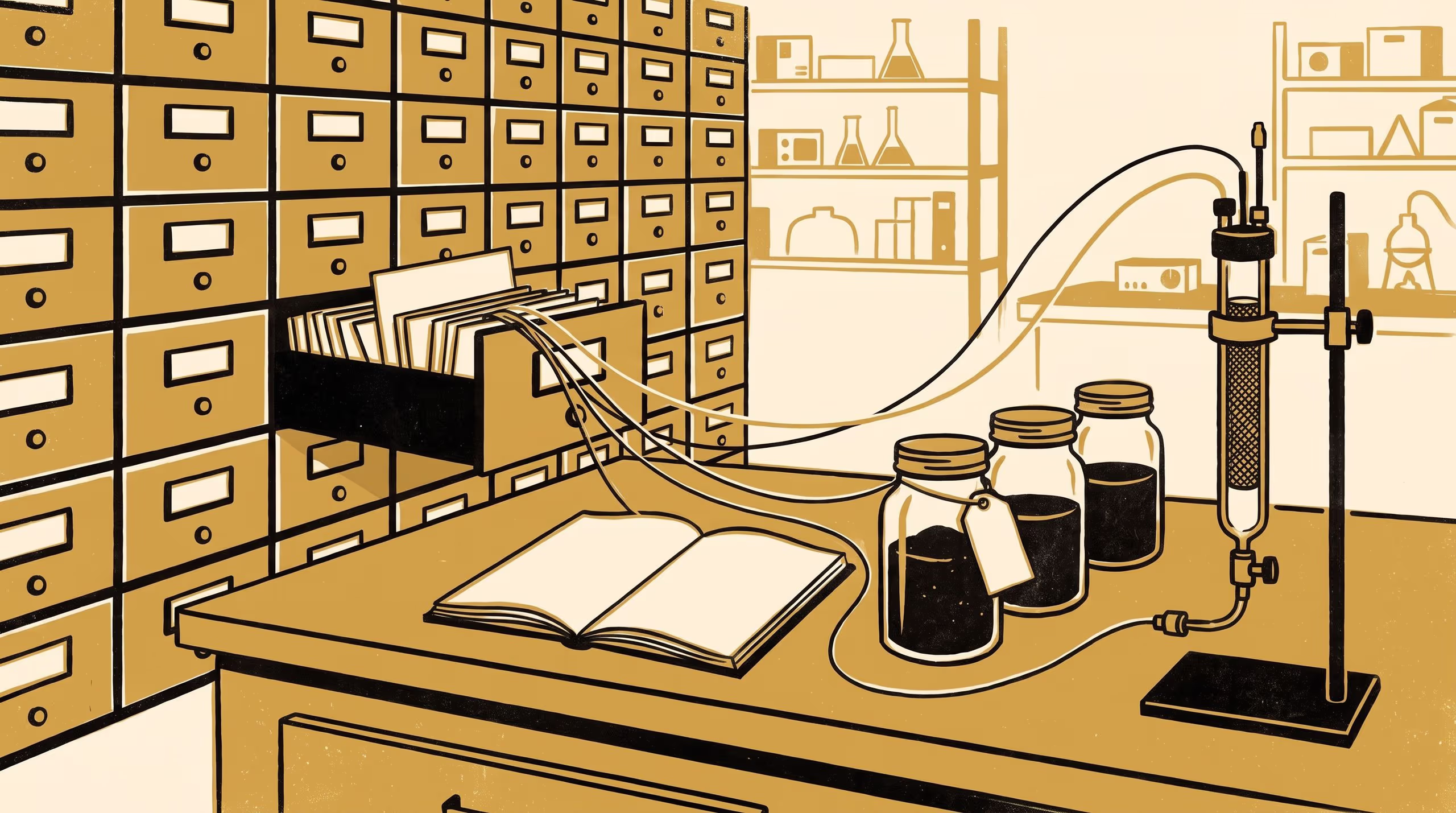
A paper from the School of Emergent Priorities catalogues 731 copper catalysts from the methanol literature with the library's reference model and proposes what a catalyst authority record should hold.
A new paper reads 186 studies of methanol made from carbon dioxide as a cataloguer would, and finds that the batch is what goes unrecorded
Seven hundred and thirty-one catalysts now have library records at the School of Emergent Priorities, and fewer than one in five of them can be traced to the batch of powder it came from. That is the headline finding of Which Catalyst Was It?, a new paper by Sunniva Balogun and Halvard Nnamani, both Doctoral Candidates in the School.
We came to these articles as visitors, with a librarian’s habits and very little chemistry, and the laboratories behind them were patient hosts on every page. If the field has questions for us now about how a batch might be written down, we would be glad to hear them.
— Halvard Nnamani, Doctoral Candidate, School of Emergent Priorities
Working through the published literature on converting carbon dioxide to methanol over copper, the pair adapted the reference model that underpins the modern library catalogue, distinguishing a catalyst’s composition, its preparation, its batch and its reactor charge, and assessed how fully each layer is captured in the record. The resulting framework positions the authority record as a shared point of alignment between the cataloguing tradition and the reproducibility agenda of catalysis science.
The paper takes its place in a widening body of work through which the School lends its instruments to neighbouring disciplines, and the University is pleased to see that hospitality extend as far as the laboratory bench.
Ms Balogun said the project had been “a reminder that a shelf and a fume cupboard are kept by much the same habits, and lose things in much the same places”.
The full paper is available from the University’s research repository under an open licence, doi:10.5555/slop.naffg4.