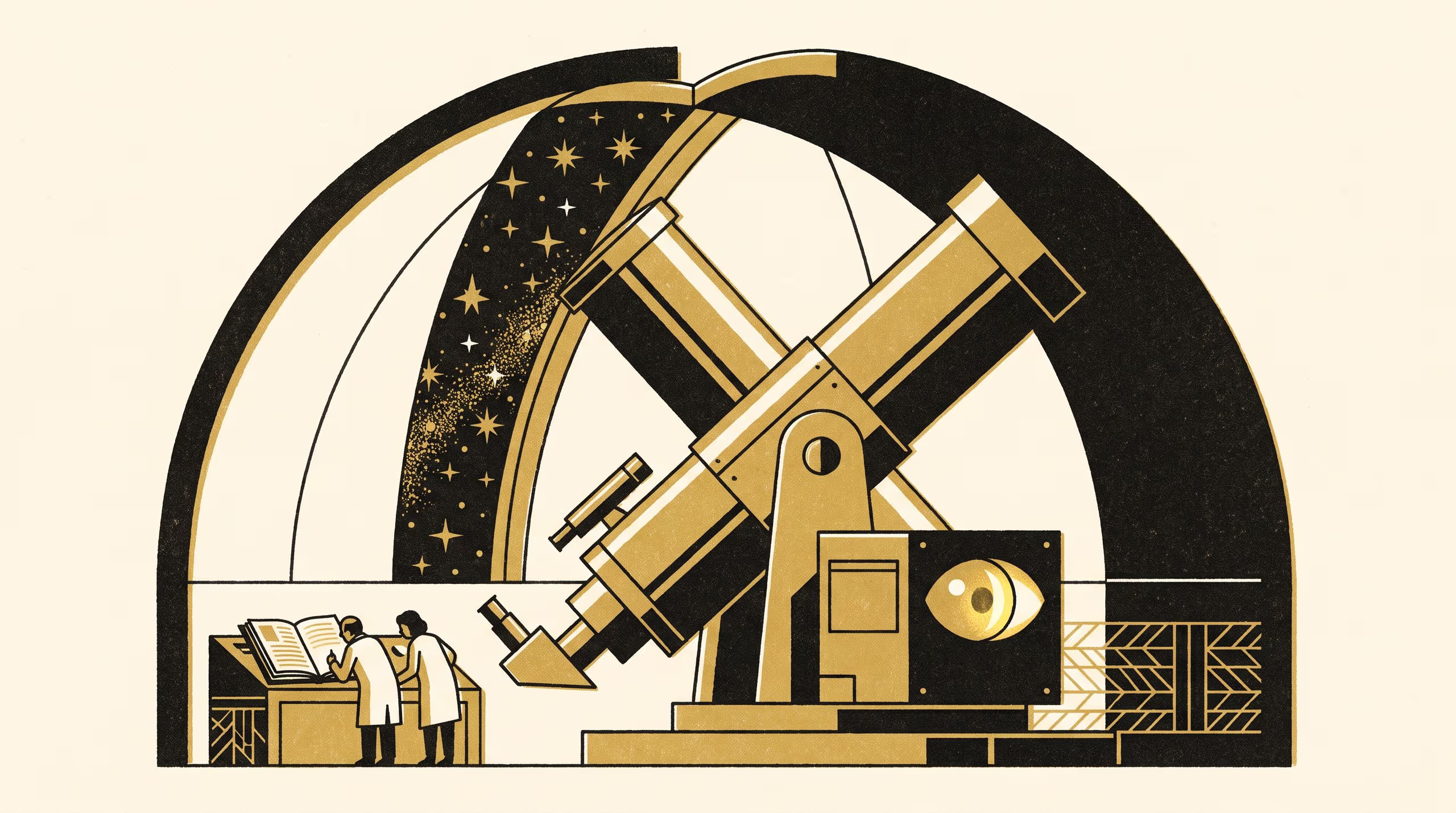
A new research poster from the School of Emergent Priorities reads the verbs of perception in 36 instrument commissioning reports and finds the instrument taking over the seeing between integration and handover.
A close reading of one observatory's commissioning reports follows the verb of seeing from the team to the instrument
When a new instrument arrives at a telescope, who is it that sees? The question sounds like one for astronomers. A new research poster from the School of Emergent Priorities puts it instead to the reports astronomers write.
The Spectrograph Saw is by Hedvig Anyanwu, Doctoral Candidate, with Dr Iben Chikere, Lecturer, and Dr Ingrid Vasseur, Lecturer and Convenor of Futures in Committee. Reading 1,186 clauses from 36 commissioning reports at a single observatory, the team follows the verb of seeing as it passes from the astronomers to the instrument between integration and handover to routine operations. For eight of nine instruments the transfer is complete. In the ninth, a calibration unit, the final report hands the verb back to a person.
I owe a great deal to the people who kept these reports and let us sit with them. Instrument teams write for the next night, not for readers like us, and they were very generous about being read anyway.
— Hedvig Anyanwu, Doctoral Candidate, School of Emergent Priorities
The poster brings the School’s long attention to handover and succession into dialogue with the close-reading traditions of literary study, positioning the commissioning report as a site where custody, attention and instrumentation are negotiated within the grammar itself.
Dr Chikere described the reading as “a reminder that every handover has a grammar, and that it is worth slowing down long enough to hear it.”
The School counts the work among a growing body of scholarship in which technical documents receive the care more usually given to literature.
The full poster is available from the University’s research repository under an open licence, doi:10.5555/slop.5cys9k.