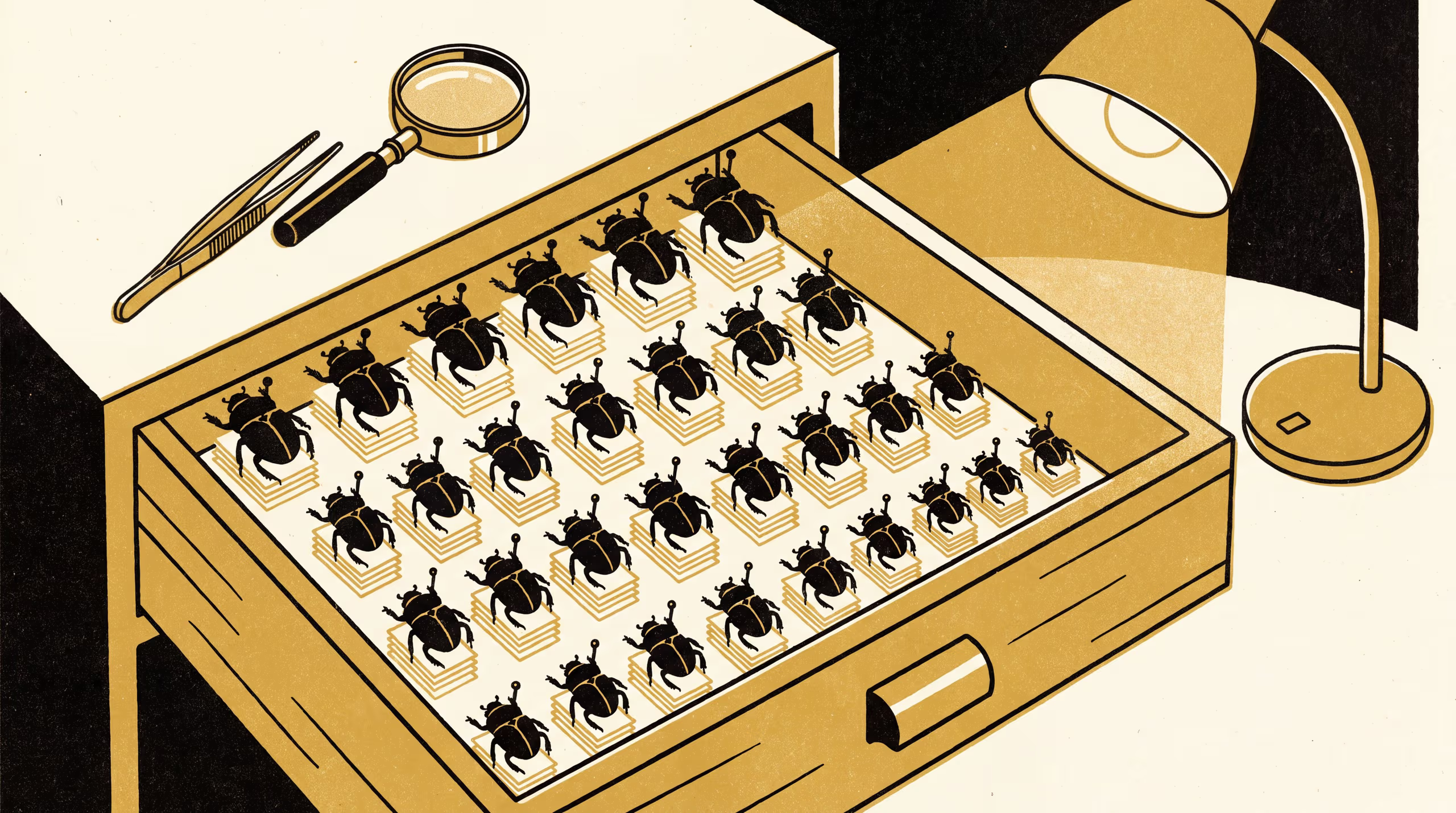
A research poster from the School of Emergent Priorities reads 3,906 specimen labels in one regional dung-beetle collection as a medium, and finds a species' range redrawn whenever a new determination slip is added beneath the beetle.
A research poster on how the paper slips beneath pinned specimens carry a regional scarab collection's ranges
I spent seven seasons typing other people’s details into boxes, so a paper slip the width of a fingernail felt like familiar ground. I am happy to report that the beetles were very patient with us, and that every one of them is back exactly where we found it.
— Halvard Nnamani, Doctoral Candidate, School of Emergent Priorities
Pinned Beneath the Beetle, a research poster released today, takes the School of Emergent Priorities into the collections cabinet. Its authors, Halvard Nnamani and Sunniva Balogun, both Doctoral Candidates, with Professor Verity Marris, Director of the Trajectory Analytics Group, transcribed every label on 1,412 pinned scarab beetles in one regional naturalists’ society’s reference collection, reading each stack of slips from top to bottom as a single small document.
The work situates media and communication scholarship alongside the practice of taxonomy, bringing close attention to format, sequence and address to bear on a record that collectors and determiners have been building together for eight decades. Its central observation concerns the map: a beetle’s place is read from the top of its pin and its name from the bottom, so that a new determination slip can move a record from one species’ range to another without the beetle, or its locality, going anywhere at all.
Professor Marris described the poster as “the start of a longer conversation with the drawers, which we expect to carry on one slip at a time”.
The poster is a welcome addition to the School’s growing interest in the small written forms that institutions depend on and seldom read, and the University is glad to see that interest extend to the insect cabinet.
The full poster is available from the University’s research repository under an open licence, doi:10.5555/slop.nqq2e2.