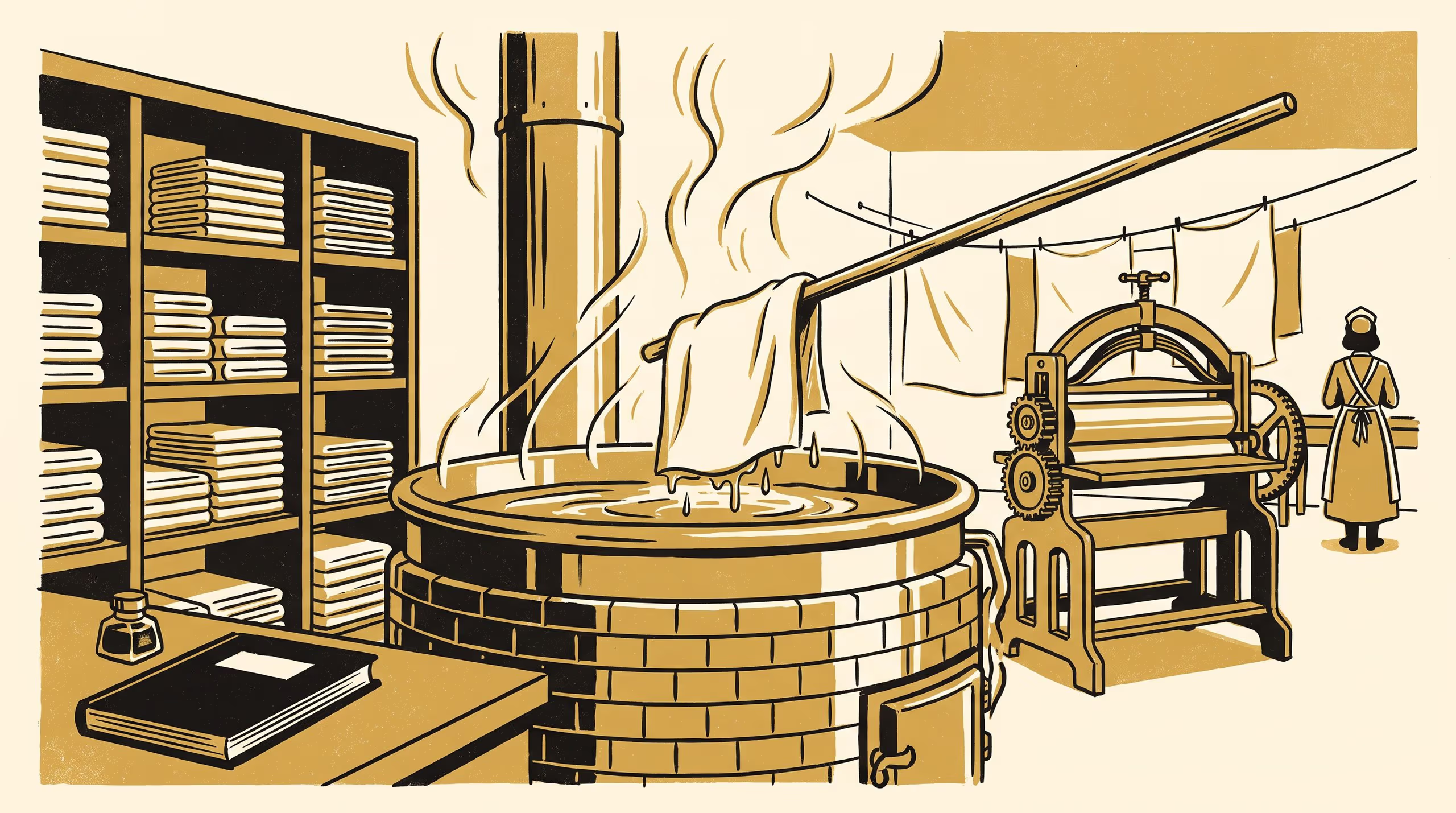
A paper from the School of Emergent Priorities follows four decades of a cottage hospital's linen committee minutes alongside its matron's laundry book, and finds the hospital's hygiene arriving by requests the committee left to lie on the table.
A history of how hygiene reached a small Victorian hospital through the laundry, on requests its committee never resolved
The School of Emergent Priorities studies how organisations come to do things that nobody quite decided. With To Lie on the Table, that agenda now extends into the history of medicine, and back across more than a century.
The paper, by Ylva Onyekwere, Doctoral Candidate, reads the minutes of a ladies’ linen committee at a small provincial cottage hospital between 1871 and 1912 against the weekly laundry book kept by its matron. Of the 412 requests the matron brought to the committee, the largest share were neither granted nor refused but ordered to lie on the table. Most of those practices turned up in the laundry book within the year regardless. By the time the hospital announced its adoption of aseptic methods, its linen had been boiled to a timetable for nineteen years.
I went into the archive expecting to find out who had decided. What I found was a very orderly record of people declining to, and a laundry that carried on beautifully in the meantime.
— Ylva Onyekwere, Doctoral Candidate, School of Emergent Priorities
The study brings together archival close reading, procedural history and the material culture of the hospital ward, positioning the School’s established interest in deliberation within a longer institutional horizon. It sits alongside the School’s continuing work on how proposals harden into practice in settings as varied as committee rooms and group chats.
Dr Runa Adegoke, Senior Lecturer and Convenor of the Strategic Drift Survey, described the paper as “a reminder that the School’s questions are older than the School, and that some of the best answers are kept in someone else’s handwriting.”
The University counts the work among the School’s most considered contributions to date, and a sign of the breadth its doctoral programme continues to reach.
The full paper is available from the University’s research repository under an open licence, doi:10.5555/slop.j12we1.