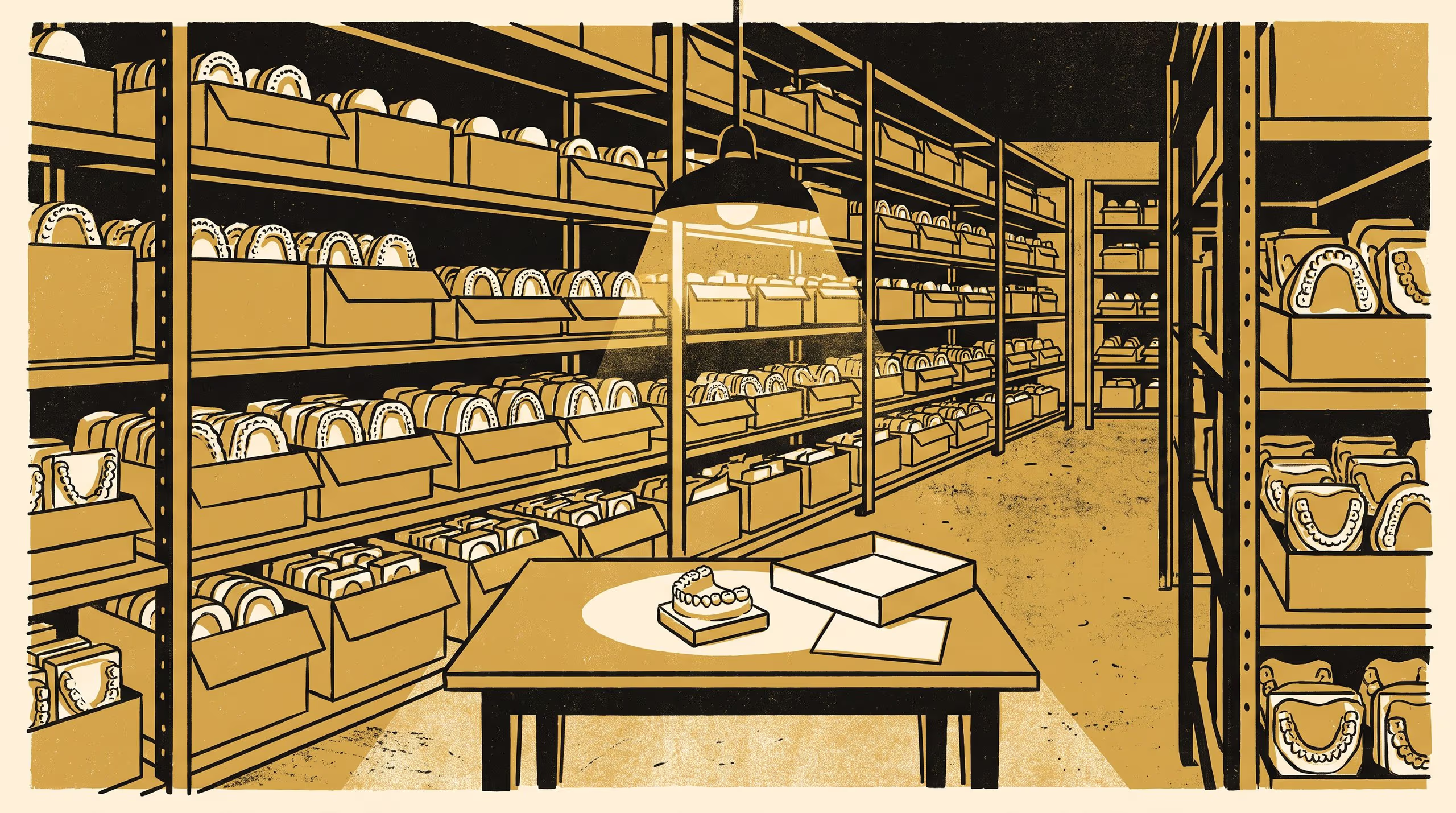
A paper from the School of Underlying Conditions traces how a regional cleft unit's store of plaster dental casts was catalogued three times over fifty years, and finds that the casts once coded for comparison are the ones that survived.
A history of science paper reads half a century of plaster dental casts in a hospital store, kept first as records, then as evidence, then as surplus
Fifty years of shelving, three catalogues and one material that never changed: the University is pleased to add Nothing Happened to the Plaster to a growing body of work on the collections institutions keep, and on what keeping them asks.
The paper, by Associate Professor Ragnhild Uzoma, Lead of the Basement Relations Group in the School of Underlying Conditions, takes the history and philosophy of science into the basement of a regional cleft lip and palate unit. It reads the unit’s impression book, card register and retention spreadsheet against every one of the 4,377 casts on its shelves in 2009, and against the layered marks on their bases.
Questions about what a store is for tend to arrive long after the shelving does. I would be glad to hear from anyone who finds those questions waiting in their own building.
— Associate Professor Ragnhild Uzoma, Lead, Basement Relations Group
Situating stored objects within the evolving purposes of the institutions that hold them, the study positions the cast not as a fixed record but as a scientific object with a career, moving between clinical, comparative and estate-management frameworks. Its sharpest finding concerns survival: almost every cast once coded for an intercentre comparison was retained, including 167 that can no longer be linked to any patient, while fewer than a third of the never-coded series remained after the review.
The work deepens the School’s long-standing attention to the materials an institution holds below ground level, and extends its practice of core-store scholarship into a new kind of collection.
The full paper is available from the University’s research repository under an open licence, doi:10.5555/slop.m9x739.