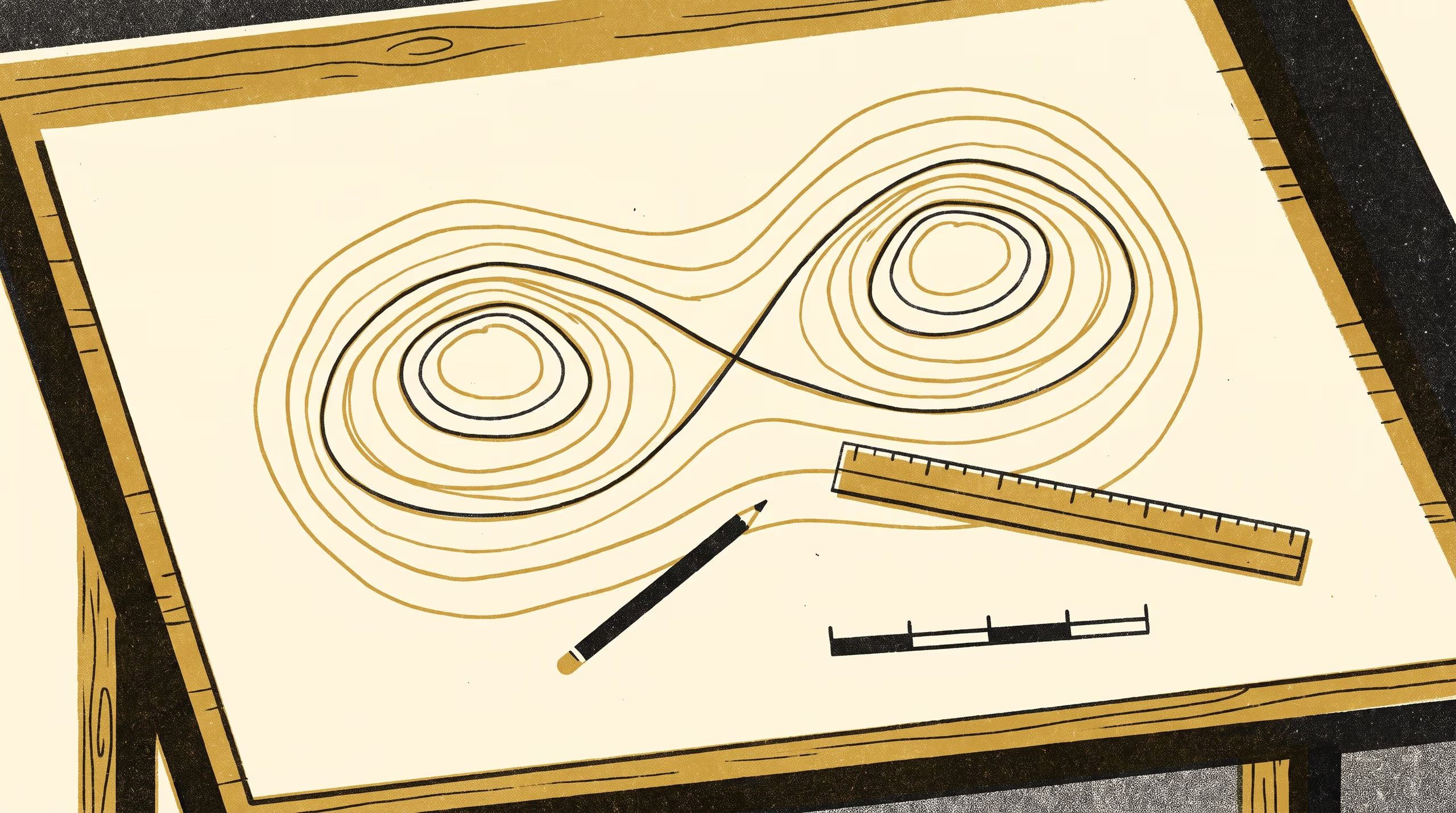
A paper from the School of Underlying Conditions finds that students trained in field mapping read contour diagrams better than their calculus classmates, except at the saddle, where the rule they learned in the field quietly stops holding.
A School of Underlying Conditions paper follows field-mapping students into multivariable calculus and finds the one place their contour rule gives way
Contour lines never cross. It is among the first things a student of field mapping is told, and according to Contours Never Cross, a paper published today by the School of Underlying Conditions, it is true of very nearly every map a student will ever draw.
The paper, by Dr Brynjar Obiora, Senior Research Fellow, follows that rule out of the field and into a second-year calculus classroom. There it meets the saddle, the one shape on which a contour line can cross itself, and the paper reports what the School’s students made of the encounter.
Field mapping teaches you where a line belongs. It has been instructive for the School to see where its students carry that line afterwards, and a little humbling to find they had been carrying it more carefully than we had.
— Dr Brynjar Obiora, Senior Research Fellow, School of Underlying Conditions
Combining a written exercise across a whole calculus cohort with extended conversations with a small group of field-trained students, the work brings the School’s long practice of reading the ground into dialogue with the teaching of mathematics, and offers a modest, practical adjustment to how contour diagrams are introduced.
The paper carries the School’s work into the scholarship of university teaching, and the University receives it as a sign that what its earth scientists know about lines on paper may travel further than the paddock.
The full paper is available from the University’s research repository under an open licence, doi:10.5555/slop.w9n27w.