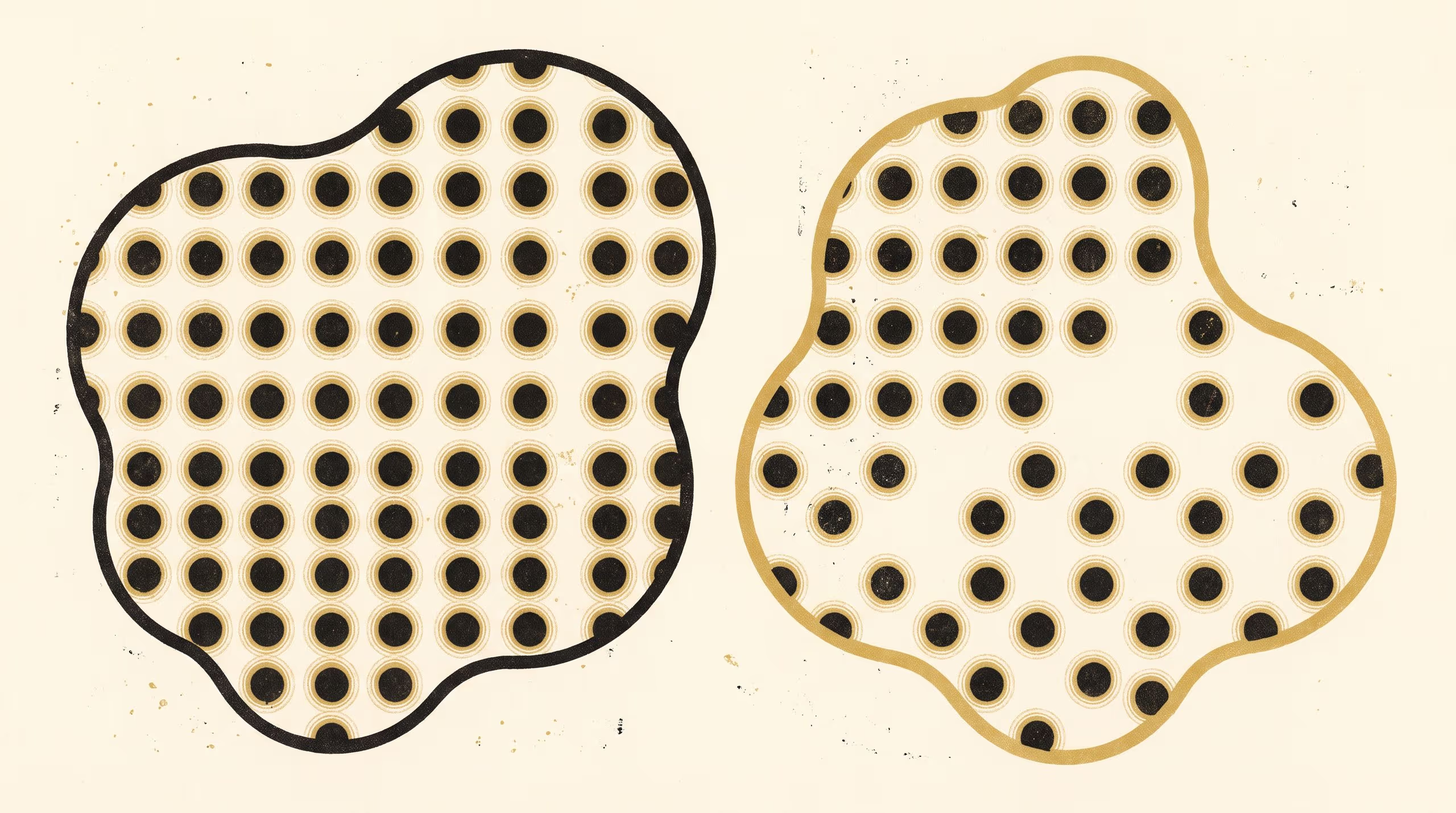
A paper from the Schools of Emergent Priorities and Continuous Improvement treats the placement of high-dose spheres in lattice radiotherapy as a packing problem, and finds that the number placed depends on the grid's starting point as much as on its shape.
Two Schools count the dose spheres that fit inside 240 simulated targets, and find the count depends on where the grid is laid
Every number in the paper arrives with the place it started from attached. The School would like to be asked about that place, often, and by people who know the field far better than we do.
— Ms Ylva Onyekwere, Doctoral Candidate, School of Emergent Priorities
With Where the Lattice Starts, the School of Emergent Priorities and the School of Continuous Improvement extend their shared attention to arrangement, spacing and the choices that sit underneath a plan into the physics of radiotherapy.
The paper takes a technique in which a small number of high-dose spheres are set inside a target, and asks how many will fit and where they should go. Working across 240 simulated targets, the authors compare four ways of placing the spheres and trace how each choice carries through to the dose that gathers between them. Their central observation is that a regular grid can place noticeably more or fewer spheres depending on where it is started, with differences of up to four spheres in the largest targets.
The release of the paper reflects a conviction the University has long held about its younger Schools: that a discipline is best learned by sitting down beside it.
Dr Bram Ntuli, Lecturer and Convenor of Improvement Grand Rounds, said the collaboration had been “a reminder that the most useful thing a plan can carry is a note of where it began”, and that its reporting suggestion would find a natural home in future Grand Rounds discussions.
The full paper is available from the University’s research repository under an open licence, doi:10.5555/slop.k0qp22.