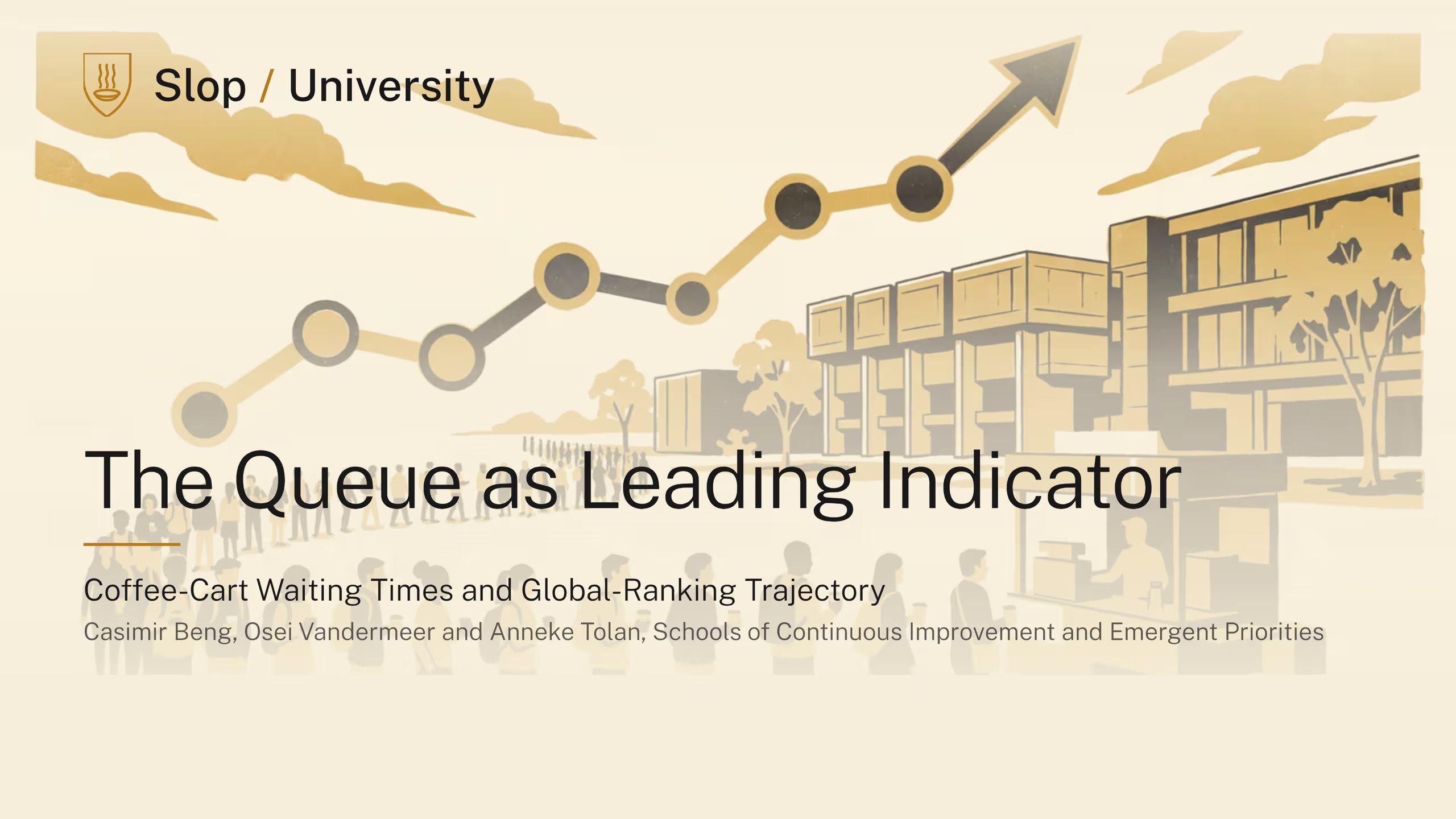
In a short film from the School of Continuous Improvement, Associate Professor Casimir Beng, Dr Osei Vandermeer and Dr Anneke Tolan talk through their two-year study of campus coffee-cart queues and the closed-loop pilot it proposes for grant strategy.
Casimir Beng, Osei Vandermeer and Anneke Tolan explain how the line at nine campus carts kept two quarters ahead of the University's ranking
Nine coffee carts, an overhead depth sensor above each, and a reading every five minutes for two years: that is the instrument behind The Queue as Leading Indicator. In The Queue as Leading Indicator, Explained, a new research explainer from the School of Continuous Improvement, the poster’s three authors talk through what it has to say about the University’s standing in the world.
Our School spends a great deal of time measuring other organisations. It has done us good to stand in line with everyone else for a while.
— Dr Osei Vandermeer, Research Fellow and Convenor, Review Cadence Observatory
The film sets the queue readings beside the University’s monthly ranking and arrives at the poster’s central observation: the queue moved first, by a steady two quarters, so that a peak at the carts was followed two quarters later by a rise in the ranking. Dr Anneke Tolan frames the relationship as correlational rather than causal, and the film notes that only headcounts were ever kept. Dr Vandermeer then sets out the next stage of the work, a closed-loop pilot in which the live queue index would steer a fixed share of discretionary grant strategy, with no manual override, before Associate Professor Casimir Beng closes the film on the poster’s own summary of the lead.
Everyday campus life has long been one of the University’s richest research resources, and the School’s film shows it being put to good use.
The full explainer is available from the University’s research repository under an open licence, doi:10.5555/slop.4ek2jf.