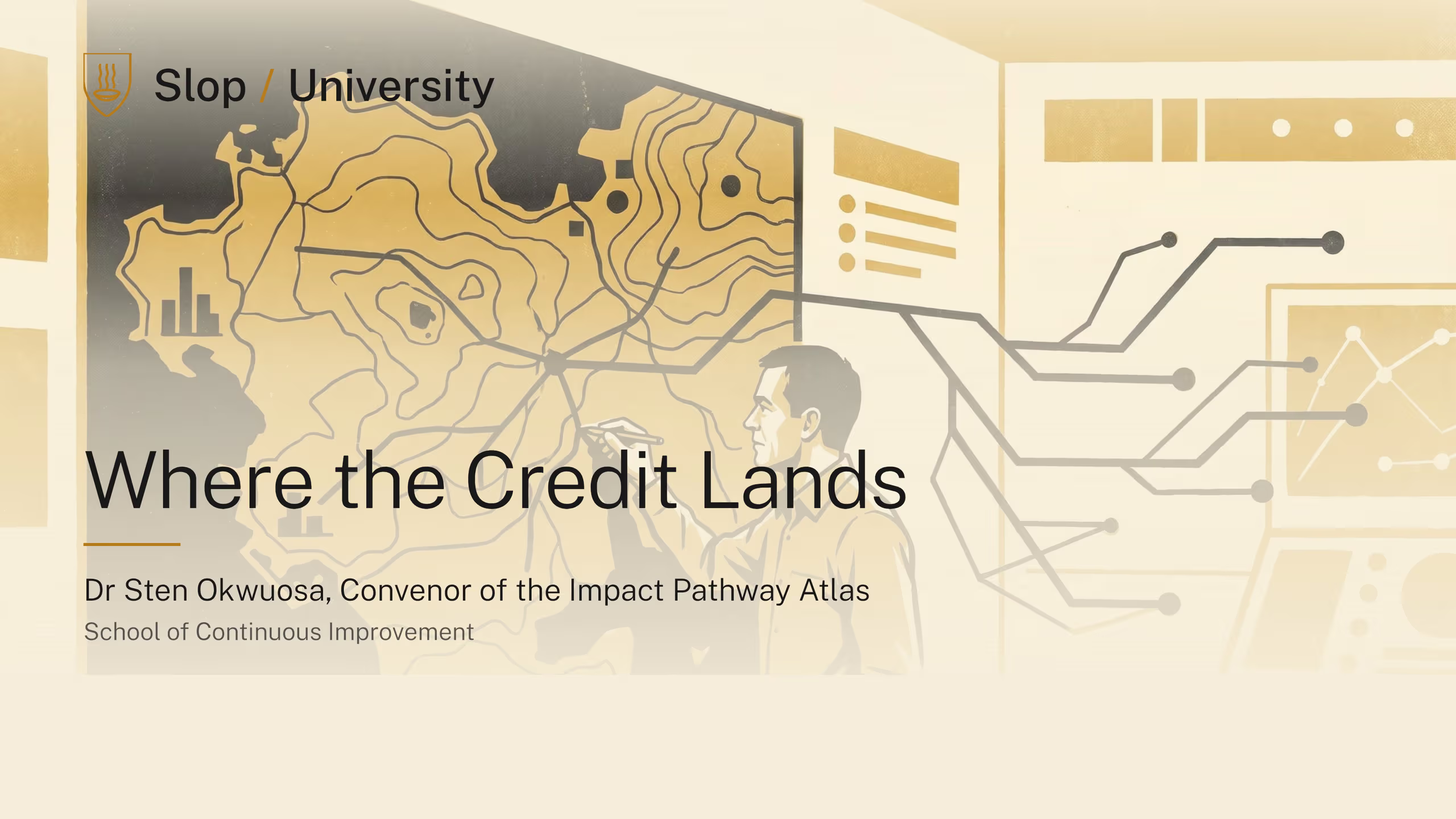
Dr Sten Okwuosa, Senior Research Fellow and Convenor of the Impact Pathway Atlas, explains in a new film from the School of Continuous Improvement how a finding's credit can arrive late, change shape or land on the wrong paper.
The Impact Pathway Atlas convenor talks through the late citation, the recast result and the credit that lands on the wrong paper, in a short film from his School
In July, the Office of Research Outputs singled out a repository deposit filed with every metadata field complete on the first pass, and awarded its depositor $1,864 as the Deposit of the Quarter Prize. That depositor, Dr Sten Okwuosa, now has a film of his own. In Where the Credit Lands, from the School of Continuous Improvement, the Convenor of the Impact Pathway Atlas describes in his own voice the life a finding leads after it is published.
Anyone who would like to know where their own work has gone is welcome to ask. Most people are pleasantly surprised.
— Dr Sten Okwuosa, Senior Research Fellow and Convenor, Impact Pathway Atlas
A bibliometrician by training, Dr Okwuosa walks through three of the pathways the Atlas records: the citation that arrives late, the narrative CV that recasts an old result for a new panel, and the recognition that lands on different work from the one that earned it. Each marks a point where counted impact and the effort behind it part company, the ground the Atlas exists to survey. The film is just as clear about his own standing, with 890 citations and an h-index of 24 to his name. Among his most-cited papers are a taxonomy of farmers-market stallholder no-shows and a field audit of hydration-station activations. His closing thought is that impact starts not with the citation but with the metadata.
The School takes heart from its own scholar of misplaced credit, whose credit, carefully filed, has stayed where it was earned.
The full video is available from the University’s research repository under an open licence, doi:10.5555/slop.wxdp1l.