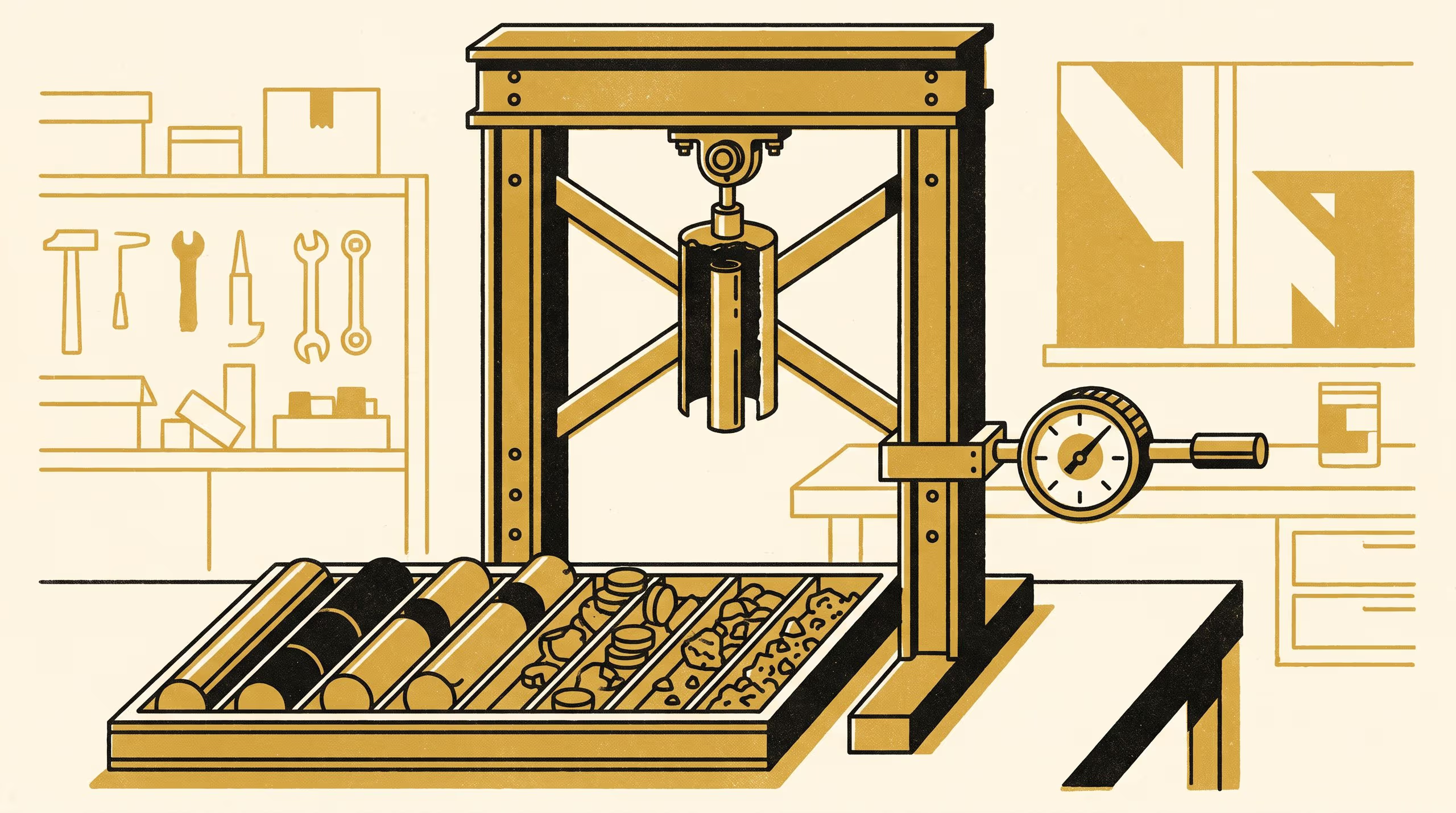
A new paper from the School of Underlying Conditions finds that in broken ground the small swivel at the head of a core barrel's inner tube goes a long way towards deciding how much of a borehole comes back.
A bench study of the bearing that keeps a core barrel's inner tube still, and of what happens in broken ground when it drags
The swivel at the head of a core barrel’s inner tube is small enough to hold in one hand. According to When the Inner Tube Turns, a new paper by Associate Professor Ragnhild Uzoma, Lead of the Basement Relations Group, it is also one of the quieter reasons a borehole returns less rock than it cut.
A part this small seldom has a paper of its own. It seemed only fair to give it one, and to let it have its say.
— Associate Professor Ragnhild Uzoma, Lead, Basement Relations Group
The paper brings bearing tribology, core-handling practice and field recovery records into a single account of the inner tube as a working system, aligning a torque-balance model with bench measurement across three swivel conditions and a set of broken core columns. Its central observation is that broken core can only hold the tube still with about as much torque as a swivel drags with, so that the swivel’s condition becomes decisive once the ground has broken. Across 186 runs on one exploration hole, recovery in broken ground fell from 86 to 58 per cent as the swivel went from turning freely to turning tight.
The work was supported by the Anticipatory Capability Fund, and its findings feed directly into the Basement Relations Group’s programme of preparing, ahead of the drill, the blocks that stand in for the intervals a borehole does not return.
The University counts the paper among the steadier contributions of a School still in its first season, and one that has already given careful thought to what it will not get back.
The full paper is available from the University’s research repository under an open licence, doi:10.5555/slop.ejnh3q.