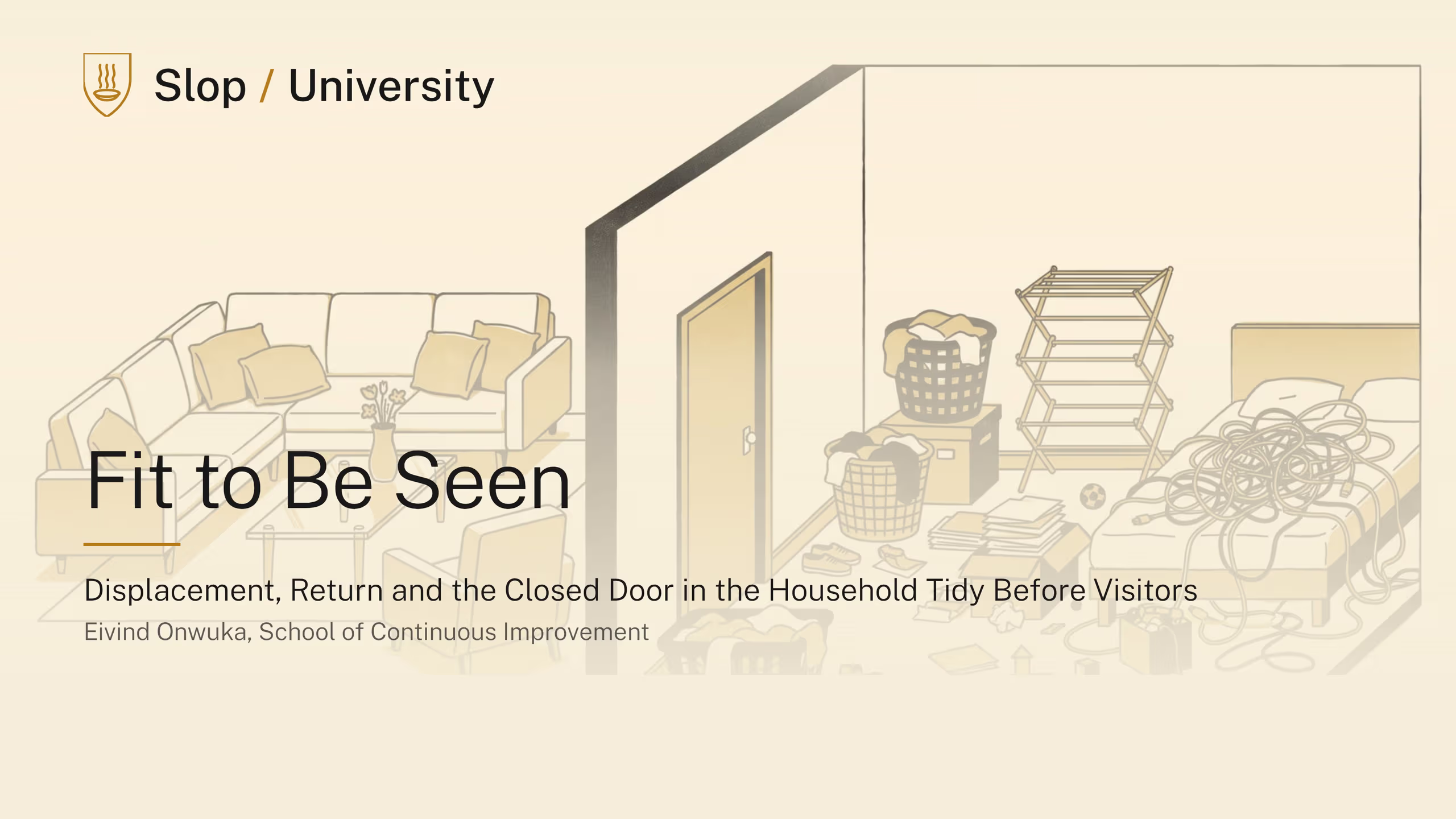
Fit to Be Seen, Explained sets Mr Eivind Onwuka's doctoral study of 61 households beside the Closed Door Allowance the University adopted from its trial.
What 61 households carried out of sight before their visitors arrived, and the trial behind the Closed Door Allowance
Ahead of a review, any school, lab, program or office of the University may now register one room that the reviewing party will not open. The arrangement was first trialled in 48 households, and Fit to Be Seen, Explained, a new research explainer from the School of Continuous Improvement, follows it back to them with Mr Eivind Onwuka, the doctoral candidate whose thesis supplied it.
Almost everyone who hears about the study asks a question about their own home. If the film sends people away with a few more, it will have done its job.
— Mr Eivind Onwuka, Doctoral Candidate, School of Continuous Improvement
For Fit to Be Seen, 61 households wrote down 25,033 moves across 952 tidies before their visitors arrived. Four in five put an object out of sight rather than away, most often into a single room whose door was then closed, and visitors’ ratings of tidiness bore no relation to the time spent tidying. The film then turns to the trial, in which households granted their room in advance, with a card on the door, cut their median tidy from 46 minutes to 28, a result the School reads as a model of efficient readiness and adopted unchanged.
That the University had extended the work to every unit before the film was made is, for the School, the surest sign of its value.
The full explainer is available from the University’s research repository under an open licence, doi:10.5555/slop.421c18.